Pineapple and Profits Quotes
by Kelly Townsend
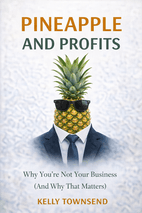
These quotes come from a book that turns business and accounting into something you can actually feel and use. You will find lines that challenge old assumptions, moments of clarity, and encouragement to separate yourself from your company so you can lead it better.
The book is quotable because it mixes sharp insights with everyday language. It treats financial literacy not as a chore but as a story you get to write. Each quote carries a spark of practical wisdom, the kind that sticks with you long after you close the cover.
Top Quotes from Pineapple and Profits
“You're tired of feeling controlled by your business instead of being the leader of it.”
Opening of the introduction, addressing the reader directly.
It articulates a universal frustration for business owners, immediately creating a sense of recognition and invitation to change.
“You'll learn to see your business as something separate from you—not to create distance, but to gain power.”
Description of what the book teaches about the relationship between owner and business.
This reframe is counterintuitive yet liberating, offering a new perspective that empowers entrepreneurs to lead more effectively.
“Now I can say no. I can tell people, 'I don't have any money.' And when they say, ‘But we see your clients coming and going,' I can respond, ‘That's not my money, it's the business's money.”
A dressmaker in eSwatini, after learning the 'pineapple' concept, realizes she can set boundaries by attributing money to the business rather than herself.
This real-life example shows how separating personal and business identity empowers owners to say no and protect business funds, making the abstract concept tangible and actionable.
“The biggest constraints aren't external, they're internal. They're how you talk to yourself and others about what's possible for you and your business.”
The authors challenge common excuses for limited business growth, pointing to internal mindset as the true barrier.
This line shifts responsibility from external factors to self-talk, empowering readers to recognize and overcome their own limiting beliefs.
“When I see a balance sheet, I see a zebra.”
A participant in Peter's workshop describing her reaction to financial reports.
It uses a vivid, memorable metaphor to capture the confusion and bewilderment many feel when looking at financial statements.
“The real transformation comes when you shift your thinking from “tracking money” to “understanding value.””
The author introduces the BaSIS Board as a tool for changing financial perspective.
It encapsulates the core message of the chapter: moving beyond mere number-crunching to grasp the deeper value dynamics of a business.
“There are only two things happening in your business at any given moment: you are either generating value, or you are consuming it.”
Peter, a character in the book, states this principle about business activity.
It distills business reality into a simple, actionable dichotomy that cuts through complexity, making financial thinking accessible to any owner.
Themes Behind the Quotes
One major theme is the idea of separation. The book argues that you need to see your business as a distinct entity, not an extension of yourself. This shift gives you power and freedom, allowing you to make clearer decisions and protect your personal identity.
Another theme is the reframing of finance and accounting as a language. The book stresses that numbers tell stories about value, promises, and relationships. It also emphasizes internal constraints over external ones, suggesting that limiting beliefs and conversations are often the real barriers to growth. Finally, it pushes you to move from tracking cash to understanding value as the core driver of your business.
Quotes by Chapter
Introduction
“So don't just read this book. Live it. Implement it. Make it real in your business.”
The authors' direct call to action near the middle of the introduction.
The imperative, rhythmic phrasing compels readers to move from theory to practice, making the message actionable and memorable.
“The business you want to build is possible. The freedom you seek is achievable. The impact you want to make is within reach.”
Closing encouragement at the end of the introduction.
The three-part repetition builds momentum and instills hope, leaving the reader with a powerful, uplifting affirmation that defines the book's promise.
1. Pineapple
“When you break free from limiting conversations, you can begin to view your business as something far greater than just a way to make a living. It becomes a vehicle to contribute to your community and the world. It becomes a platform for the legacy that you're creating. And importantly, it persistently reveals its potential to be an asset of real value. Your asset of value!”
The author explains the transformation that occurs when a business owner separates personal identity from the business.
This passage reframes the purpose of a business beyond profit, inspiring readers to see it as a vehicle for contribution, legacy, and lasting value.
“When you see it this way—separate from you but guided by your word—everything changes.”
The author concludes a key section on the benefits of viewing the business as a distinct entity.
This succinct statement captures the profound shift in perspective that unlocks new possibilities, making it memorable and encouraging.
2. A common limiting belief: numbers and finance
“If this is your experience, know that these aren't character flaws. They're past-based beliefs that quietly run your business without you even realizing it.”
Author's advice to readers experiencing anxiety about financial statements.
It normalizes the experience and shifts blame from personal flaw to learned belief, empowering readers to change their mindset.
“He problem wasn't her ability, it was a 40- year-old limiting belief about math that she'd never questioned and had evolved into a limiting conversation about finance.”
Kelly's insight after attending Peter's Color Accounting program.
It illustrates how a single childhood event can shape lifelong behavior and shows that overcoming such beliefs is possible.
“Business ownership demands an entirely different skill set, one that importantly includes financial literacy and strategic decision-making.”
Author's observation about the challenges of running a business.
It highlights the critical need for financial skills beyond technical expertise, motivating owners to develop them.
3. Learning any skill starts with language
“When you get these three things—language, structure, and logic—accounting and finance become intuitive and logical to understand in the same way that humans intuitively understand folklore or any other stories that similarly have a language, structure, and internal logic.”
The author explains how mastering language, structure, and logic makes accounting intuitive.
This line demystifies accounting by comparing it to understanding stories, making the subject relatable and accessible.
“Those who get good at business get comfortable speaking its language, feeling at home operating within its grammar, vocabulary, and syntax.”
The author emphasizes that business proficiency comes from fluency in its language.
This line uses a powerful metaphor of language to convey that business skill is about comfort and familiarity, not just technical knowledge.
“Alongside literacy and numeracy, accounting ranks as one of civilization's three most transformative social technologies.”
The author ranks accounting alongside reading and math as a fundamental human technology.
It elevates accounting from a mundane subject to a cornerstone of civilization, giving readers a profound sense of its importance.
“The learning we want for you isn’t just facts or even your ability to simply read and interpret those facts; it's about actually changing what you do.”
The author describes the course's goal of changing behavior, not just knowledge.
This line highlights that true learning is transformational, not just informational, which resonates with anyone seeking personal growth.
4. The balance sheet: A butterfly
“Getting to grips with accounting is much more about language, structure, and logic than numbers.”
The author explains why understanding accounting requires more than just numerical skills.
This reframes accounting as a conceptual discipline, making it accessible to those intimidated by math and emphasizing the importance of clear thinking over calculation.
“Once you understand the RELAX framework, you begin to hear your business speak.”
Introducing the RELAX communication model for financial statements.
The metaphor of a business 'speaking' gives life to dry financial concepts, empowering readers to feel they can interpret what their business is communicating.
“Much of the confusion in financial conversations happens when one person talks about one wing, and the other talks about the other wing. But both wings are always in play. Always.”
Using the butterfly metaphor to explain the duality of the balance sheet.
It pinpoints a common source of miscommunication in business discussions and reinforces the fundamental principle of double-entry accounting in a vivid, memorable way.
“But now you know what these terms mean in real life. You understand that behind every number lies a decision, a relationship, and a promise.”
After walking through the balance sheet of Alicia's Organic Market.
This sentence transforms sterile numbers into human stories, helping readers see financial statements as narratives of choices and commitments rather than cold data.
5. The income statement and BaSIS Board
“Profit isn't an asset. It's not the $2,000 in the asset box, it's the increase in what the business owes Alicia.”
The author explains the nature of profit using the example of Alicia's Organic Market.
This clarifies a common misconception that profit is cash or an asset, emphasizing that profit is the growth in the owner's claim on the business.
“Revenue is value-generating activity, not only cash-generating activity.”
The author distinguishes revenue from cash flow in the discussion of the income statement.
It shifts focus from cash to value creation, helping business owners recognize earned revenue even before payment is received.
“You can earn a profit while receiving no cash.”
The author illustrates the difference between profit and cash flow in the case study of Sarah the consultant.
This striking statement highlights a crucial insight for cash flow management and challenges the assumption that profit equals cash in hand.
6. RELAX, it’s about the system
“You don't need a finance degree to track this. You only need the courage to look and engage with your business as the separate entity that it is.”
The author asserts this after introducing the RELAX framework.
It empowers readers by removing the perceived barrier of financial expertise and reframing the challenge as one of mindset and honesty.
“In the same way you get to write the story of your life, you give voice to the story of your business.”
The author encourages readers to see their business narrative as a personal story they can choose.
This line equates business stewardship with personal agency, inspiring owners to take creative and intentional control of their financial narrative.
“What we're encouraging you to do is have your own continual—even if unspoken and sub-conscious—ever-present narrative like these for your own business.”
The author explains the purpose of the conversational narratives introduced in the chapter.
It normalizes ongoing financial awareness as a habit, not a chore, and makes the complex system feel intuitive and constant.
7. The bridge to the future
“You're not doing accounting for the IRS —you're doing it for you, driven by your business's purpose. It's your steering wheel.”
Peter speaking about the purpose of accounting.
It reframes accounting from a chore to a strategic tool, empowering business owners to lead with purpose.
“Once Kelly realized she had collapsed her identity and that she could house her vision inside a separate entity—an asset of value—everything changed.”
Kelly's personal realization about separating herself from her business.
It captures the book's core insight that separating identity from business enables growth and legacy.