Peak Quotes
by Anders Ericsson
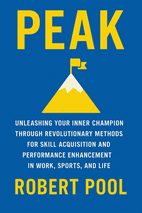
This page collects the most striking lines from Anders Ericsson's "Peak," a book that reshapes how we think about skill and achievement. You will find quotes that challenge common assumptions about talent, highlight the science of deliberate practice, and offer practical wisdom for anyone looking to improve. What makes this book quotable is its blend of rigorous research and clear, actionable insights. Ericsson doesn't just describe what experts do; he explains how their methods can work for anyone. These quotes capture that message in memorable, punchy language that sticks with you long after you finish reading.
Top Quotes from Peak
“We live in a world full of people with extraordinary abilities—abilities that from the vantage point of almost any other time in human history would have been deemed impossible.”
The author discusses the rise of extraordinary performers across various fields.
This line captures the central theme that human potential has expanded dramatically through practice. It challenges the reader to rethink what is possible.
“This is a fundamental truth about any sort of practice: If you never push yourself beyond your comfort zone, you will never improve.”
The author explains why the music student's naive practice fails and why pushing beyond comfort is essential.
It distills a core principle of skill improvement into a simple, unforgettable statement that challenges the reader to embrace discomfort for growth.
“By now it is safe to conclude from many studies on a wide variety of disciplines that nobody develops extraordinary abilities without putting in tremendous amounts of practice.”
The author summarizing research findings on expert performance.
This directly counters the common myth of innate talent and emphasizes the necessity of hard work, making it a powerful motivator.
“Doing the same thing over and over again in exactly the same way is not a recipe for improvement; it is a recipe for stagnation and gradual decline.”
The author debunks the myth that mere experience leads to improvement.
It is a memorable, blunt warning against complacency, urging readers to break out of routine to achieve real growth.
“Deliberate practice is for everyone who dreams.”
The author, Anders Ericsson, states this after recounting Dan McLaughlin's story about pursuing golf despite having no background.
It distills the inclusive, empowering message of the book: anyone with ambition can benefit from deliberate practice.
“If your mind is wandering or you're relaxed and just having fun, you probably won't improve.”
The author explains the necessity of focused engagement during practice, contrasting it with mindless repetition.
This blunt, memorable line challenges the common belief that fun and relaxation lead to progress, reinforcing the value of intense concentration.
“The hallmark of purposeful or deliberate practice is that you try to do something you cannot do—that takes you out of your comfort zone—and that you practice it over and over again, focusing on exactly how you are doing it, where you are falling short, and how you can get better.”
The author summarizes the core concept of deliberate practice while discussing how Benjamin Franklin taught himself to write.
This concise definition captures the essence of deliberate practice in a single, actionable sentence, making it highly memorable and quotable.
Themes Behind the Quotes
A central theme is that extraordinary abilities are not innate but developed through intense, focused effort. The book argues that simply repeating a task leads to stagnation, while pushing beyond your comfort zone triggers real growth. Another major idea is that the brain and body adapt to training, much like muscles do. This adaptability means that with the right approach, almost anyone can reach levels of performance once thought impossible.
A second theme involves the role of mental representations and feedback. Experts build rich internal models that let them process information quickly and make better decisions. But improvement also requires honest, immediate feedback to identify weaknesses. Finally, motivation matters a great deal. Lasting change must come from within, and even top performers keep refining their methods. There are no shortcuts, but deliberate practice is a path open to everyone.
Quotes by Chapter
The Power of Purposeful Practice
“The most effective and most powerful types of practice in any field work by harnessing the adaptability of the human body and brain to create, step by step, the ability to do things that were previously not possible.”
The author explains why all truly effective practice techniques follow the same principles.
It succinctly explains the fundamental mechanism behind skill acquisition. This insight is the core of the book's argument about deliberate practice.
“Research has shown that, generally speaking, once a person reaches that level of “acceptable” performance and automaticity, the additional years of “practice” don’t lead to improvement.”
The author describes the usual approach to learning a skill like tennis.
This statement debunks the common myth that mere experience leads to improvement. It forces readers to reconsider the value of mindless repetition.
Harnessing Adaptability
“There is a growing body of evidence that both the structure and the function of the brain change in response to various sorts of mental training, in much the same way as your muscles and cardiovascular system respond to physical training.”
The author explains that while mental training lacks visible signs, it actually produces comparable physical changes in the brain.
This line powerfully establishes the core analogy between physical and mental adaptability, making the scientific concept of neuroplasticity intuitive and compelling.
“The volume of the posterior hippocampi had gotten significantly larger in the group of trainees who had continued their training and had become licensed taxi drivers.”
Eleanor Maguire's study comparing licensed taxi drivers, failed trainees, and a control group.
It presents the most dramatic evidence of brain growth through deliberate practice, showing that the brain physically changes in response to intense cognitive training.
“It is possible to shape the brain— your brain, my brain, anybody's brain—in the ways that we desire through conscious, deliberate training.”
After discussing studies of brain plasticity in blind subjects and Braille readers.
This statement is empowering and universal, directly challenging the fixed-mindset view and inspiring readers to take control of their own cognitive development.
“The body’s desire for homeostasis can be harnessed to drive changes: push it hard enough and for long enough, and it will respond by changing in ways that make that push easier to do.”
The author describes how physical activity triggers adaptations by pushing the body out of homeostasis.
It elegantly captures the core mechanism of adaptation—that sustained stress forces the body to improve. Readers find it motivating because it frames effort as a tool for growth.
Mental Representations
“Blindfold chess offers one of the most dramatic examples of what is possible to accomplish with purposeful practice.”
The chapter describes how Alekhine played 26 blindfold chess games simultaneously.
This line directly ties the remarkable feat to the book's central theme of purposeful practice. It inspires readers by showing that extreme abilities are achievable through dedicated training.
“It was never something that he made a special effort to develop, but rather something that grew out of his relentless effort to master the game and become the best in the world.”
This refers to Alekhine's blindfold chess skill, which he considered a byproduct of his training.
It illustrates that extraordinary abilities often emerge as unintended consequences of focused mastery. This resonates because it suggests that deep pursuit of excellence can yield surprising additional talents.
“The thing all mental representations have in common is that they make it possible to process large amounts of information quickly, despite the limitations of short-term memory.”
The author is explaining the function of mental representations across different domains.
It captures the essence of why mental representations are so powerful. Readers can grasp how experts overcome cognitive bottlenecks through structured knowledge.
“What sets expert performers apart from everyone else is the quality and quantity of their mental representations.”
This is a summary statement near the end of the chapter comparing novices and experts.
It is a concise, memorable definition of expertise. It emphasizes that deliberate practice builds superior internal models, which is a key insight for anyone seeking to improve.
The Gold Standard
“It is the gold standard, the ideal to which anyone learning a skill should aspire.”
The author introduces deliberate practice as the most effective method of training.
This line encapsulates the central theme of the chapter and provides a memorable definition of deliberate practice's importance.
“We found no shortcuts and no “prodigies” who reached an expert level with relatively little practice.”
Conclusion from the study of violin students at the Berlin music academy.
It powerfully challenges the myth of innate talent and reinforces the necessity of thousands of hours of dedicated practice.
“Improvement was hard, and they didn’t enjoy the work they did to improve.”
Observations from interviews with violin students about the effort required for solitary practice.
This honest statement demystifies the learning process and resonates with anyone who has struggled to improve a skill.
Principles of Deliberate Practice on the Job
“The deliberate-practice mindset offers a very different view: anyone can improve, but it requires the right approach.”
The author summarizes the key takeaway after debunking three myths about performance improvement.
This line encapsulates the empowering core message of the book—that improvement is not about innate talent but about adopting the correct practice methods.
“Over time the students learned to ask themselves the questions, as it was more comfortable than hearing them from the instructors, and each day they would take the previous session’s lessons with them as they flew.”
Describing how Top Gun pilots internalized after-action report feedback.
This illustrates the ultimate goal of deliberate practice: self-directed learning and continuous improvement through reflection.
“The main problem that radiologists face in this situation is the difficulty in getting effective feedback on their diagnoses, which limits how much they can improve over time.”
The author analyzes why radiologists struggle to get better at interpreting mammograms.
It highlights a universal barrier to expertise—lack of accurate, timely feedback—and sets up the need for a Top Gun–style training solution.
Principles of Deliberate Practice in Everyday Life
“It is better to train at 100 percent effort for less time than at 70 percent effort for a longer period.”
The author offers this advice to Per Holmlév on how to structure practice sessions for maximum effectiveness.
It provides a practical, counterintuitive principle that emphasizes quality over quantity, a key insight for anyone trying to improve.
But What About Natural Talent?
“A woman's preaching is like a dog's walking on his hind legs. It is not done well; but you are surprised to find it done at all.”
The author cites Samuel Johnson's famous quote to illustrate the common attitude toward women playing chess at the time of the Polgar experiment.
This witty, memorable line captures the historical prejudice that the Polgar sisters shattered, making it a powerful and quotable indictment of low expectations.
“I originally was attracted to the shape of the figures. Later, it was the logic that fascinated me and the challenge.”
Susan Polgar recalls how she first became interested in chess as a child.
The progression from playful curiosity to intellectual engagement illustrates the natural first stage of expert development, making the quote relatable and insightful.
“While there are various ways that parents and teachers can motivate children, the motivation must ultimately be something that comes from within the child, or else it won’t endure.”
The author discusses the limits of external motivation in the development of expertise.
This succinct truth about intrinsic motivation resonates broadly, reminding readers that lasting excellence requires personal drive, not just external rewards.
“One of the hallmarks of expert performers is that even once they become one of the best at what they do, they still constantly strive to improve their practice techniques and to get better.”
The author describes the continuous improvement mindset that distinguishes elite performers.
This line captures the relentless pursuit of mastery that defines true experts, inspiring readers to see that reaching the top is not a finish line but an ongoing journey.
Where Do We Go from Here?
“The students who were taught the material with a method inspired by the principles of deliberate practice learned more than twice as much as those students taught with the traditional approach.”
Describing the result of the University of British Columbia physics experiment comparing deliberate practice to traditional instruction.
The quote presents a dramatic quantitative result that immediately captures the power of deliberate practice, making readers eager to understand how such improvement is possible.
“Wieman’s achievement is tremendously exciting. It suggests that by modifying traditional teaching approaches to reflect the insights of deliberate practice, we might dramatically improve the effectiveness of teaching in various fields.”
After detailing the experiment's success, the author reflects on the broader implications for education.
This line conveys optimism and the potential for widespread educational reform, inspiring readers to consider adopting deliberate practice in their own fields.