One Split Second Book Club Questions
by Robert Dugoni
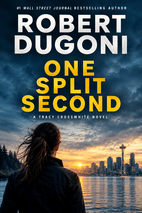
These questions assume everyone has finished the book and contain spoilers, including the ending.
This novel is a strong book club pick because it turns one decision into a web of legal, moral, and emotional questions. There is plenty to debate about Jenny, Tracy, small-town loyalties, trauma, and the cost of pursuing the truth.
Use these questions as conversation starters, not a checklist. Pick the ones that spark the most disagreement, give everyone room to answer, and circle back to how choices and loyalties shape the story. The goal is a lively discussion, not a quiz.
Jenny's Decision and the Aftermath
- 1.Jenny Almond goes to Anthony Alvarez's property alone during a storm despite Neil's objections and her father Buzz's instruction to handle Alvarez personally. How did that decision shape everything that follows, and did you understand why she felt she had to go?
- 2.When Jenny sees a hooded figure charge at her with a metal object and hears what she thinks are rifle shots, she fires and then discovers Alvarez was unarmed and holding only a flashlight. Did the later evidence of bootprints, muzzle flashes, and a second shooter change how you judged her use of force?
- 3.Tracy Crosswhite reflects that every justified killing took a piece of her soul, while Jenny says being told the shooting was justifiable does not make her feel better and that she let her empathetic father down. How does the novel portray the emotional aftermath of a legally justified shooting?
- 4.Dan O'Leary insists on attorney-client privilege and refuses to enter Alvarez's trailer without a warrant, while Tracy pushes to document bootprints and find exculpatory evidence quickly. Whose approach do you think was right in the early days of Jenny's case?
The Cold Case and Its Scapegoat
- 5.Anthony Alvarez was a Vietnam veteran with PTSD, had let his medications lapse in the past, and had been a person of interest in Jacquelyn Parker's disappearance. How did the book use his paranoia, trip wire, and marked newspaper article to make him both a suspect and a tragic scapegoat?
- 6.Jan Oliva's cassette tape, recorded from her father's musical diary, contained two men discussing Jackie Parker's abduction and one saying he deliberately directed the investigation toward Alvarez. How important was that tape to the outcome, and did it feel like a satisfying answer to a forty-five-year-old cold case?
- 7.Evelyn Carson wanted an easement and water rights to expand the CCR ranch, and the plan to fake Jackie Parker's kidnapping went wrong when Jackie saw Marcus Kane's face. How did the book connect economic desperation and ranch survival to the murder of a fifteen-year-old girl?
Villains, Victims, and Complicity
- 8.Marcus Kane manipulated Curtis Parker by claiming Jackie died of an asthma attack, killed Jerry Ostertag and Anthony Alvarez, and tried to kill Tracy in Alvarez's underground shelter. What made Kane such an effective villain in this story, and how did he exploit small-town loyalties?
- 9.Curtis Parker buried his sister Jackie on the Parker Pear Farm, supplied information only after Kane was dead, and shot Kane to save Tracy. Did you see Curtis as a victim, an accomplice, or something in between, and did you agree with how Tracy and Will George handled him?
Legal Strategy and Local Authority
- 10.Dan O'Leary's opening statement tied Anthony Alvarez's shooting to Jacquelyn Parker's 1980 abduction, even though Neil worried it could backfire and Jenny risked conviction by raising it. Do you think Dan made the right strategic choice?
- 11.Travis Beaumont's deputized posse confronted Tracy at Alvarez's trailer and later outside El Sol Cantina, while Beaumont warned her not to impede his investigation. How did the novel portray the tension between local authority, a deputized posse, and outside law enforcement?
- 12.Kaylee Wright's shoeprint analysis and Stuart Funk's conclusion that Jerry Ostertag was murdered rather than a suicide gave the defense new momentum. Which piece of expert testimony did you find most persuasive, and why?
The Ending and Emotional Resolution
- 13.At the end, Judge Blackwood and Erik Mitchell dismiss all charges against Jenny, and Jenny gives Tracy her father Buzz Almond's Klickitat County Sheriff badge. What did that gesture mean to you, and did the ending resolve Tracy's feelings about family, loss, and her own career?
- 14.Tracy tells Dan at the end that there is no place else she would rather be than beside him, after visiting Sam and Adele Goldman. Did the novel earn that emotional resolution for Tracy and Dan, given the dangers Tracy faced and her history with her sister Sarah's murder?