No More Tears Quotes
by Gardiner Harris
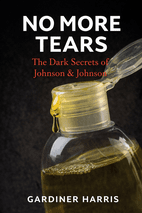
You will find lines that cut through decades of carefully managed corporate storytelling. Some come from internal memos marked "DO NOT USE THIS REPORT." Others are from courtroom testimony where executives admit they never tested the product. What makes this book so quotable is the gap between what Johnson & Johnson said in public and what they wrote in private. The quotes here are not just revealing. They are the kind that make you read them twice, then send them to someone else. Each one peels back another layer of a carefully built myth.
Top Quotes from No More Tears
“So, for generations, much of the American population was implanted in the womb and throughout infancy with a brain worm that associates Johnson & Johnson with love, happiness, trust, and intimacy—a public relations contrivance of unrivaled power and perseverance.”
Author's commentary on the effect of Baby Powder's fragrance on consumers from birth.
The visceral metaphor 'brain worm' and the stark exposure of deliberate manipulation make this a striking, thought-provoking indictment of corporate marketing.
“It is difficult to conceive of a better way of having fibers inhaled than the use of cosmetic talcum powders.”
A researcher wrote this in the American Review of Respiratory Disease in 1969.
The irony is devastating: a product designed for baby care is described as the perfect delivery system for carcinogenic fibers, making the danger seem obvious in hindsight.
“DO NOT USE THIS REPORT," someone at J & J wrote by hand on the original report's cover."”
A J&J employee wrote this on a lab report that had detected tremolite asbestos in baby powder, before the company redacted that finding.
The handwritten note is a chilling, visceral artifact of corporate suppression of evidence, revealing deliberate concealment of contamination.
“There is no safe level of asbestos known.”
Dr. Selikoff explaining to Marian Burros the danger of asbestos in talcum powder.
This stark declaration crystallizes the idea that no amount of asbestos is safe, resonating because it undercuts industry defenses and highlights the lifelong risk of exposure.
“Women who dusted their crotch with talc had a 92 percent increased risk of ovarian cancer.”
Dr. Cramer's 1982 study published in the journal Cancer.
This stark statistic from a Harvard researcher launched a decades-long battle between Johnson & Johnson and the medical community over talc safety.
“Given that talc has no medical benefit, even a hint of risk is unacceptable.”
Dr. Cramer's argument about why women should avoid talc regardless of whether the danger comes from asbestos or talc itself.
This ethical principle cuts through scientific debate and frames talc use as an unnecessary gamble with women's lives.
“Anybody who denies this risks that the talc industry will be perceived by the public like it perceives the cigarette industry: denying the obvious in the face of all evidence to the contrary.”
Dr. Alfred Wehner, a Johnson & Johnson consultant, wrote this in a letter to a top company executive, criticizing the company's false defenses of talc safety.
The stark comparison to the cigarette industry foreshadows the public reckoning to come and condemns the company's willful denial of scientific evidence.
Themes Behind the Quotes
A central theme is the weaponization of trust. The company built its brand on baby imagery and maternal love, then used that emotional bond to sell a product it knew might be dangerous. Time and again, internal documents show executives choosing profit over safety, and public statements directly contradicting what they knew. Another theme is the suppression of evidence. Scientists who found asbestos in talc were silenced. Reports were hidden. Regulators were kept in the dark for decades. The quotes reveal a systemic pattern of denial that only cracked under the weight of lawsuits and dying women. Finally, there is the human cost. Behind the statistics and corporate spin are real people who believed in the brand and paid with their health. Their voices cut through the noise.
Quotes by Chapter
Chapter 1: An Emotional Bond
“Only Johnson & Johnson also has real emotional trust.”
From a 1999 corporate slide deck comparing trust levels among pharmaceutical and consumer goods companies.
This line starkly differentiates Johnson & Johnson from its competitors, asserting a unique emotional bond that transcends rational trust—a powerful branding claim.
“The official story is repeated so often within the company that it has become something of a prayer.”
Describing how Johnson & Johnson employees are indoctrinated with the 1982 Tylenol crisis response narrative.
This line brilliantly encapsulates the quasi-religious reverence for the company's own mythology, revealing the internal culture that enables both loyalty and ethical lapses.
Chapter 2: Three Brothers Go to New Brunswick, 1860–1968
“The difficulties in manufacture of plasters,” Johnson later explained, “were that we could make plasters that would stick but wouldn’t keep, and we could make ones that would keep but wouldn't stick.”
Robert Wood Johnson explains the challenge of creating plasters that are both adhesive and durable.
This line perfectly captures the classic trade-off in product development, highlighting the ingenuity required to solve a seemingly simple problem.
“A disorderly plant is a symptom of confused management,” he once wrote. “I cannot look into a man’s mind, but I can look into his plant.”
Robert Wood Johnson II articulates his philosophy on factory cleanliness and management.
This quote reveals his hands-on, visual approach to leadership and the belief that physical environment reflects organizational discipline.
“Perhaps,” he reportedly said, “now we will have a clean window.”
After finding a dirty window still uncleaned, Johnson smashed it to make a point.
Dramatic illustration of his uncompromising standards and his willingness to take extreme actions to enforce them.
“Millions of pounds of cotton, millions of yards of gauze, miles upon miles of bandages, plasters enough to encircle the Earth. They are yours, Uncle Sam, if you need them.”
Fred Kilmer's pledge to the military during the Spanish-American War.
This stirring declaration of industrial patriotism captures the company's commitment to national service and its massive scale.
Chapter 3: Mineral Twins
“The worst industrial disaster in American history, Hawk's Nest demonstrated for the first time that intense exposure to some kinds of rock dust can kill within days.”
Describing the Hawk's Nest tunnel tragedy where hundreds of miners died from silicosis.
This line powerfully encapsulates the scale and horror of a largely forgotten industrial catastrophe, forcing readers to confront the lethal consequences of unchecked corporate negligence.
“Johnson & Johnson promptly issued a statement falsely reassuring its customers: “Our fifty years of research knowledge in this area indicates that there is no asbestos contained in the powder manufactured by Johnson & Johnson.””
After New York City's environmental official recommended stopping use of talc-based powders due to asbestos contamination.
This direct quote reveals a pattern of corporate deception that prioritized profits over public health, and the false reassurance is chilling given decades of subsequent litigation.
Chapter 5: Birth of the Modern Fda
“The very idea of seriously investigating the safety of a product as beloved and widely used as Johnson's Baby Powder likely struck agency officials as crazy. They had bigger fish to fry.”
The narrative describes the FDA's historical neglect of cosmetics regulation due to a belief that cosmetics don't kill like drugs or food.
This passage underscores the tragic irony of regulators overlooking a beloved product, allowing decades of unchecked asbestos exposure.
“In a 2019 deposition, Dr. Susan Nicholson, a J & J talc safety executive, admitted that the company hadn't sent the agency a single talc test result since 1973.”
Decades after the FDA relied on J&J's self-testing, a company executive revealed they never reported any results to regulators.
This stark admission exposes the complete failure of industry self-regulation and the FDA's lack of oversight, highlighting a systemic betrayal of public trust.
Chapter 6: The Power of Pressure
“Have these bastards hurt me in the past?” he asked. “Sure, but you can’t dwell on the personal side of things. Because they hurt humanity.”
Langer reflecting on J&J's campaign to discredit his research.
The raw emotion and moral clarity of this line resonate deeply: Langer acknowledges personal harm but redirects focus to the greater harm inflicted on humanity, making it a powerful indictment of corporate malfeasance.
“Making decisions is what business is all about, and you don’t make decisions without making mistakes. Don't ever make that mistake again, Mr. Burke, but please be sure you make other mistakes.”
General Johnson's response to James Burke after a costly product failure.
This paradoxical wisdom encourages bold decision-making while learning from errors, resonating as a timeless leadership lesson that embraces failure as part of success.
“But there is a huge chink in their armor,” Selikoff told Burros. “They were dusting people with asbestos all these years before, so what was put in the lungs before is still there.”
Selikoff explaining to Marian Burros that improved talc formulations do not undo past exposure.
The vivid metaphor of a 'chink in the armor' and the haunting reminder of accumulated harm resonate as a damning critique of corporate responsibility and the long tail of industrial negligence.
Chapter 7: A Meeting at a Harvard Hospital
“He agreed not to make further public statements or grant interviews on this study.”
An internal J&J memo describing Cramer's concession after meeting with company executives.
It exposes how corporate pressure silenced a scientist's findings, highlighting the suppression of health warnings.
“Every single one was positive for asbestos.”
Results from 15 weeks of Engelhard's talc samples sent to Georgia Tech's sensitive lab in 1979.
The relentless positivity of the tests demolishes the company's earlier denials and reveals systematic contamination.
Chapter 8: Secrecy Is a Top Priority
“I admit that Powder has not been a priority for me but the more I think about it, the more our proposition makes me uncomfortable. The reality that talc is unsafe for use on/around babies is disturbing. I don’t mind selling talc, I just don’t think we can continue to call it Baby Powder and keep it in the baby aisle.”
Todd True, a member of Johnson & Johnson's Global Design Strategy Team, wrote this in an April 18, 2008, email headlined 'Baby Powder —not for babies.'
This internal admission that talc is unsafe for babies and the product's name is deceptive shows that even company insiders recognized the ethical crisis, yet the proposal was shelved.
Chapter 9: A Sacred Cow
“Johnson's Baby Powder does not contain asbestos, has never been found in the baby powder and never will.”
This is the company's official statement that Mark Lanier showed to Dr. Joanne Waldstreicher, J&J's chief medical officer, during the Ingham trial.
The line captures the company's decades-long denial in a single, absolute declaration—one that later evidence proved to be false, making it a powerful symbol of corporate dishonesty.
“I'm a fighter and a thriver,” she told the jury. “I can’t say I'm a survivor yet, but I'm a thriver.”
Plaintiff Toni Roberts, diagnosed with ovarian cancer after years of using Johnson's Baby Powder, testifies about her condition.
Her distinction between 'survivor' and 'thriver' is heartbreaking and defiant, giving a human face to the statistics and underscoring the emotional weight of the case.
“They paint the company out to be a collection of nuns, for lack of a better way of saying it,” Lanier fulminated, “not wanting the jury to see that they're working at night as prostitutes, and I ought to get to show the other side of that coin.”
Lanier argues during a sidebar after J&J's expert gave an emotional defense of the company's ethics.
The vivid, provocative metaphor strips away J&J's saintly image and highlights the hypocrisy of a company with a history of criminal misconduct pretending to be above reproach.
“They have marketed this and their company as a baby company so that we would trust the company. They have done things that are outrageous.”
Plaintiffs' attorney Mark Lanier in his closing argument to the jury.
It captures the deep betrayal of consumer trust and the moral outrage at the heart of the case.
Chapter 10: An Infamous Crime, the Birth of a Myth
“The smell of bitter almonds—a telltale sign of cyanide—was unmistakable, he later said.”
Michael Schaffer, the chief toxicologist for the Cook County medical examiner, opened the two Tylenol bottles.
The visceral detail of bitter almonds makes the hidden poison suddenly tangible, turning an abstract crime into a sensory horror.
“Don't take Tylenol,” she said, “not even in tablet or liquid form.”
Chicago mayor Jane Byrne held a news conference instructing city residents to hand over all bottles of Tylenol.
This stark, urgent command captures the raw panic and total distrust that swept the nation, elevating a product recall to a public emergency.
“Johnson & Johnson's response has long been seen as the most ethical, honest, and effective crisis reaction in American corporate history—thus the legendary Harvard Business School case, and the use of J & J's decision-making as a model of executive leadership.”
The chapter describes how J&J handled the Tylenol crisis after the poisonings.
This sentence encapsulates the corporate mythology that emerged, setting up the chapter's later critique by contrasting the heroic narrative with overlooked flaws.