Night Objects Quotes
by Eli Raphael
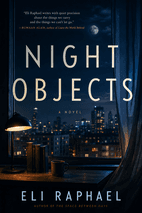
Inside this collection you will find quick dialogue, tense narration, and the raw inner monologue of a narrator who is trying to make sense of grief and guilt. Some lines are quiet and aching. Others arrive like a shock and stay with you long after you close the book.
What makes Night Objects so quotable is how often it turns ordinary moments into small revelations. The prose is clear, dark, and surprisingly warm. It captures the way people talk to themselves when no one is listening, and the sharp thoughts that surface in moments of danger, longing, or regret. These are lines you may want to underline, screenshot, or read to someone else.
Top Quotes from Night Objects
“It’s true that I wished him dead dozens of times. Hundreds, even. But I, Lenny Winter, did not kill that boy.”
— Lenny Winter
At the book's opening, Lenny insists on her innocence regarding a boy's death.
The confession is stark and immediate, pairing guilt with denial and pulling the reader into the mystery.
“It was like realizing you hadn't breathed in several seconds and then taking in so much air you thought it might kill you.”
— Lenny Winter
Lenny sees the Olympic Mountains for the first time as the car enters Port Angeles.
The physical metaphor makes awe and arrival visceral, conveying the shock of the landscape.
“I was delirious. It was like Clue, or one of those PSAT word problems: Lenny, Sara, Vikram, Nico, Sloan, and Henry board a boat before the sun sets. How many are alive when the sun rises?”
The narrator faces drowning and death in the ocean before dawn, with a corpse nearby.
The macabre comparison to a test problem shows how trauma scrambles the mind into black comedy.
“Which of us was the rabbit, and which the fox?”
Hidden in a phone booth, the narrator faces a masked member of a secret society through the glass.
The question distills the novel's predator-prey power dynamics into one sharp, haunting line.
“To tell him would be like jumping from a plane. You trust that the parachute is working. You believe that it will deploy when it needs to. Otherwise, you find yourself hurtling toward the ground, on a path to certain destruction.”
The narrator considers whether to be honest with Yip about everything that happened.
The parachute metaphor captures the terrifying gamble of trusting someone with the truth.
“Bad things would happen whether you feared them or not.”
— Lenny
After chapel, Lenny hides in the bathroom and reflects on Dr. Hesse's lecture and her mother's death.
It distills the novel's fatalism into a quiet, devastating truth: grief doesn't obey caution.
“It was like cracking a safe. You had to listen for the click as each tumbler aligned, or else you'd miss the bigger pattern.”
Lenny connects Sloan's revelation about Yip's custody plans to earlier clues he had ignored.
The safe-cracking metaphor turns painful hindsight into an almost tactile image. It shows how easily the truth can be missed when you're not listening for the click.
Themes Behind the Quotes
Grief is the heavy current throughout these lines. The narrator carries loss in his chest, in private memories, and in the sound of a nickname from the past. Guilt wraps around that grief, making every mistake feel louder and every moment of happiness suspect. The story keeps returning to how people survive those feelings without ever truly escaping them.
Another major thread is the ache of belonging. The narrator wants friends, wants to be wanted, and fears being cast out by the only person who ever offered him a home. Trust becomes a dangerous gamble, especially when safety can dissolve in a few seconds. The quotes also explore luck, fear, and the strange arithmetic of violence: who lives, who dies, and how much of that is simply chance.
Quotes by Chapter
1: Before
“In the strange alchemy that transmutes a parent's dreams into their child's, her excitement became my own.”
— Lenny Winter
Lenny recalls how her mother's joy when she first found Venus deepened her own love of astronomy.
It captures the quiet, almost chemical way a parent's enthusiasm shapes a child's dreams.
“I'd known there were billions of stars in our galaxy, but I had not believed it until we arrived in Port Angeles.”
— Lenny Winter
On her first night in Port Angeles, Lenny sits on the top deck and looks up at the extraordinarily clear sky.
It separates intellectual knowledge from lived belief, a core tension for a would-be astronomer.
4: After
“I had not cried since my mother's death. I hadn't been able to.”
The narrator watches Yip’s controlled tears in the diner and realizes he has not been able to cry since his mother’s death.
It captures the grief-driven emotional numbness that can feel like betrayal.
“It's difficult to remember, even after a decade, that wounded feeling. How wrong I was.”
The narrator remembers the wounded, frightened child he was after his mother’s death.
The simple juxtaposition of the remembered feeling and the adult correction is devastating.
“The truth was this: Even after the events of the previous forty-eight hours, I did not want to die.”
After swimming to shore, the narrator reflects on what the night has revealed.
This is a stark, unadorned declaration of the will to live, made more powerful by all that precedes it.
5: Before
“I'd been preparing myself for the day that someone might come to take me away from Yip. It hadn't occurred to me that Yip himself would banish me.”
Yip tells Lenny he has already enrolled her in a boarding school and that she will leave within the week.
It twists her fear of being taken by strangers into the sharper pain of being sent away by the person she trusted.
“Underneath all his pragmatism and aloofness, there was the pervasive sense that, ever so abruptly, their souls had been drawn together and then thrust apart by some force greater than his understanding.”
Lenny thinks about Yip's grief after he says her mother would have wanted her to go to boarding school.
This sentence gives Yip sudden interior depth, showing that his cold decision is also a form of love and loss.
“I could have cried. He hadn’t called me Pushkin since before my mother's death. Each time he spoke my name it felt like losing her all over again.”
Yip comes home early and greets her as Lenny instead of using his old nickname for her.
The loss of the nickname becomes another small death, making Yip's distance feel inseparable from the mother's absence.
“This would always be the last place I'd heard my mother’s laughter.”
Lenny cries alone in her cabin while packing for Blanchard.
It ties grief to a physical place, making the boat feel sacred and the leaving feel like another loss.
8: Before
“My chest felt like it was cracking open. All my fault, all my fault, all my fault.”
After the boat crash, Alena sobs in the hospital while a nurse tries to comfort her.
The jagged repetition makes guilt feel physical and inescapable, capturing raw self-blame in the aftermath of tragedy.
“This moment: I still loathe the memory of it. The boat crash changed everything between us.”
On the beach in the crash's aftermath, the narrator watches Nico slumped in devastation.
It names the exact instant when the relationship shifted, and the present-day loathing gives the memory retroactive weight.
“A hand of mercy had been extended, but it held a dagger. They were giving me a chance, but I couldn't fuck this up.”
The school psychiatrist offers Lenny an independent study and presses her to fill a prescription.
It captures the double-edged nature of institutional kindness and the crushing pressure to prove oneself worthy of it.
11: After
“The memory rushed back, water taking the shape of its container.”
In the hospital, the narrator suddenly recalls the boat crash.
The simile gives memory a physical, fluid force, as if the past fills the exact shape of the present trauma.
“All our planning, the months of sacrifice and uncertainty, had resulted in nothing.”
The narrator realizes the camera is lost at the bottom of the strait after the crash.
It is a devastating one-sentence summation of wasted effort and dashed hopes.
“A couple of them were treated here, I think. Sounds like the others were picked up by their parents.”
— Yip
Yip answers the narrator's question about what happened to the friends.
The flat, practical report mixes relief with a sense of abandonment and adult cleanup of a teenage disaster.
12: Before
“I wanted friends. I needed them. I did not think that I would survive the school year without them.”
— Lenny
After Nico and Vikram invite her to spend the evening with them, Lenny realizes how desperately she wants connection.
It captures the raw, urgent need for belonging and makes her vulnerability impossible to ignore.
“I remember thinking that I'd have sacrificed every summer if it meant having a mother to force me to study for the SATs.”
— Lenny
At Thea's party, students complain about summer SAT prep while Lenny thinks about her mother.
It twists envy and grief into one devastating line: she would trade any privilege for more time with her mother.
“I hadn’t been this happy since before my mother died.”
— Lenny
High on the beach with Nico and Vikram, Lenny feels joy for the first time since her mother's death.
The sentence holds both relief and loss, making happiness itself feel grief-tinged.
14: After
“Her face hovered a few inches from my own. Cherry Coke and vodka vaporized between us. I was hypnotized.”
— Alena
Sloan corners Alena in their room after Murchie leaves, drawing close enough that Alena can feel the alcohol on her breath.
The sensory detail makes the moment feel intimate and dangerous, capturing how easily Alena is drawn in before everything falls apart.
“Danger. Grown-ups never referred to conversations as “little” unless they were, in fact, big.”
— Alena
Detective Thibeaut says she wants a little chat with Alena, and Alena recognizes the euphemism.
It’s a cynical, sharp observation that shows how quickly Alena reads adult threats.
“I'd had practice that year at hiding my emotions. My face felt cool. Not a muscle twitched.”
— Alena
Alena keeps her face still while Detective Thibeaut introduces herself and shows her badge.
It captures the cost of self-concealment; the cool face is a survival skill, not a strength.
“Sloan was right. I didn't deserve to belong.”
— Alena
Alena stands alone in her room after Sloan leaves, internalizing the accusation.
It’s blunt self-condemnation with no defense, and it lands like a confession.
15: Before
“Yip had never been anything less than honest with me: He was not my father. I did not belong to him.”
Lenny realizes that Yip's careful wording was always a warning he refused to hear.
The blunt finality of "I did not belong to him" is devastating. It strips away every comforting fantasy in a single breath.