My Next Breath Quotes
by Jeremy Renner
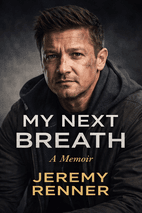
These quotes come from a memoir about survival, love, and the choices we make when everything is on the line. You will find lines that cut straight to the heart, whether they are about breathing through pain or choosing family above all else.
What makes this book so quotable is how Jeremy Renner turns his most difficult moments into lessons anyone can apply. The language is direct and honest, never hiding behind pretense. Each quote feels earned, pulled from real experience rather than theory.
Top Quotes from My Next Breath
“I believe that the most important thing in life is to take action.”
The narrator states his personal philosophy just before describing the accident.
This line encapsulates the book's central theme of taking decisive action, and it's a mantra that resonates with readers facing inertia.
“But emotions never built a bridge or fed the hungry or saved a life.”
The narrator continues his argument that feelings alone are insufficient.
The blunt, almost harsh statement challenges the reader to prioritize deeds over emotions, making it memorable and provocative.
“This is no longer conscious thought. This is pure action, motivated by love.”
During the split-second leap to save his nephew, the narrator describes his instinctual response.
It contrasts conscious thought with pure love-driven action, highlighting the primal protective instinct.
“But love doesn’t wait for the impossible, doesn’t countenance doubt or nonaction, at least not for me.”
The narrator reflects on his instinct to leap across the snowcat tracks to save his nephew Alex.
This line encapsulates the theme of love overcoming impossible odds, showing that selfless action can transcend rational hesitation.
“It was an act entirely motivated by love, by family, by an innate sense of “rather me than him, rather me than anyone.””
The narrator explains the motivation behind his leap to save Alex.
It powerfully expresses selfless sacrifice and the depth of familial love, resonating with anyone who would risk everything for a loved one.
“Fear can control our lives, and I didn’t want fear to control my Life, so I just kicked its ass; I owned it.”
After a decade of systematically confronting each fear by writing it down and facing it.
An empowering declaration of reclaiming agency over fear, resonating with anyone who has felt paralyzed by anxiety and seeking mastery over it.
“Love: That's what lasts. That's what wins. Always.”
The narrator concludes his reflection on the power of love after his near-death experience.
This succinct, rhythmic line distills the book's central message—that love is eternal and ultimately overcomes all—into a memorable mantra.
Themes Behind the Quotes
A central theme is the power of taking action, especially when driven by love. The quotes repeatedly show that hesitation and doubt vanish when someone you care about is in danger. Action becomes a lifeline, a way to push through panic and fear.
Another theme is the role of breath in survival and mindfulness. Breathing is not just automatic but a conscious choice that can save a life. The book also explores the ripple effects of trauma, how it impacts family and friends, and the need to rewrite your own story. Ultimately, love is presented as the only thing that truly lasts and wins.
Quotes by Chapter
Prologue: One Shot
“I had no choice. I had one shot. One shot—a long shot, but a shot.”
The narrator reflects on the moment he decided to act despite the odds.
This line captures the high-stakes, no-other-option desperation of the situation, and the repetition of 'one shot' emphasizes the pivotal moment.
1. Snowmaggedon
“In a busy life, filled with work and travel and thousands of distractions—the mundane business of being alive—this annual get-together served to remind me why I work so hard in the first place: I get to take a breath, on the top of a mountain, away from the pressures of success.”
The author reflects on the meaning of his family's New Year's gathering at Camp Renner.
This line captures the universal desire to find purpose beyond daily grind, framing success as the ability to pause and reconnect with what matters most. It resonates because it acknowledges both ambition and the need for respite.
“By the last day of 2022 we had no cell service and no internet, meaning no phones, no tablets, no TVs. The kids had long given up the TV room to come and hang out with the adults. We were just one big extended happy family, no longer separated by the glow of screens—what a marvel that was in and of itself.”
The author describes the unexpected gift of being snowed in without technology.
In an age of constant digital distraction, this passage celebrates the simple, profound joy of unplugged togetherness. It reminds readers that genuine connection often emerges when screens are stripped away.
“And through it all I've never lost sight of the normal life; maybe coming into the peak of my career a little later than some, in my thirties and after, helped me keep my feet on the ground? Whatever it was, I never needed reminding that I was a lucky man to have so many people to love and who loved me.”
The author reflects on his identity beyond fame, grounded by family and late-career success.
This line humbly acknowledges that true richness lies in relationships, not accolades. It resonates because it challenges the myth that success requires sacrificing what is ordinary and precious.
“Family is everything to me; maybe I didn’t know that day quite how much (though the universe was about to send me a lesson on that one).”
The author insists on returning to his snowed-in family despite a roadblock.
This moment of foreshadowing and raw honesty heightens the stakes, hinting at a life-altering event to come. It resonates because it captures the fierce, sometimes unrecognized depth of familial love.
2. Snowcat
“I don’t need Valium; I need a deep breath, or several, or ten minutes of it; I don’t need the hit from a joint: just breathe.”
The narrator describes his lifelong philosophy of using conscious breathing to manage stress.
This relatable, simple wisdom highlights the universal power of breath as a tool for calm and resilience, especially poignant given his struggle to breathe after the accident.
“The only way to measure progress is to know where you started from.”
The narrator reflects after describing his leap, as a turning point in his ordeal.
A profound, philosophical observation that applies to any journey of survival or recovery, grounding the narrative in a larger truth about growth and change.
3. Lamaze
“Because there can’t be many teenagers who are made to accompany their mother to Lamaze classes, where pregnant women like my mom are taught how to breathe, how to control pain through explicit, deeply considered breathing. I was that kid.”
The author recalls his unusual childhood experience attending Lamaze classes with his mother.
This line immediately establishes the central metaphor of breathing as a life-saving skill, and the author's unique perspective sets up the entire chapter's theme.
“Neither of us could have known that in learning Lamaze together, she effectively saved my life without knowing she was saving it. Because now I was on the ice, and I knew I needed to breathe or I wouldn't make it.”
The author reflects on the Lamaze class's significance after surviving his accident.
It powerfully connects a mundane childhood moment to a life-or-death crisis, showing how small lessons can have profound unintended consequences.
“I must do so, or I'm going to die. If I pass out, I will be dead in a minute, maybe two —with no breathing, my heart will stall, my organs will slow, I'll lose consciousness, and then I'll be unable to manually breathe. And I'll be done for.”
The author describes his urgent realization while struggling to breathe after being crushed.
The stark, clinical enumeration of death's timeline creates visceral urgency and highlights his desperate focus on survival.
“I keep the panic back behind a dam of pain.”
The author describes his mental state while manually breathing on the ice.
This short, poetic image encapsulates the immense willpower and control required to survive, making it unforgettable.
4. Swimming With Sharks
“Because the deepest truth of what happened that morning is that it didn’t just happen to me.”
Reflecting on how the accident affected his nephew Alex, his sister Barb, and others close to him.
This line reframes a personal tragedy as a shared ordeal, highlighting the interconnectedness of suffering and the responsibility to heal together.
“I had invited the people I loved into a hellscape of my own making.”
After acknowledging the trauma his accident caused his family and friends.
A raw, honest metaphor for unintended consequences that captures the weight of guilt and the drive to make amends through survival and recovery.
“I had to change the narrative, rewrite the script, reshoot the ending.”
Realizing he had to transform the story of the accident for everyone affected.
Brilliantly uses his actor's vocabulary to describe personal reinvention, inspiring readers to see their own struggles as stories they can rewrite.
5. Taillights
“I could see my lifetime. I could see everything all at once. It could have been for ten seconds; could have been for five minutes. Could have been forever.”
The narrator describes what he experienced during the moments he died on the ice.
The repetition and collapsing of time evoke a transcendent, timeless perspective that powerfully conveys the ineffable nature of his death experience.
“Dying, you become connected to the collective energy everywhere all at once, which is itself a kind of divinity.”
The narrator explains his understanding of death as a unifying, spiritual state.
This sentence redefines death not as an end but as a profound connection to a universal divine energy, offering comfort and wonder.
“The only thing that matters in life is love.”
Near the end of the chapter, the narrator summarizes his core insight from dying.
Its stark simplicity cuts through the chaos of daily life, delivering a universal truth that resonates deeply with readers.
6. Operation Evacuation
“His eye’s out, Mom, everything's crushed. He wasn’t breathing. They got him on a helicopter, they airlifted him. I don't even know if he's still breathing, Mom, I really don't know anything.”
Alex tells his mother Kym about the accident involving the author.
The raw, unfiltered panic and vivid detail convey the horror and urgency of the moment, making the reader feel the trauma.
“I’ve got to go save my brother, I got to go and protect him.”
Kym responds to Alex immediately after hearing the news.
This line encapsulates her instinctive love and fierce determination, a powerful display of familial loyalty in crisis.
“It's incredible how a traumatized mind reacts: Kym's immediate thoughts were, I need to get a bra on because I don't have a bra on, and I have to get my keys, and I need a charger.”
Narration describing Kym's internal reaction after Alex tells her about the accident.
This darkly comic yet relatable detail shows how shock can manifest in mundane, practical thoughts, highlighting the surreal nature of a crisis.
“You're so strong,” she said, “you're going to be just fine. Mom's on her way, Dad, too. Ava is fine. The kids are okay. Everyone's on their way.”
Kym talks to the comatose author in the ICU, believing he might hear her.
This displays hope and reassurance in the face of uncertainty, a tender moment that underscores the family's love and support.
7. Jenga
“I knew that I had filled Alex's mind with images he'd never disperse, never fully expunge from a life that was only just gaining steam and purpose.”
Jeremy reflects on the trauma his nephew Alex experienced from witnessing the accident.
It shows profound empathy and guilt, acknowledging the lasting emotional impact on a young person, which resonates with anyone who has ever felt responsible for another's pain.
“And then, for the next hour, she sat on the hotel bed and watched videos of the two of us over and over and over on her iPad. It broke everyone's heart.”
Jeremy's daughter Ava after being told about his accident, retreating to videos of them together.
This quiet, heartbreaking image captures a child's silent grief and the comfort found in memory, making the reader feel the weight of uncertainty and love.