Moral Ambition Quotes
by Rutger Bregman
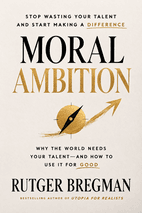
This collection gathers the most memorable lines from Rutger Bregman's Moral Ambition. You'll find quotes that challenge how you think about success, purpose, and what truly matters. Some are sharp wake up calls. Others are quietly hopeful. All of them push you to reconsider your choices.
What makes this book so quotable is its rare blend of idealism and hard nosed realism. Bregman doesn't just inspire you to care. He also warns you that good intentions aren't enough. The lines are direct, often uncomfortable, and hard to forget because they ask something of you.
Top Quotes from Moral Ambition
“I cannot believe that the purpose of life is to be “happy.” I think the purpose of life is to be useful, to be responsible, to be honorable, to be compassionate. It is, above all, to matter: to count, to stand for something, to have it make some difference that you lived at all.”
Epigraph by writer Leo Rosten that opens the prologue.
This line redefines life's purpose away from personal happiness toward meaningful impact, challenging a widespread cultural norm and setting a provocative foundation for the book.
“Not a book that makes life easier, but one that makes life a little harder. Not a book that offers solace, but one that causes friction. The kind of book you half-wish you'd never picked up at all because once you put it down, you might just have to change your life.”
The author directly describes the nature and intention of the book itself.
This honest, provocative promise signals that the book is intended to disrupt complacency and inspire difficult transformation, making it memorable for anyone seeking more than comfortable advice.
“People may spend their whole lives climbing the ladder of success only to find, once they reach the top, that the ladder is leaning against the wrong wall.”
The chapter opens with this metaphor about misplaced ambition.
It powerfully captures the futility of pursuing conventional success without moral direction, prompting readers to question their own goals.
“Don't diminish yourself, the lawyer argued, by selling your talents to the highest bidder to work on “lucrative trivia.””
The author summarizes Nader's warning to students about pursuing profitable but empty careers.
The phrase 'lucrative trivia' brilliantly captures the trade-off between financial reward and meaningful impact, making it a memorable critique of careerism.
“In the fight against injustice, winning is a moral duty.”
The author summarizes the conviction of civil rights activists like Rosa Parks and Jo Ann Robinson.
It encapsulates the chapter's central thesis that effective idealism requires a commitment to achieving results, not just good intentions.
“If we swim, we save lives. If we don't swim, we don't save lives. So let's swim.”
Rob Mather's simple logic to motivate participants in his swim-a-thon.
The directness and moral clarity of this statement make it a powerful call to action, stripping away excuses and focusing on the essential choice.
“Mik never said, “I have a nightmare.” He had a dream.”
The author's reflection on the need for positive vision in activism.
A clever play on MLK's speech to argue that we should focus on what we are for, not just against; memorable and thought-provoking.
Themes Behind the Quotes
A central theme is the difference between being busy and being useful. Many quotes urge readers to move beyond awareness and into action, warning that moral clarity without follow through can become a trap. Another recurring idea is that real change often starts small, with ordinary people who simply decide to step up.
The book also explores the cost of playing it safe. It contrasts climbing the wrong ladder with the kind of ambition that serves others. Underneath it all is a call to take responsibility, to stop waiting for permission, and to embrace the discomfort that comes with trying to make a difference.
Quotes by Chapter
Prologue: The happiest brain on earth
“Here's a guy who spent 60,000 hours—that's 7,500 workdays, or a solid thirty years of full-time work—inside his own head. Thirty years in which he did little for others, thirty years in which he didn’t lift a finger to make the world a better place.”
The author's critical perspective on Matthieu Ricard, known as 'the happiest man in the world,' after describing his extensive meditation practice.
It forces readers to question whether extreme self-focus is a worthwhile use of a lifetime, directly challenging the obsession with personal well-being and framing the need for outward-directed ambition.
“The trouble with idealists who lack ambition is they tend to prize awareness more than action. Words and intentions take precedence over deeds and consequences, and what something's really like gets eclipsed by what it feels like.”
The author critiques modern activists and 'woke' movements that focus on language and online presence rather than concrete results.
It succinctly diagnoses a widespread failure in contemporary social movements, urging a shift from performative awareness to effective action—a sharp, quotable insight for activists and critics alike.
1. No, you’re not fine just the way you are A model for what you can do with your talents and your time
“Awareness is at best a starting point, while for many activists, it seems to have become the end goal.”
After a brief mention of factory farms, the author critiques the tendency to stop at awareness.
This sharp observation challenges performative activism and urges readers to move beyond passive awareness to meaningful action.
“What the apostle Paul was to Christianity, and Martin Luther to the Reformation, Thomas Clarkson was to abolitionism.”
The author describes the historical significance of Thomas Clarkson in the fight against slavery.
This bold comparison elevates Clarkson's legacy and inspires readers to envision the outsized impact one person can have.
“Fear of change is often the first sign of aging, and before you know it, you're in golden handcuffs: stuck in a ho-hum job with no time to spare and all your money earmarked for things like that replacement toothbrush-head subscription.”
The author urges readers to seize the moment and avoid complacency.
The humorous yet biting imagery of golden handcuffs and trivial subscriptions resonates as a wake-up call against settling for a mediocre life.
2. Lower your threshold for taking action On resistance heroes and how contagious moral ambition can be
“Never doubt that a small group of thoughtful, committed citizens can change the world. Indeed, it's the only thing that ever has.”
The author quotes anthropologist Margaret Mead in reflecting on the power of small committed groups.
This line is a classic call to action, reminding readers that even a few determined people can reshape history, countering feelings of helplessness.
“He's the only person in the entire scene,” a historian later wrote, “who's on the right side of history.”
A historian's comment on August Landmesser, the man who refused to give the Nazi salute in a famous photograph.
It starkly highlights the rarity of moral courage and the enduring judgment of history on those who stand alone against injustice.
“Those who were asked to help someone in danger almost always said yes.”
A finding from research on rescuers during World War II, showing that being asked was the decisive factor.
It reveals that moral action is often triggered by a simple request, emphasizing the power of invitation and the contagious nature of courage.
“If anybody had asked me a year ago to head the movement, I tell you very honestly that I would have run a mile to get away from it. I had no intention of being involved in this way.”
Martin Luther King Jr. in December 1956, reflecting on his initial reluctance to lead the Montgomery bus boycott.
This shows that even iconic moral leaders started with hesitation, making activism feel accessible rather than reserved for the fearless.
3. Join a cult (or start your own) Nader’s Raiders, the Quakers, and other outsiders who change the world
“We are here, not because we are law-breakers; we are here in our efforts to become law-makers.”
The chapter opens with this line from suffragette Emmeline Pankhurst.
It perfectly captures the essence of moral ambition—challenging unjust systems from within, using legality and persistence to reshape the rules.
“Dear Ralph,” they wrote, “You have sacrificed for the benefit of the common good your entire adult life, as we, your friends and colleagues, know well. There have been countless occasions where you stayed in the background when that helped achieve the maximum benefit for others. It is time for you once again to step aside in the best interests of our nation.”
In October 2000, former Nader's Raiders wrote an open letter begging him to withdraw his presidential candidacy.
This heartfelt plea highlights the tragic irony of a moral crusader becoming a threat to the very causes he championed, making it a powerful warning about unchecked ambition.
“The tragic thing about Nader was that he morphed into the kind of cult leader who's deaf to all criticism.”
The author reflects on Nader's decline after his 2000 presidential run.
It distills a complex downfall into a single, haunting image, showing how even virtuous outsiders can become rigid and isolated when they stop listening.
4. See winning as your moral duty The Noble Loser’s five illusions and the genius of Rosa Parks
“It’s not what you think is right that counts, but what you're prepared to do about it.”
After discussing the belief-behavior gap and political hobbyism.
This line cuts through passive engagement, emphasizing action over mere opinion and challenging readers to move beyond awareness.
“The only kind of person we can’t use in this fight is the fool who thinks good intentions are enough.”
The author contrasts various activist roles with the 'Noble Loser' figure.
It sharply distinguishes between naive idealism and effective action, reinforcing the book's pragmatic message.
“Opportunities can be squandered, and time wasted. History is full of idealists with good intentions who achieved little, while the problems they could have fixed instead fester.”
From the section on the illusion of good intentions, after citing failed social programs.
It's a sobering reminder that good intentions don't guarantee impact, urging strategic evaluation and accountability.
5. Learn to weep over spreadsheets The remarkable tale of the man who hit the wrong button on his remote
“I’m rubbish with a TV remote control, and that led to a major left turn in my life.”
Rob Mather explaining how he accidentally changed channels and saw the documentary about Terri.
This line is both humorous and relatable, showing how a small, random mishap can lead to a life-changing moral awakening.
“The mark of a civilized man is the capacity to read a column of numbers and weep.”
Author quoting philosopher Bertrand Russell while reflecting on Rob Mather's emotional reaction to data.
It captures the core theme of moral ambition: combining analytical rigor with deep empathy, and challenges readers to feel the weight behind statistics.
“Are you telling me that twenty phone calls out of the back room of my home in London has created the world's single largest advocacy group for the world’s single largest killer of children?”
Rob Mather's surprised reaction when told his initiative had become the largest malaria advocacy group.
It illustrates how ordinary actions, when pursued with focus, can achieve extraordinary results, inspiring readers to believe in the power of small beginnings.
6. Enr oll at a Hogwarts for do-gooders Visiting one of the most inspiring schools on the planet
“A hotbed of innovation where you learn to avoid the illusions of the Noble Loser and turn your moral ambition into sound results.”
Describing the ethos of Charity Entrepreneurship, the 'Hogwarts for do-gooders'.
It encapsulates the central tension between good intentions and effective action, urging idealists to abandon self-defeating martyrdom for measurable impact.
“All too often, you're stuck trying to fix the internet connection somewhere in northern Nigeria while the AC's gone out.”
Joey Savoie describing the unglamorous reality of running a charity.
It strips away romanticized notions of saving the world, grounding moral ambition in gritty, practical sacrifice.
“Someone who points and says, “Hey, you. Yes, you! You're needed, right now. You have a mission to accomplish in this world.” It's how many a heroic tale begins.”
Reflecting on the role of a mentor like Arnold Douwes or Rob Mather in calling people to action.
An inspiring, almost cinematic invitation that frames moral ambition as a personal summons, making the reader feel seen and chosen.
“More than 95 percent of the people they approach agree to help. Like Arnold Douwes and Rob Mather had discovered before them: nearly everyone takes action, as long as they're asked.”
Describing Suvita's method of recruiting village gossips to spread vaccination reminders.
The striking statistic and the simple principle that most people will help if directly asked is both counterintuitive and deeply empowering for anyone trying to mobilize others.
7. Find out what the world needs and make it happen What we can learn from innovators like Jonas Salk and Josephine Cochrane
“Well, the people, I'd say. There is no patent. Could you patent the sun?”
Jonas Salk's response when asked about the patent for his polio vaccine.
Emphasizes selflessness and moral ambition; a powerful statement that knowledge for public good should not be patented.