Mirror Image Themes
by Lauren E. Rico
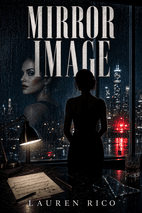
Underneath its plot, the novel is really asking how much identity is fixed and how much is performed, especially when twins, mistaken recognition, and impersonation blur the line. It also wrestles with whether family loyalty can survive image management, grief, and the misuse of authority.
Here you’ll find theme breakdowns on twins and identity, family loyalty versus conditional love, grief and survivor’s guilt, abuse of power, secrets and investigation, and money and control (bribes, trust distributions, hospital access). Concrete moments include Mary and Sam’s reunion, Sam entering the Langston world, Jenn’s loss of Jess, Julian’s exploitation, the adoption lie, and the journals. Recurring symbols include the pink elastic band, red leather journals, Gemini tattoo, and Mirror Image ad.
Major Themes in Mirror Image
Twins, identity, and impersonation
The novel repeatedly makes identity unstable through identical twins, mistaken recognition, and deliberate impersonation. Mary and Sam’s reunion exposes how much of identity is assumed, performed, and proved through small physical or behavioral details.
- Mary and Samantha confirm they share the same face, birthday, blood type, and peanut allergy.
- Mary cuts her hair to match Sam and impersonates her to Theresa, who mistakes Mary for Sam and offers her a bribe.
- Terry demands to see Sam’s shoulder and identifies the Gemini tattoo as Samantha’s, exposing that the patient is not Mary.
- Mary resolves to stop being Mary and boards the Lake Shore Limited as Samantha Kinski.
Family loyalty versus conditional love and appearances
The Langstons’ wealth and concern with image repeatedly conflict with genuine loyalty, especially when Sam enters Mary’s life. Mary’s choice of Sam over her parents exposes how conditional their love and acceptance can be.
- Theresa offers Sam $200,000 plus a monthly stipend to cut off all communication with Mary, and Sam refuses, saying she would rather have her sister.
- Mary tells her parents that Sam is blood and that if they reject Sam, she does not want to be part of the family either.
- Mary says her family cares about “the picture” and that her parents offered Sam money to leave because Sam was not good for optics.
- Doug and Terry blame Samantha for the rift with Mary and describe feeling held hostage because criticizing Sam risked being cut off.
Grief, survivor’s guilt, and letting go
Jenn’s loss of her twin Jess shapes her attempts to help Mary, while Mary’s loss of Sam forces her into a different kind of survival. The novel links grief to guilt, delayed mourning, and the difficult work of releasing the dead.
- Jenn says after Jess died she became “the walking embodiment of what everyone else was too polite to call survivor’s guilt.”
- Jenn admits she feels responsible for Jess’s death because she let go, and she tells Mary she has wished it had been her instead of Jess.
- Mary asks Jenn whether she ever wished it had been her instead of Jess, and Jenn says yes.
- One year later Jenn visits Jess’s grave, buries a pink elastic band, says “I love you, Jess,” and lets go.
Abuse of power and institutional betrayal
Doctors, lawyers, and family friends use their authority to control, silence, or scapegoat others. Julian’s care is exposed as exploitation, while the hospital and legal systems protect reputation and power over patients.
- Julian admits he recused himself from Jenn’s hearing because Kellogg promised Rose a clinical trial.
- Julian’s journals reveal a sexual relationship with Sam when she was fifteen and his plan to send her child to the Harper Home to keep control.
- Kellogg tells Jenn she would make a good scapegoat if Mary’s case goes south.
- The fifth-floor VIP ward has Persian rugs, a concierge, and Wolfgang Puck catering while Jenn notes regular patients wait hours for beds below.
Secrets, hidden truth, and investigation
The plot turns on withheld truths: the adoption lie, Julian’s journals, the twins’ separation, and the real circumstances of Sam’s death. Investigation—whether clinical, legal, or intuitive—becomes the method for exposing those secrets.
- Jenn notices autopsy anomalies: Mary’s Gemini tattoo matching Sam’s, beef stew in vegan Mary’s stomach, and old rib and pelvic fractures matching Sam’s accident.
- Mary confronts Doug and Theresa with birth and death certificates and her grandfather’s will, revealing that they adopted her and passed her off as their dead daughter.
- The woman at Blue Heron park gives Dr. Flores a cobalt bag full of Julian’s red leather journals and says they contain “every vile thing spelled out in his own handwriting.”
- Dr. Flores privately concludes that Terry and Doug love and worry about Mary but are lying about something.
Money, inheritance, and control
Wealth functions as a tool of coercion and containment, from bribes to trust distributions to hospital access. The novel contrasts the Langstons’ financial power with Sam’s foster-care background and Mary’s attempts to use money for independence and care.
- Theresa offers Sam $200,000 to leave Mary’s life, and Sam refuses the money.
- Mary’s parents contest her trust distribution and require her to move home for a year in exchange for a car, stipend, and eventual sign-off.
- Doug accuses Sam of pretending for money and identity theft after the Gemini tattoo reveals she is Samantha.
- Mary plans a tour company, a wildlife conservation foundation, and support for young adults aging out of foster care after learning about her ten-million-dollar trust document.
Symbols and Motifs
Pink elastic band
Jenn’s attachment to her dead twin Jess and her unresolved grief; burying it marks her attempt to let go.
- Jenn wakes at 3:47 a.m. after dreaming of Jess falling from Freefall Fury, clutching the pink elastic around her wrist.
- One year later Jenn visits Jess’s grave with Gabe, buries a pink elastic band there, and says “I love you, Jess.”
Red leather journals
Julian’s hidden record of abuse, manipulation, and control; written evidence that turns private exploitation into public proof.
- The woman at Blue Heron park gives Dr. Flores a cobalt bag full of Julian’s red leather journals.
- Jenn reads Julian’s journal entries aloud, including one implying a sexual relationship with Sam at fifteen and another about Sam’s pregnancy and the Harper Home.
- David Kellogg says the journals are in an evidence locker when he and Jenn confront Julian.
Gemini tattoo
The twins’ inseparable identity and the physical mark that can expose impersonation and hidden truth.
- Terry demands to see Sam’s shoulder and identifies the Gemini tattoo as Samantha’s, accusing her of killing Mary.
- Jenn notices in the autopsy report that Mary’s Gemini tattoo matches Sam’s, one of the anomalies that makes her suspect the identity switch.
Mirror Image ad and slogan
The gap between public image and private reality, and the way the twins’ bond is packaged for consumption while their private life fractures.
- The Mirror Image ad airs, and Sam and Mary celebrate before arguing over Brad and getting into a physical fight.
- The ad’s slogan “Fashion that suits every side of you” contrasts with the tabloid headline “Twisted Twins” and the sisters’ private fight.