Inside the Box Quotes
by David Epstein
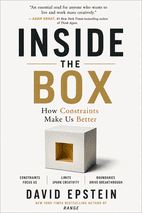
This collection brings together thirty of the most thought provoking lines from David Epstein's Inside the Box. You will find observations about creativity, innovation, and the surprising power of limits. The book challenges the idea that more freedom leads to better results. Instead it shows how constraints can spark invention and sharpen focus. These quotes capture that paradox with clarity and wit. They are the kind of lines you want to write down and share.
What makes Inside the Box so quotable is its ability to reframe common assumptions. Epstein draws from business, science, and art to illustrate his points. The quotes range from practical advice to philosophical insights. They stick because they are concrete and relatable. Whether you are a designer, entrepreneur, or just curious, these lines will make you think differently about constraints.
Top Quotes from Inside the Box
“It must offer the kind of personal satisfaction that a fine piece of jewelry brings. It will have a perceived value even when it’s not being used. It should offer the comfort of a touchstone, the tactile satisfaction of a seashell, the enchantment of a crystal.”
Marc Porat writes this in his red notebook in 1989, describing the vision for his Pocket Crystal, a device that uncannily resembles the future iPhone.
The poetic, almost spiritual language contrasts sharply with the technological failure that follows, making the quote a haunting reminder that even the most beautiful vision can collapse without constraints.
“We have a saying in venture: ‘More startups die of indigestion than starvation.”
Venture capitalist Bill Gurley tells the author, summarizing why too many resources can kill a startup.
The memorable metaphor flips conventional wisdom and perfectly explains how General Magic's overabundance of ideas, money, and talent led to its collapse.
“If you don’t have constraints, then make up constraints!”
Tony Fadell, reflecting on lessons from General Magic, tells the author.
A punchy, actionable mantra that summarizes the book's central argument about embracing boundaries.
“Too much freedom is horrible. It's like telling a young child, ‘Do whatever you want to.’...It's certainly bad to be directed to do things very, very narrowly and with no freedom. It’s my guess that for every person who needs more freedom, there are ten people who need more help in finding their way.”
Bell Labs scientist John R. Pierce describing the lab's ethos of 'circumscribed freedom.'
The vivid analogy and the 10-to-1 ratio make a compelling case that most people thrive with helpful boundaries, not unlimited freedom.
“Well-conceived constraints, like those at the heart of the scientific method, compel us to stop, think, and test. In other words, they force us to learn.”
Concluding the argument that structured limitations improve decision-making, whether in science or business.
This statement encapsulates the chapter's central insight in an inspiring, actionable form, urging readers to embrace deliberate constraints for deeper understanding.
“As Robert Frost said, writing free verse is like “playing tennis without a net.””
The author uses Frost's remark to argue for the necessity of form in poetry.
The vivid sports metaphor makes the case for constraints instantly memorable and relatable, even to non-writers.
“Forcing yourself to use restricted means is the sort of restraint that liberates invention. It obliges you to make a kind of progress that you can’t even imagine in advance.”
Picasso explaining the value of constraints in art.
This is a powerful endorsement of the paired-constraints method, showing that restrictions drive innovation beyond what is foreseeable.
Themes Behind the Quotes
A central theme is that constraints are not obstacles but tools for innovation. Across many fields, from product design to scientific research, imposing limits forces deeper thinking and more creative solutions. The book argues that too much freedom can lead to sloppiness and indecision, while well chosen restrictions compel us to learn and refine our ideas. This idea runs counter to the common belief that creativity thrives only in unbounded environments.
Another recurring theme is the relationship between novelty and context. Truly original ideas often need a familiar framework to be accepted and understood. The book also highlights the concept of universal design, where constraints like accessibility requirements lead to better outcomes for everyone. Finally, the notion that growth can come from embracing limits rather than pursuing endless expansion offers a profound shift in perspective. These themes weave together to show that the most powerful breakthroughs often emerge from working within boundaries.
Quotes by Chapter
Chapter 1: A World without Limits
“It was just too much creative freedom fueled by too much money.”
Sarah Kerruish, the videographer who later made a documentary about General Magic, reflects on the company's downfall.
This succinct diagnosis captures the central paradox of General Magic's story: abundance without boundaries leads to chaos, not innovation.
“Probably the most challenging part of the product was deciding what not to do. What to do, and what not to do.”
Megan Smith, a former General Magic engineer who later became U.S. CTO, reflects on the team's difficulty in setting boundaries.
This line crystallizes the core lesson of the chapter: without clear constraints, even brilliant teams drown in endless possibilities.
Chapter 2: A World with Limits
“It goes through chapter by chapter the things that have to be solved,” Catmull explains. “The supplies; the fuel; how do you get up into space; what's it like to actually be there; landing; food; the process of getting back. It’s a step-by-step of what it takes to get to the Moon.”
Catmull describes the book 'By Space Ship to the Moon' to illustrate how even moon shots are broken into small steps.
The quote directly challenges the myth of the 'moonshot' as a single leap, emphasizing the power of incremental, constrained problem-solving.
“I found early on that an abundance of resources leads to sloppiness.”
Catmull reflects on his leadership at Pixar.
It expresses a counterintuitive truth: that limits, not abundance, foster discipline and creativity.
Chapter 3: Limit-Powered Learning
“It was as if some millennium bug had struck, and medicine stopped working.”
Describing the sudden shift in NHLBI clinical trial results after 2000 when positive findings largely disappeared.
This vivid metaphor makes the statistical phenomenon instantly relatable and memorable, capturing the shocking reversal of medical progress.
“The practice is akin to a sharpshooter who fires bullets randomly at a wall, chooses a few that are close together, and then draws a bull's-eye around them.”
Explaining how HARKing (Hypothesizing After the Results are Known) creates false positives.
This powerful analogy clarifies a complex methodological flaw in an intuitive way, making it easy for readers to visualize and remember the problem.
“The point of restricting freedom in this way, as the NHLBI did for clinical trials starting in 2000, is not to stifle inquiry but to make it more valuable.”
Discussing the benefits of preregistering hypotheses and analysis plans before conducting research.
This quote succinctly reframes constraints as enablers of better science, directly reinforcing the book's core theme that limits can enhance learning.
Chapter 4: The Green Eggs and Ham Effect
“That piano did him the biggest favor on the planet.”
Vera Brandes, the concert promoter, reflecting on Keith Jarrett's use of the faulty piano.
It succinctly captures the paradoxical idea that a flawed instrument forced a creative breakthrough, making it a memorable summary of the chapter's theme.
“Bach, predisposed from the very beginning toward traversing conventional boundaries, nevertheless preferred to work within a given framework and accept the challenges it posed.”
Christoph Wolff's biography describing Bach's creative philosophy.
It illustrates how even the greatest musical genius voluntarily embraced constraints, reinforcing the chapter's central thesis with a historical example.
“In other words, the way to instantly make someone more creative is to force them to explore by limiting their options.”
The author concludes a passage about a study where less creative students used a template to generate better ad ideas.
It delivers the chapter's core message as a clear, actionable takeaway: creativity thrives under well-chosen boundaries.
Chapter 5: Building a New Box
“There’s no doubt in my mind that I have found out how to begin (at 40) to say something in my own voice; & that interests me so that I feel I can go ahead without praise.”
Virginia Woolf's diary entry after finishing Jacob's Room, before any reviews.
This shows the personal triumph of finding one's unique voice despite uncertainty about public reception, inspiring readers to pursue their own authentic expression.
“Somehow I had to find a common ground between us, a convention which would not seem to you too odd, unreal, and far-fetched to believe in.”
Virginia Woolf's own reflection on her need to connect with readers while pushing artistic boundaries.
This line captures the universal challenge of balancing innovation with accessibility, making it profoundly relatable for any creator.
“The more bold a new idea, the more important the rope.”
The author's concluding insight on the necessity of providing readers with a familiar anchor when introducing radical concepts.
The metaphor of the 'rope' is both vivid and memorable, distilling the chapter's core lesson into a single, punchy maxim.
Chapter 6: The Remix of Everything
“Excessive originality, in fact, was seen as self-centered, if not downright suspicious.”
Keith Miller explains the folk-preaching tradition that shaped Martin Luther King Jr.'s approach to sermon writing.
This line challenges the modern obsession with originality, revealing that in some traditions, borrowing and remixing were signs of humility and connection.
“The more novel his ideas, the more familiar the context had to be.”
The author summarizes King's persuasive strategy of embedding radical ideas in familiar frames.
It perfectly captures the counterintuitive principle that innovation often succeeds by leaning on the known, a lesson applicable far beyond rhetoric.
“Though we usually make the false equation between creativity and complete originality, King never did.”
Keith Miller's observation about King's view of creativity versus originality.
This reframes creativity as the ability to improve and remix existing material, freeing us from the burden of having to invent everything from scratch.
“Borrowing was so common that mid-twentieth-century preachers would occasionally pester one another to publish their sermons so that they could be riffed upon, like jazz standards.”
Description of the culture of borrowing among mid-20th-century preachers.
The jazz metaphor makes the practice of borrowing feel collaborative and artistic rather than unethical, highlighting a communal approach to creation.
Chapter 7: Designing for Constraints
“I’ve had to explain to Congress several times that we built the vest for women,” Miller said, “but we call it unisex because we want men to wear it.”
Retired Lieutenant Colonel Stephen Miller explains why the new body armor designed for women was marketed as unisex.
This quote highlights the irony that designing for a niche (women) produced better fit for many men, illustrating the power of universal design in a humorous, concrete way.
“There must be access for the disabled,” he said. “In effect, better access for everyone.”
Urban sociologist William Whyte argued for accessible public spaces in New York City.
This line succinctly encapsulates the core principle of universal design — that accommodating the most constrained users benefits everyone — and is both inspirational and practical.
“The podcast isn't impairing our vision; it's taking up working memory, that fundamental constraint of human cognition.”
The author explains why people turn down music or podcasts when needing to focus on driving directions.
It makes a subtle cognitive limitation relatable and tangible, showing how a common habit reveals a deep mental constraint.
“The power of universal-design thinking lies in the idea of using constraints to illuminate opportunities for improvement and innovation.”
The author introduces the core principle of universal-design thinking in the chapter.
This line crisply captures the chapter's central insight—that constraints are not obstacles but lenses for finding creative solutions.
Chapter 8: Widen the Bottleneck
“We produce enough food to feed everyone,” Rogers told me. “But it goes bad before we can get it to people, or before they use it.”
James Rogers, founder of Apeel Sciences, explaining the global food waste problem.
This line reframes the global food crisis from a problem of scarcity to a problem of time, making the solution both tangible and urgent.
“The idea that growth can come from a focus on limits, rather than limitless expansion, is at the core of a simple but profound idea.”
The narrator summarizing the underlying philosophy behind both Apeel's approach and the theory of constraints.
It challenges conventional growth paradigms and offers a counterintuitive yet powerful insight: constraints can be catalysts for innovation.