How To Get To The Top of Google Quotes
by Tim Cameron-Kitchen
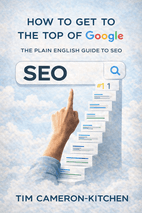
This collection brings together the sharpest, most quotable moments from Tim Cameron-Kitchen's book on dominating Google search. You'll find bold predictions about AI reshaping search, practical wisdom on keyword strategy, and unforgettable analogies that make complex SEO concepts stick. What makes this book so quotable is its no-nonsense attitude. The author refuses to sugarcoat the truth about competition, algorithm changes, or the effort required to win. Every line is crafted to provoke thought or spur action, often with a dash of humor or tough love.
Top Quotes from How To Get To The Top of Google
“Al Search isn't coming, it's here already.”
The author states this early in the introduction to emphasize the immediacy of AI's impact on search.
It's a concise, forceful declaration that cuts through hype and signals the urgency of adapting to the new landscape.
“Traffic from Google might drop by 25% in favour of new platforms? Great! That means there are new search channels to monetise and draw traffic from!”
The author reacts to Gartner's prediction of a 25% drop in traditional search volume.
It reframes a potential threat as a massive opportunity, encouraging readers to embrace change rather than fear it.
“Al Overviews, or generative Al search results, aren't just a new feature of Google's search results, they're going to be the only way Google answers a search in the next year.”
The author predicts the centrality of AI Overviews in Google's future.
This bold, forward-looking statement grabs attention and underscores the urgency of adapting to the next major shift in search.
“It’s just like the winner of the Olympic 100m race receives a disproportionate share of the rewards compared to the person who comes second, despite the runner-up being the second fastest person alive.”
The author explains why the #1 organic ranking gets a vastly disproportionate share of clicks.
The Olympic analogy makes the winner-take-all nature of SEO instantly relatable and memorable, reinforcing the value of aiming for the top spot.
“Google is more like a cat. You can try to discipline, you can try to train, but the cat won't obey you unless it perceives that it stands to gain big.”
The author explains why SEO is about persuasion rather than force.
This memorable analogy captures the unpredictable nature of Google's algorithm and the need for strategic alignment, resonating with anyone frustrated by SEO challenges.
“We need to make your website so perfect for the top spot that your absence would make the search results feel incomplete and broken.”
The author describes the ultimate goal of SEO.
It sets a high bar for quality and user value, inspiring readers to aim for excellence rather than just optimization.
“Trying to promote a poorly-optimised website is like pushing water up a hill, whereas promoting a well-optimised website is like pouring it downhill.”
The author uses an analogy to illustrate the ease or difficulty of ranking a website.
The simple, vivid metaphor sticks in the reader’s mind, instantly clarifying why optimisation is the foundation of all SEO efforts.
Themes Behind the Quotes
One clear theme is the urgent need to adapt to generative AI and new search platforms before competitors do. The author argues that early movers will capture disproportionate rewards, much like an Olympic gold medalist. Another theme is the importance of common sense over blind data reliance. He stresses that fundamental SEO elements like page titles and user intent matter more than chasing metrics. A third theme is the balance between on-site optimization and link building. Great content and structure come first, while links amplify success but cannot fix a fundamentally weak site. Finally, the book emphasizes thinking like both a user and Google's algorithm to create pages that feel essential and authoritative.
Quotes by Chapter
Introduction
“The businesses that take action today—including your competitors—are going to hoover up market share in these new engines before slower businesses even realise that they should be doing SEO at all, let alone Generative Engine Optimisation.”
The author warns about the competitive urgency of adopting new search strategies.
This line creates a clear call to action by highlighting the cost of inaction and the advantage of early movers.
“That’s why they’re not doing it and that’s why you should.”
The author explains that competitors avoid hard work, so you should embrace it.
This line turns a common excuse into a competitive advantage, motivating readers to push past inertia.
Chapter 1: Five Free Ways to Appear on the First Page of Google
“It's the success of claiming Featured Snippets for our clients (since Day 0 2014) and the conversions that come from doing so that makes me so bullish that moving early on Al Overviews is the only way to go.”
The author reflects on past achievements to justify his confidence in AI Overviews.
This line combines proven results with a strong personal conviction, motivating readers to act early rather than wait and miss the opportunity.
“This makes sense because if someone else writes about you and says how great you are, doesn’t that hold more weight than if you're writing about yourself saying how great you are?”
The author discusses the power of third-party endorsements for building credibility.
The rhetorical question challenges conventional self-promotion and highlights the persuasive advantage of external validation, making the insight stick.
Chapter 2: How Google Decides Where to Rank You and Your Competitors
“PageRank is not a zero-sum game and there's plenty to go around.”
The author explains that passing PageRank through links does not diminish the source's authority.
This clarifies a common misconception about link equity, making a complex concept simple and encouraging link building.
“If you know that both people and Google's algorithm are looking for insightful and useful information, wouldn't you make each page of your website match that criteria?”
The author challenges readers to consider the dual audience of users and the algorithm.
It turns a technical requirement into a philosophical question about purpose, motivating content creators to prioritize genuine value.
Chapter 3: How to Find and Rank for the Most Profitable Keywords
“My number one rule of SEO is never to trust data before common sense, so if you know you should be targeting that phrase, get it on the list!”
The author discusses how keyword search volume estimates can be misleading and advises trusting your own judgment.
This memorable rule cuts through the noise of data overload, empowering readers to trust their intuition and business knowledge over imperfect metrics.
“Who would you rather have visit your site, 10 people who want to buy the exact product you are selling or 100 people who sort of maybe want something similar to what you're selling?”
The author argues that low‑search‑volume keywords with high commercial intent are more valuable than broad, high‑volume phrases.
This rhetorical question starkly illustrates the trade‑off between traffic quantity and quality, a core principle of profitable keyword targeting.
“Keyword research is not an exact science and there are no right or wrong answers.”
The author closes the chapter by reminding readers that judgment and common sense are essential.
It relieves the pressure to find a perfect formula and encourages a pragmatic, iterative approach to SEO.
“If you're looking for a tool or method to tell you conclusively which keywords you should be targeting, you'll be disappointed to find the only ones that will do this are too basic to be of any use.”
The author warns against over‑reliance on automated tools for keyword selection.
This candid statement challenges the myth of a one‑click solution, reinforcing that strategic thinking is irreplaceable.
Chapter 4: Analysing Your Competition and Identifying Their Strengths and Weaknesses
“If you do more of what they do than them, you can win.”
The author explains how savvy competitors can show you what you should be doing.
This line distills competitive strategy into a simple, actionable mantra that resonates with anyone seeking an edge.
“If you've just realised that your site ranks a lot lower than you thought, I'm sorry, but you needed to know.”
The author warns about the skewing effect of being logged into Google when checking rankings.
The blunt honesty and empathetic tone make it memorable, breaking the illusion many site owners have about their performance.
“We're now going to forensically study your competitors’ websites and find out how they got to number one, so we can beat them.”
The author introduces the section on deconstructing competitor success.
The phrase 'forensically study' evokes a detective-like determination, turning research into a direct, competitive mission.
“This page title is one of the most fundamental and basic SEO elements on the website so if a competitor has their brand name on its own there, that's a total waste of an area that should be used for targeting keywords.”
The author explains what to look for in the <title> tag when viewing a competitor's source code.
It highlights a common, costly mistake in a clear, no-nonsense way that immediately makes readers rethink their own title strategy.
Chapter 5: An Introduction to Backlinks
“Remember that Google likes websites that have a lot of links pointing at them because this indicates that they're popular and authoritative.”
From the chapter's opening explanation of backlinks and Google's ranking logic.
This line captures the core principle of link-based SEO in a simple, memorable way, making it a foundational insight for readers.
“Popular and authoritative sites tend to rank better because they're usually better quality and more useful.”
Immediately following the previous quote, reinforcing Google's rationale.
It ties ranking success directly to quality and usefulness, motivating ethical SEO practices rather than manipulation.
“It's natural for websites to get a lot of links with their company name and website address as anchor text, so this is what Google expects to see in what we call a “natural-looking link profile”.”
When discussing anchor text strategies and avoiding over-optimization.
This warns against spammy exact-match anchor text while offering a clear benchmark for what a healthy backlink profile looks like.
“So when you're building links, it's a good idea to use descriptive anchor text, as long as you're being natural.”
Conclusion of the anchor text section, offering practical advice.
It provides actionable guidance that balances keyword targeting with naturalness, a key takeaway for safe link building.
Chapter 6: Website Optimisation
“The best links in the world can’t help an awful website, whereas a ruthlessly optimised site can take you a long way towards the ranking domination you might be aiming for, even before you start adding links.”
The author explains why internal optimisation must precede link building.
It powerfully contrasts the futility of promoting a bad site with the leverage of a well-optimised one, making the need for on‑page SEO unforgettable.
“Always remember the 10 million dollar question: Does this website look like the sort of website that deserves to rank at the top of Google?”
The author challenges the reader to honestly assess their own site’s quality.
This blunt, self‑reflective question cuts through technical jargon and forces a critical perspective on what Google actually rewards.
“+ Your website is heavily Flash-based. If so, kill it with fire immediately. It will never rank and Flash has been retired.”
The author warns against using outdated technology that harms SEO.
The dramatic, humorous command makes a strong technical point impossible to ignore, and the final statement provides a clear, irreversible reason.
Chapter 7: Domains and URLs
“I'm not joking. We could rank sites within a day or two based purely on the domain in some cases, which meant we didn't have to worry about troublesome things like content and links.”
The author describing the ease of ranking with Exact Match Domains before Google's 2012 update.
This line is memorable because it reveals how absurdly easy SEO once was, emphasizing that the algorithm was exploitable.
“Like all loopholes, this one was closed around the time of peak effectiveness.”
Author reflecting on the EMD update.
A succinct and universal observation about how algorithmic loopholes are patched just when they are most valuable.