Good Energy Quotes
by Casey Means
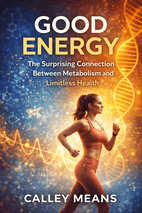
These quotes from Good Energy capture the book's core message about health and vitality. They range from eye opening facts about your gut and light exposure to sharp critiques of a system that profits from sickness.
What makes this book so quotable is its blend of science and directness. Casey Means has a way of distilling complex ideas into lines that stick with you. Whether she is talking about cells, food, or modern life, each quote feels like a small revelation. They are made to be shared, discussed, and acted upon.
Top Quotes from Good Energy
“The biggest lie in health care is that the root cause of why we're getting sicker, heavier, more depressed, and more infertile is complicated.”
The author argues against the conventional medical narrative that chronic disease is mysterious and complex.
This line powerfully challenges readers to reconsider the simplicity of the root cause, offering hope that solutions are accessible and not beyond our control.
“It’s a terrible trickle-up: Bad Energy leads to broken cells, broken organs, broken bodies, and the pain you feel.”
The author explains how metabolic dysfunction at the cellular level escalates into full-blown disease.
The vivid metaphor 'trickle-up' makes the systemic progression of poor health easy to grasp and memorable.
“Every institution that impacts your health makes more money when you are sick and less when you are healthy—from hospitals to pharma to medical schools, and even insurance companies.”
The author explains the financial incentives that drive the healthcare system.
This quote exposes the fundamental conflict of interest in medicine in a clear, memorable way, making readers question the motives behind standard medical advice.
“You should not blindly trust your doctor and you should not blindly trust me. You should trust your own body.”
Author Casey Means emphasizes the importance of personal health agency.
This line challenges the traditional deference to medical authority and empowers readers to become active participants in their own health.
“You may have been indoctrinated to think you're not capable of understanding your body, to distrust common sense, and to outsource your health agency. This stops now.”
Call to action at the end of a section about bio-observability.
It directly confronts the learned helplessness that many people feel about their health, offering a powerful, declarative turning point toward empowerment.
“Want to kill a puppy? Subject it to sleep deprivation for just nine days. Want to give yourself prediabetes? Reduce sleep to four hours a night for just six days.”
The author emphasizes the severe metabolic consequences of sleep deprivation.
The shocking comparison to killing a puppy makes the danger of sleep loss impossible to ignore, driving home the urgency of prioritizing sleep.
“But push a body just past the point of comfort—specifically with movement and temperature—and magic happens: the cells rise to the occasion, adapting and turning on dormant pathways to make us more resilient, happier, and healthier, especially if we follow that stress with time to adapt, recover, and amplify resilience pathways.”
The author explains how controlled discomfort triggers cellular adaptation.
It beautifully captures the central thesis of the book—that gentle stress, not constant comfort, unlocks our biological potential.
Themes Behind the Quotes
A central theme is that nearly all health problems stem from a breakdown in how our cells produce and use energy. Symptoms are not random but directly reflect cellular dysfunction. This perspective shifts focus from treating isolated diseases to supporting the fundamental processes that keep us alive. Lifestyle factors like what we eat, how we sleep, and our exposure to light become essential tools for restoring balance.
Another major theme is the harsh critique of modern medicine and society. The system is designed to profit from sickness, not health, creating a cycle of dependency. At the same time, the book emphasizes that we have more power than we realize. By understanding our biology and making intentional choices, we can break free from this cycle. Reclaiming agency over our own bodies is both a personal and revolutionary act.
Quotes by Chapter
Chapter 1: Siloed Health vs. Energy-Centric Health
“I had become a doctor to generate foundational, vibrant health for my patients—not to drug, cut, and bill as many bodies as I possibly could each day.”
The author reflects on his growing disillusionment with the medical system during his surgical residency.
This quote reveals the painful gap between the noble intentions of physicians and the perverse incentives of the healthcare system, resonating with anyone who feels the system fails to truly heal.
“The next revolution in health will come from understanding how the root of almost every disease relates to energy, and how less specialization, rather than more, is the answer.”
The author introduces the central thesis of the book in the opening section.
This line distills the book's core promise—that shifting our focus from siloed specialties to a unified energy-based framework can transform health. It is both provocative and hopeful, inviting readers to rethink everything they know about medicine.
Chapter 2: Bad Energy Is the Root of Disease
“All symptoms are the direct result of dysfunction in our cells; symptoms cannot arise out of thin air.”
From the author's three simple truths about chronic disease.
It succinctly reframes symptoms as signals of cellular dysfunction, empowering readers to look beyond surface-level diagnoses.
“More than 90 percent of serotonin, the hormone that regulates mood and contentment, is made in the gut—not in the brain.”
The author explains the gut-brain axis during her discussion of depression.
This surprising fact highlights the profound connection between digestive health and mental well-being, challenging conventional views.
“Is it possible that the same fundamental problem with inflammatory overdrive is just showing up in different body parts as different symptoms?”
The author reflects after reading a JAMA article on sinusitis.
This rhetorical question encapsulates the book's central thesis that diverse diseases share a common root cause of cellular dysfunction.
“The skyrocketing rate of autoimmune disease is the most obvious example of the devastating results of biochemical fear. It represents the body's cells saying “WTF?” to our modern exposures and acting out.”
The author discusses the rapid increase in autoimmune diseases in the United States.
This passage uses vivid, colloquial language to personify cellular distress, making a complex biological phenomenon both relatable and memorable.
Chapter 3: Trust Yourself, Not Your Doctor
“The most important thirteen days of my life came from ignoring a team of doctors.”
The author reflects on his mother's final days after choosing to decline recommended procedures.
This opening line immediately grabs attention and establishes the book's central thesis—that trusting your own judgment over the medical system can lead to profoundly meaningful outcomes.
“But what nobody talks about—what I think many doctors don't even realize—is that the rates of all these conditions are going up at the exact time we are spending trillions of dollars to “treat them.””
The author lists common chronic conditions and their standard pharmaceutical treatments.
It powerfully highlights the failure of the intervention-based model, showing that spending more on treatments does not lead to better population health.
“Saying “You have the best medical team” after a cancer diagnosis is like saying you have the best mechanic after totaling your car.”
The author critiques the glorification of medical teams for late-stage disease management.
This analogy is both shocking and relatable, underscoring the point that prevention is far more valuable than even the best intervention after the damage is done.
Chapter 4: Your Body Has the Answers | How to Read Your Blood Tests and Get Actionable Insights from Wearables
“We have so normalized what Dr. Mark Hyman refers to as “FLC” (feel like crap) syndrome that many of us can't even imagine what it could feel like to be symptom-free.”
The author discusses how common symptoms are often dismissed as normal.
It vividly exposes how society has accepted low-grade suffering, prompting readers to question their own baseline health and aspire to feeling truly well.
“The truth is that most doctors don’t understand how to interpret the lab results in a meaningful way.”
After describing typical unhelpful doctor responses to lab work.
This blunt statement validates the frustration many patients feel and underscores the need for self-education and better data access.
Chapter 6: Creating a Good Energy Meal
“We have a compulsive collective food addiction. We are eating ourselves to death.”
The author describes the crisis of ultra-processed food addiction affecting the nation.
This stark, simple statement encapsulates the core urgency of the book, making the hidden epidemic impossible to ignore.
“Inside your mother's body, you were 3D printed out of food, and every item you ingest continues to print the next iteration of yourself.”
The author explains how our bodies are built entirely from the food we consume.
The vivid metaphor of 3D printing makes the concept of food as building material tangible and unforgettable.
“Eating is a matching problem: Matching the food inputs with the cells’ needs produces health.”
The author introduces Principle 2 of Good Energy eating.
This concise definition reframes eating as a precise biological task, empowering readers to think beyond fad diets and focus on cellular needs.
“You can think of yourself and your behavior as a robot acting at the will of your cells and microbiome.”
The author explains how cravings are biological signals from cells and microbiome.
This striking metaphor reframes personal agency and helps readers understand that cravings are not a character flaw but a biological drive.
Chapter 7: Respecting Your Biological Clock | Light, Sleep, and Meal Timing
“Sadly, in the modern world, a successful life looks like living inside a box, working inside a box, staring at lighted boxes, and being buried in a box.”
The author reflects on how modern society separates us from natural light and the outdoors.
This poignant metaphor sharply critiques the indoor-centric lifestyle, making readers reconsider what true success and health mean.
“Simply put: a key way that you regulate your hormones, metabolism, weight, and risk for disease is by showing your cells what time it is by exposing your eyeballs to direct sunlight throughout the light part of the day and by hiding your eyeballs from as much light as possible when the sun is down.”
The author summarizes the essential role of light exposure in synchronizing the body's circadian rhythm.
This clear, actionable advice connects everyday behavior to deep biological processes, empowering readers to take control of their health.
“We wonder why we feel terrible after not sleeping well for just one night, and hopefully, this section helps flesh it out: it's like putting a bomb inside your cells.”
The author explains the cellular damage caused by poor sleep.
The bomb metaphor vividly illustrates the internal destruction from sleep deprivation, making the science relatable and memorable.
Chapter 8: Replenishing What Modernity Took Away | Movement, Temperature, and Nontoxic Living
“We now know sitting is one of the fastest ways to ensure increased risk for the exact diseases med students are learning how to treat.”
The author reflects on his failed attempts to install standing desks at Stanford Medical School.
This line sharply highlights the tragic irony of medical education itself contributing to the diseases future doctors are trained to fight.
“It is ironic that we pay for the luxury of comfort and then are sold solutions to remedy the resulting deficiencies.”
The author discusses how modern life has stripped away natural movement and temperature variation.
This pithy observation exposes the absurd cycle of paying for comfort and then paying again to undo its harms.
“Despite a doubling of fitness center memberships since the year 2000, obesity has gone up 10 percent in that time.”
The author contrasts America's fitness industry growth with worsening health outcomes.
It starkly reveals that more gyms and memberships have not translated into better metabolic health, challenging conventional assumptions about exercise.
Chapter 9: Fearlessness | The Highest Level of Good Energy
“Overnight, the traumas and fears of eight billion others have all become ours to process.”
Discussing how modern technology exposes us to global traumas.
It powerfully encapsulates the unprecedented psychological burden of the digital age, making readers realize the scale of external fears we absorb.
“We've created a culture where really large numbers of people can’t bear to be present in their daily lives and need to medicate themselves throughout the day.”
Author Johann Hari's observation about modern culture.
It starkly describes our collective inability to be present and our reliance on distractions, prompting self-reflection on our own coping habits.