Get Found Quotes
by Matt Diamante
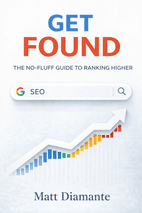
Looking for the best quotes from Get Found by Matt Diamante? Below are the lines that stand out most across the book.
The quotes are organized by chapter, each with a short note on where it appears and why it stands out.
Top Quotes from Get Found
“SEO isn’t an overnight solution; it’s a long- term strategy that, when done right, delivers sustainable growth that no ad spend can compete with.”
The author explains the true nature of SEO to set realistic expectations.
This line cuts through the hype of quick fixes and emphasizes the long-term commitment needed, which resonates with anyone tired of empty promises.
“The secrecy and gatekeeping by so-called “experts” is exactly why I decided to write this book: to show you that SEO isn’t just for professionals, it's for anyone willing to learn.”
The author reveals his motivation for writing the book.
It democratizes SEO knowledge and directly addresses the frustration many beginners feel when faced with confusing jargon.
“Marketing takes time and patience. If you're expecting instant results, you’re setting yourself up for disappointment.”
The author warns readers about the reality of marketing before they dive in.
This honest, straightforward advice prepares readers for the slow grind of SEO and encourages perseverance over instant gratification.
“When you're thinking about cutting marketing, don’t.”
The author shares a key lesson from the COVID-19 pandemic when clients paused SEO services.
This short, punchy command is memorable and counterintuitive, reminding readers that marketing is the last thing to cut even in tough times.
“They went from 11 bins for rent to over 100. That's over a 1,000% growth rate—but who's counting?”
The author discovers his client's business exploded after the basic on-page SEO he did.
This line delivers a stunning, concrete result that proves the transformative power of SEO, making the abstract concept tangible and memorable.
“I watched this couple go from renting a small apartment to owning a home big enough to host family gatherings with spare bedrooms for their grandkids.”
The author reflects on the real-life impact of his work for the bin rental couple.
It humanizes the success story, showing that SEO isn't just about rankings—it changes lives, which resonates emotionally with readers.
Quotes by Chapter
Prologue
“I had just made money out of thin air, and I knew this was only the beginning.”
The author's realization after his first client's success, despite initially earning below minimum wage.
This encapsulates the entrepreneurial thrill and belief that SEO can create value from nothing, inspiring readers to see their own potential.
1. Introduction to On-Page SEO
“Without content on your website, search engines have no way of understanding what your site is about, so how can they connect you with the right searchers?”
Introduction explaining why on-page SEO matters.
Highlights the fundamental role of content in communicating site purpose to search engines, making it clear why content is essential for visibility.
“Every platform (search engines, social media sites, etc.) has one main goal: to keep users engaged so they don’t leave for a competitor.”
Explaining how algorithms work.
Reveals the underlying motivation of all platforms, giving readers a key insight into how to align with platform goals for better rankings.
“While great content is the foundation of SEO, there's a lot more that goes into ranking at the top.”
After discussing the ideal scenario but noting the reality.
Sets realistic expectations and piques curiosity about the other factors covered in the book.
2. Content
“Most importantly, high-quality content doesn’t just inform, it solves a problem.”
The author defines the core purpose of high-quality content in the chapter.
It distills the essence of effective content creation into a single actionable principle, reminding creators to focus on utility over fluff.
“Google wants your personal experience in your content. It makes it unique.”
The author explains the E-E-A-T guidelines and why personal experience matters for SEO.
This line reassures creators that their unique perspective is not only valuable but also rewarded by search engines, encouraging authenticity.
“The real power lies in making complex ideas simple.”
The author discusses the importance of readability and clear communication.
It captures a universal truth about effective communication, empowering writers to prioritize clarity over jargon to reach a broader audience.
“Think of every page on your website, blogs included, as a door to your business. The more doors you have, the more opportunities people have to find you.”
The author explains the strategic value of blogging and content creation for driving traffic.
This metaphor makes the abstract concept of content marketing tangible and motivating, inspiring readers to create more entry points for customers.
3. Keywords
“When you align your content with the intent behind a keyword, you're no longer just showing up in search results, you're showing up at the right moment, with the right message, for the right person.”
From the section on User Intent, explaining the importance of matching content to search intent.
This line captures the core value of SEO alignment—turning generic visibility into targeted, impactful connection with the audience.
“Great SEO isn’t about keyword stuffing, it’s about creating content people actually want to read.”
Concluding the discussion on keyword density, emphasizing natural writing over artificial optimization.
It's a clean, memorable summary of modern SEO philosophy that prioritizes reader experience over manipulation.
“The number one reason people fail to rank is that they're not even using their keyword on their page at all!”
From the 'Where to Use Keywords on Your Page' section, addressing a common oversight.
This blunt truth shocks readers into checking the basics and highlights a simple yet frequent mistake that undermines SEO efforts.
“This is the kind of content that builds long-term momentum. It compounds. You're not chasing trends, you're building assets.”
From the discussion on evergreen keywords, illustrating the payoff of sustainable content.
The metaphor of compounding assets resonates with business owners seeking lasting value rather than fleeting wins.
5. Meta Descriptions
“Think of the meta description as the title tag's partner in crime: They always show up together and help users decide whether your page is worth their time.”
Author describing the relationship between title tags and meta descriptions.
Uses a memorable metaphor that makes the connection easily understandable and emphasizes their joint importance.
“Think of it as your second (and final) chance to convince someone that your link is the best one on the page.”
Author highlighting the decisive role of meta descriptions after the title tag.
Conveys the high stakes of meta descriptions, motivating readers to invest effort.
“Bottom line: Invest a little extra time in your meta descriptions. They're often the deciding factor in getting the click.”
Author concluding the importance section with a direct call to action.
Simple, actionable advice backed by a clear benefit – a powerful takeaway.
“It's not about nailing just one piece, it’s about how all the pieces connect. When done right, they create something far greater than the sum of their parts.”
Author summarizing the interconnected nature of SEO elements at the end of the chapter.
Inspires a holistic mindset, reminding readers that synergy creates greater results.
6. URLs (aka Links)
“Think of a URL like a street address. Just like every house needs a unique address so people can find it, every page on your website needs a unique URL so users (and Google) know exactly where to go.”
The author is explaining the importance of URLs by comparing them to street addresses.
This uses a simple, relatable analogy that underscores the fundamental necessity of clear URLs for both human visitors and search engines.
“Spoiler alert: Keyword stuffing doesn’t work. In fact, it can actually hurt your rankings.”
The author warns against overloading URLs with keywords.
It delivers a blunt, memorable truth that dispels a common SEO myth, emphasizing that tricking Google backfires.
“Google’s way too smart for that now, and it's focused on clarity and user experience, not keyword spam.”
The author explains why keyword stuffing is ineffective.
This line humanizes Google's algorithm as intelligent and user-focused, reassuring readers that quality content is rewarded.
“Clean, organized URLs = a better website for everyone.”
The author summarizes the benefit of structured URLs with subdirectories.
It's a concise, powerful takeaway that encapsulates the chapter's core advice in a memorable slogan-like statement.
7. Heading Tags
“Heading tags ( H1, H2, H3, etc.) act like signposts, guiding users through your content and helping Google understand what each section is about.”
The author explains the role of heading tags in organizing content for both readers and search engines.
The metaphor of signposts is instantly relatable and memorable, clearly illustrating the dual purpose of heading tags for usability and SEO.
“In short: They're not just about structure, they’re about clarity, relevance, and helping both humans and algorithms make sense of your content.”
The author summarizes the deeper value of heading tags beyond mere organization.
This line distills the core benefit of headings into a punchy, quotable takeaway that resonates with anyone trying to improve content performance.
“And that kind of visibility? It can be a game-changer, putting your page front and center, even above the traditional #1 spot.”
The author describes the potential SEO advantage of aligning headings with search queries to earn rich snippets.
The bold claim about surpassing the #1 ranking is both aspirational and motivating, making it a powerful closing statement for the section.
8. Anchor Text
“Anchor text is used to give users and search engines context about the page it’s linking to.”
From the opening explanation of what anchor text does.
It clearly defines the dual purpose of anchor text for both human readers and search engines, making it a foundational principle.