Freedom of Money Quotes
by Changpeng Zhao
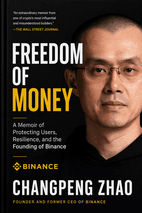
This page collects the sharpest lines from Changpeng Zhao's 'Freedom of Money'. You will find moments of raw honesty, hard earned business lessons, and reflections on poverty, risk, and resilience. Some quotes capture a single vivid memory, others offer advice that sticks.
The book is quotable because CZ writes with the same directness he uses to build things. He does not polish his past or hide his mistakes. Every line comes from someone who has been poor, imprisoned, and misunderstood, yet still believes in building a freer future.
Top Quotes from Freedom of Money
“What we see in someone else is often just a mirror of ourselves.”
Yi He reflecting on the varied perceptions of CZ across millions of people.
It offers a universal truth about human perception and projection, encouraging self-awareness and humility.
“He was never a myth, nor a villain. Just himself — the five-year-old staring at well water and electric lights; the teenager working night shifts at a gas station while dreaming of the future; the programmer who kept giving, even as his assets shrank; the founder who put himself at risk for the survival of his company.”
Yi He concluding the foreword with a summary of CZ's true nature.
This passage humanizes a public figure, reminding readers that greatness comes from staying true to one's roots and values through all trials.
“I wrote the first draft of this book as a brain dump while in prison, using a basic editor that didn’t have a copy-paste function on a limited inmate terminal.”
The author explains how he began writing the book during his incarceration.
The raw, restrictive conditions of writing from prison add a visceral layer of authenticity and perseverance that resonates with readers.
“I remember the day the grown ups put a light bulb in our room. It felt like witnessing witchcraft.”
The author describes the first time electricity arrived in his village home.
This line captures the childlike wonder and astonishment at a technology we now take for granted. It shows how transformative simple innovations can feel in a resource-scarce environment.
“We knew we were poor compared to many of the people around us, but the idea of complaining never crossed our minds. Life was more than good, and we appreciated all that we had.”
The author recalls his family’s modest living situation after moving to Canada.
This passage radiates gratitude and resilience, reminding readers that happiness does not depend on material wealth. It conveys a powerful mindset of contentment despite hardship.
“I learned two important lessons: 1. Don’t be a jerk. Be a nice person. 2. Don’t use ultimatums in arguments or negotiations.”
After his girlfriend finally ended their relationship when he threatened to break up.
This raw self-reflection captures growth from a painful mistake and offers universal advice on kindness and communication.
“There are always more opportunities in the future than there were in the past.”
The author reflects on not working with AI for 25 years despite early research.
This optimistic mantra reframes regret as hope, encouraging readers to embrace future possibilities instead of dwelling on missed chances.
Themes Behind the Quotes
A central theme is the power of humility and learning from failure. CZ repeatedly returns to moments of stupidity, bad assumptions, and painful losses, treating them as essential teachers. Another strong thread is the idea that opportunity comes from curiosity and hard work, not from privilege or luck.
Freedom itself runs through the quotes, both as a personal value and as a technological promise. The book argues that open systems like blockchain can give people more control over their money and lives. At the same time, it warns against ego, ultimatums, and shiny distractions, insisting that character and cash flow matter more than fame.
Quotes by Chapter
Testimonials
“I recommend it for anyone who aspires to go from humble beginnings to a world shaper or is interested in a fascinating read of CZ building Binance into a pillar of the new monetary order.”
Ray Dalio, founder of Bridgewater Associates, says in his testimonial.
This line perfectly encapsulates the aspirational power of the book, connecting humble beginnings to world-shaping impact.
“CZ saw early what many are only now beginning to understand: that digital assets and blockchain technology can unlock real opportunity for nations willing to embrace the future.”
His Majesty Jigme Khesar Namgyel Wangchuck, King of Bhutan, says in his testimonial.
It highlights CZ's foresight and the transformative potential of blockchain for entire nations, making it a visionary statement.
“CZ’s turbulent journey proves that courage and perseverance can create new possibilities, even when one must walk the path alone.”
Yong Zhang, founder of Haidilao, says in his testimonial.
This quote is inspiring because it acknowledges the loneliness of innovation while celebrating the power of resilience.
“Freedom of Money reflects deeply on how open systems can expand opportunity, agency, and human freedom — and on the enduring idea that freedom begins with the ability to act, to build, and to shape a better future.”
Matthew Roszak, co-founder of Hemi, says in his testimonial.
It connects the book's theme of financial freedom to the core human desire for agency and action, making it universally resonant.
Foreword: Yi He
“But when CZ stood on stage talking about blockchain, his eyes were alive with belief, untouched by the crash around us.”
Yi He describing her first impression of CZ during the 2014 crypto downturn.
This line captures unwavering conviction in the face of adversity, inspiring readers to hold onto their beliefs despite external chaos.
“The person they praise and criticize are both someone they've imagined,” he said. “No need to take it too seriously.”
CZ's response to journalists turning his old minivan into a punchline.
This reveals CZ's equanimity and detachment from public opinion, a powerful lesson in not letting external judgments define one's self-worth.
Prologue
“No one in U.S. history has ever been sentenced to prison for this single BSA charge, except me.”
The author describes the uniqueness of his prison sentence for a single Bank Secrecy Act violation.
This line highlights the unprecedented and arguably disproportionate nature of his punishment, making it a striking assertion of selective justice.
“I'm not a great writer. English is my second language. Worse, I'm stubborn in how I want to tell my story. As always, I believe authenticity is more important than sounding polished.”
The author offers a candid disclaimer about his writing style and priorities.
This self-aware admission endears the author to readers by valuing honest storytelling over flawless prose, a refreshing stance in a polished world.
Go Live, July 14th, 2017
“Bam, the screen was filled with Sell orders, no Buy orders.”
The moment Binance went live with BNB trading on its platform.
This line captures the immediate, visceral shock of a launch gone wrong, setting the tone for the chapter's tension.
“The room went from excited anticipation to silence.”
After seeing the flood of sell orders and no buy orders on the launch day.
It perfectly distills the emotional collapse of a team's hopes in a single, stark image.
“I didn’t care about the comments about my ancestors, but I felt a burden that I had never felt before or since.”
Reflecting on the profanity-laced chat and the pressure of leading the exchange.
It reveals the personal weight of leadership—indifference to insults but deep responsibility for investors' losses.
“We are in the new age of social media and instantaneous two-way communication. Your users want to know you care. Don’t hide behind a curtain.”
The author explaining his decision to live stream despite constant cursing from users.
This encapsulates a modern leadership philosophy of transparency and direct engagement, resonating with anyone facing public scrutiny.
Early Days
“That pump didn’t just provide our family with water, it also sparked my fascination with technology and the wonders it could bring to our lives.”
The author reflects on installing a hand pump in their yard, replacing the daily trips to the well.
It links a practical improvement to a lifelong curiosity, illustrating how early exposure to problem‑solving technology can shape a person’s future. The sentence is both humble and profound.
“When I was 13, Dad took me to a small computer shop, where he paid $7,000 Canadian dollars to buy an x286 computer with a five-megabyte hard disk. It shows how good he was at budgeting because that was equivalent to seven months of his full salary.”
The author’s father prioritizes buying a computer despite a tight budget.
This demonstrates remarkable financial discipline and a belief in the value of technology. It underscores how a single, thoughtful investment can alter the trajectory of a child’s life.
McGill, 1995-1999
“That experience taught me an important life lesson: pick something that interests you.”
The author reflects on why he hated biology at university.
It's a simple yet profound reminder to pursue passion over obligation, relatable to anyone facing a career or academic choice.
“I cried outside the computer lab, in front of my good friend Danny. The crying was partly out of sadness, but more so for my own stupidity.”
The author describes his emotional reaction after losing his girlfriend due to his immature behavior.
The admission of crying from shame rather than loss is brutally honest, making the lesson feel earned and human.
Tokyo, New York and Shanghai
“I learned some advanced business lessons from that experience, like: 1. Without revenue, a business will fail. 2. Previous success doesn’t guarantee future success. In fact, it may hinder it, as you may be less willing to grind as hard as you did before. 3. Stick to fundamentals. No shiny objects.”
Author reflecting on the failure of his startup Building2 after partners spent lavishly without revenue.
These three lessons are universally relevant to entrepreneurs, emphasizing revenue, humility, and focus on fundamentals.
“That experience taught me the dangers of making assumptions about foreign markets. Every market has its own rules and culture. It was essential to assess each new market as it is, not as how we imagine it to be.”
Author realizing that Chinese brokers refused to work with his foreign-owned company, a mistake they made before entering the market.
This line captures a critical business lesson about avoiding cultural and regulatory assumptions when expanding internationally.
“I read a bunch of management books, and one big lesson was “hire slow and fire fast.” It sounded simple in theory, but was actually really hard in practice and made me feel bad sometimes.”
Author describing his early management experience at Bloomberg, learning to lead a large team.
The honest admission that a simple management principle is emotionally difficult in practice resonates with anyone who has had to make tough personnel decisions.
“I invested about $200,000 of my savings into the business, which was a significant portion of my net worth, showing my commitment. This ingrained the lesson in me: cash flow is everything.”
Author recounting his personal financial sacrifice during the early days of Fusion Systems Shanghai.
The blunt final statement underscores the fundamental importance of cash flow, a hard-earned truth from hands-on experience.
Getting into Bitcoin, 2013
“The blockchain will increase our freedom of money.”
The author describes his realization after using bitcoin for the first time, comparing the internet's impact on information to blockchain's impact on money.
This line encapsulates the core thesis of the book and the crypto movement, offering a memorable and hopeful vision for financial sovereignty.
“Risk is personal and varies for each individual.”
The author discusses his decision to sell his apartment and quit his job to invest in bitcoin, explaining that risk depends on personal circumstances.
It challenges conventional risk assessment and encourages readers to evaluate their own unique situations, a powerful mindset shift for any major decision.
“Keep it and use it to teach the next person.”
James Thomas sends the author $500 in XRP and refuses repayment, urging him to use it to educate others.
This act of generosity and the phrase embody the collaborative, non-monetary spirit of the early crypto community, contrasting with negative media portrayals.