Forsaking All Others Themes
by Giana Darling
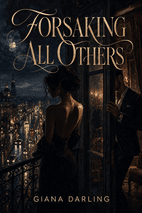
Underneath its plot, Forsaking All Others is really about how family duty, marriage as alliance, and the need to control someone can warp love and identity. It keeps asking what loyalty costs when desire, violence, and deception get tangled up with the people you are supposed to trust.
On this page, you’ll find each major theme tied to concrete moments, from Fiammetta’s arranged marriage to Dario and his surveillance to her Oracle persona and Luca’s impersonation of Dario. It covers freedom and self-reinvention, violence tangled with intimacy and desire, and the messy mix of love, loyalty, sacrifice, and betrayal, plus recurring symbols like Cerberus, masks and aliases, blood, and Dario’s locket.
Major Themes in Forsaking All Others
Duty, family obligation, and marriage as alliance
The novel repeatedly frames marriage as a transaction made for the Family rather than for love. Fiammetta is raised to obey and is married to Dario to end a feud, while Dario and Lando also treat the union as a power arrangement requiring an heir.
- Fiammetta agrees to the arranged marriage because she was raised to contribute to the Family through an advantageous match, and Vincenzo tells her the entire family is counting on her.
- Dario says he agreed to the marriage only because Lando agreed to hand over leadership, and Lando insists an heir will solidify the Sicilian alliance.
- Carla later reveals she told Fiammetta to stop birth control because a child serves the Family’s plans.
Control, ownership, and confinement in marriage
Dario’s marriage to Fiammetta is marked by possession, surveillance, and threats of isolation, and Fiammetta repeatedly resists being treated as property. The novel links romantic tension to control even as Fiammetta seeks her own power.
- Dario calls Fiammetta his property and a “pretty doll to be set upon a shelf,” forbids other men to look at her, and says she is his.
- Fiammetta declares she will not be caged or isolated, and later breaks Dario’s grip, bloodies his nose, and declares she is forsaking him.
- Luca-as-Dario demands “Tell me you’re mine,” while Fiammetta privately insists she is not a bird that could be caged.
Masks, deception, and hidden identity
Almost every major relationship is shaped by concealed identities and double roles. Fiammetta hides behind the Oracle persona, Luca impersonates Dario and is Lo Spettro, Niccolo returns as Orpheus, and allies are revealed as betrayers.
- Fiammetta secretly works as the Oracle while presenting herself as a society wife, and Lando hires the Oracle without knowing she is Fiammetta.
- Luca reveals he is Dario’s identical twin, legally declared dead at nine and raised as the secret assassin Lo Spettro, and that he has impersonated Dario many times.
- Niccolo meets Fiammetta as the masked Orpheus, and Alessia is revealed to have known Fia was the Oracle and to have betrayed her.
Violence intertwined with intimacy and desire
The novel repeatedly places sex beside bloodshed, torture, and danger, making violence part of the characters’ erotic and emotional language. Desire does not replace violence; it is often expressed through or immediately after it.
- Fiammetta kisses blood from Dario’s mouth after he tortures Professor Hewitt, and they have sex in the shower.
- Dario and Fiammetta have sex on the office floor beside Serena’s body after Serena tries to shoot Dario.
- Luca presents Joey’s body to Fia after killing him, and they have sex on the table; later Fia smears Luca’s blood from his wound onto his cock as lubricant.
Freedom, agency, and self-reinvention
Fiammetta’s arc moves from obedient daughter and ornamental wife to a woman who builds secret power, investigates, fights, and rescues. The novel presents reinvention as necessary for survival and as a rejection of the roles imposed on her.
- Fiammetta resolves that Fiammetta Cavallaro is dead and Fiammetta Ferretti has taken her place, vowing to be less docile and carve out her own freedom.
- She creates the Oracle identity, buys her own diamonds, and says she is tired of being the sheep and will become the wolf.
- She shoots Serena to save Dario, later helps rescue Dario at the Church of Santa Maria, and by the end is coboss of the Chicago Outfit.
Love, loyalty, sacrifice, and betrayal
The book contrasts chosen loyalty and found family against betrayals inside the blood family. Characters repeatedly test whether love means possession, protection, sacrifice, or destruction.
- Dario stays in the burning house, sends down his locket with Fia’s photo, tells Luca and Fia to be happy, and dies so Fia’s family can be restored to her.
- Carla, who presents as a compliant wife, shoots Lando, embraces Niccolo, and reveals she has schemed to control the Outfit.
- Hank tells Fiammetta she has more family than the one she married into, and Fia tells her assembled allies “I love you all.”
Symbols and Motifs
Cerberus
Cerberus represents guard-dog protection, vigilance, and Fiammetta’s growing ability to defend herself and her family.
- Dario sends Fiammetta the Doberman puppy Cerberus with a note saying the dog is a weapon and will go where she goes.
- Cerberus tackles the fleeing Tony at the casino, and Luigi holds Tony at gunpoint.
- Cerberus accompanies Fiammetta to the Church of Santa Maria, bites a guard’s wrist, and stays close to her as they escape.
Masks and aliases
Masks and aliases represent hidden selves, deception, and the way characters survive by performing identities. They also blur the line between the person and the role.
- Fiammetta operates as the Oracle, while Niccolo appears before her as the masked Orpheus.
- Luca is Lo Spettro, the Ghost, and impersonates Dario; later Fia calls him a ghost and says a doll and ghost are not so different.
- By the end Luca lives as Dario’s identity, married to Fia, after Dario’s death.
Blood
Blood marks violence, intimacy, and sacrifice in the novel; it is both evidence of cruelty and a substance that binds desire and family.
- Fiammetta cuts into Ricco’s chest and inserts a hollow pen barrel, restoring his breathing after he is shot.
- Fiammetta kisses blood from Dario’s mouth after he tortures Professor Hewitt, and they have sex in the shower.
- Fia smears Luca’s blood from his wound onto his cock as lubricant, and Luca describes the act as a baptism of his own blood.
Dario’s locket
The locket represents Dario’s love, memory, and final sacrifice for Fiammetta and Luca.
- Dario refuses to jump from the burning Wicker Park house and sends down his locket with Fia’s photo.
- Fia later reflects that Dario ended his life to give her family back, and her unborn son Darien is named after that sacrifice.