Expert Secrets Key Takeaways
by Russell Brunson
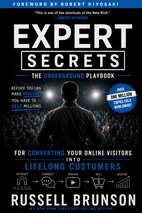
5 Main Takeaways from Expert Secrets
Claim your superpower by embracing your ordinary expertise
Your natural abilities and the things you geek out on feel ordinary to you but are extraordinary to others. Give yourself permission to be the guide by moving through the dreamer, reporter, and contributor phases—building proprietary frameworks from your own patterns and testing them on beta clients.
Build a movement around a future-based cause, not just a product
Your product is simply a tool; the real transformation comes from a shared vision of what’s possible. Create a tribe around a future-based cause, use identity shifts (like “Funnel Hacker”) and milestone awards to sustain momentum, and remember that the journey of who they become matters more than the results they achieve.
Sell belief through the Epiphany Bridge story structure
People don’t buy logic—they buy the feeling of an epiphany. Use the 14-question Epiphany Bridge script to break an old false belief and replace it with a new empowering one, scaling the same structure from a 30-second ad to a 90-minute webinar. Your origin story and four core story types (Origin, Vehicle, Internal, External) are all you need.
Master the Perfect Webinar: one belief, three secrets, stack and close
Every presentation should target a single belief—your Big Domino—and attack the three false doubts (about the vehicle, self, and external forces) with story, strategy, and social proof. Teach the 'what' and 'why' but never the 'how'; then present your Stack Slide with a 10:1 value-to-price ratio and use trial closes to make the final ask feel natural.
Position yourself as the guide, not the hero of your customer’s story
Your dream customer is the hero stuck in their ordinary world. Your role is to meet them there, share your story of epiphany, and present the new opportunity. By stepping into the guide role—using vulnerability, transparency, and your own backstory—you transform from a title into someone they choose to follow.
Executive Analysis
Together, these five takeaways form a complete system for turning any skill or passion into a scalable movement that changes lives. Russell Brunson’s central thesis is that expertise is not about credentials but about becoming a guide who uses storytelling, proprietary frameworks, and a future-based cause to create belief and drive action. The book systematically moves readers from finding their voice and building a movement, to crafting persuasive stories, to selling one-to-many through the Perfect Webinar, and finally to serving as the trusted guide in the customer’s transformation journey.
This book matters because it provides a battle-tested playbook—not theory—for anyone wanting to monetize their expertise without needing a degree or a big budget. Brunson integrates psychological principles (epiphany, identity shift, belief change) with concrete marketing tactics (Stack Slides, trial closes, value ladders). It sits as the persuasion and messaging core within his trilogy alongside DotCom Secrets (funnel structure) and Traffic Secrets (audience acquisition), making it essential for entrepreneurs, coaches, and creators who want to build a loyal tribe and generate revenue by serving others.
Chapter-by-Chapter Key Takeaways
Publisher's Note (Chapter 1)
Expertise develops through five phases: dreamer → reporter → framework creator → servant → expert/guide.
Passion isn’t found; it’s built by experimenting, noticing sparks, and deepening engagement.
The path to mastery mirrors the path to passion—fascination plus deliberate practice.
Leadership starts with a personal spark, not an innate gift.
Try this: Embrace the five phases from dreamer to expert by deliberately experimenting with your curiosities and building frameworks from your patterns, rather than waiting for a preordained passion.
Foreword (Foreword)
The biggest obstacle to becoming an expert is often your own internal voice of inadequacy. Give yourself permission to move forward anyway.
Your natural abilities feel ordinary to you but are extraordinary to others. Embrace the things you geek out on—that’s where your superpower lives.
Stay teachable. A high teachability index keeps you open to new ideas and prevents you from stagnating after you’ve achieved a degree or milestone.
Adopt the identity of a reporter: attend events, host interviews, and launch summits to learn from experts who are ahead of you. This is the fastest way to compress years of knowledge into actionable insights.
Try this: Give yourself permission to claim your natural abilities as extraordinary and actively adopt the 'reporter' identity to learn from experts through interviews and summits.
SECTION ONE: Creating Your Movement (Chapter 2)
Your product is just a tool; the movement is what changes people's lives
Every successful movement shares three things: an expert/guide, a new opportunity, and a future-based cause
Position your offers as new opportunities, not just improvements
Build your tribe around a shared vision that creates lasting momentum
Try this: Build your movement by defining your expert/guide role, identifying a new opportunity, and crafting a future-based cause that rallies a tribe around a shared vision.
Secret #1: Finding Your Voice (Chapter 3)
Expertise isn't about grades or credentials; it's about developing a spark through genuine curiosity and deep engagement.
The biggest hurdle is often your own inner voice of inadequacy—give yourself permission to claim your superpower, even if it feels ordinary to you.
Move through three phases: Dreamer (spark), Reporter (learn from many experts), then shift to Contribution (teach and help others).
Use live events, interviews, and summit funnels to accelerate learning and spot market gaps.
Frameworks turn your patterns into replicable systems that position you as the guide, with your product or service as a step inside the bigger result.
Create a framework by teaching your past self, then test it on yourself before others.
Name your proprietary framework to own the methodology and make it memorable.
Serve beta clients for free to prove your framework works and gather testimonials.
Your results are your certification—you don't need degrees to help others.
Publish daily on a consistent platform to find your voice and build a loyal audience over time.
Your backstory and flaws are not weaknesses—they're the foundation of genuine influence.
Transparency builds trust faster than perfection ever could.
Leadership isn't claimed; it's earned through repeated, honest vulnerability.
Letting your tribe see the real you transforms you from a title into a person they choose to follow.
Try this: Find your voice by publishing daily on one platform, creating a proprietary framework from your patterns, and using transparency about your flaws to earn trust as a leader.
Secret #2: Teaching Your Frameworks (Chapter 4)
Your framework is your savior: It’s a map that keeps you on track and can be taught at any depth (2 minutes to 2 days).
Teach in four steps: Introduce it, share how you earned it (preframe value), outline the strategy (what), then teach the tactics (how), and back it up with proof from others.
Value comes from story first: Never skip telling the pain or process that earned the framework—it’s what makes the pearl worth receiving.
Embedded frameworks allow scaling: Each step can become its own mini framework, letting you expand or condense teaching depending on time.
Collect proof early: Case studies and testimonials from clients are the final key to building belief and transferability.
Try this: Teach your framework in four steps—introduce it, preframe value with your story, outline the strategy, then share the tactics—and always collect client proof to build belief.
Secret #3: The Three Core Markets or Desires (Chapter 5)
Position your offer against an existing market that already has frustrated customers.
A great tagline declares your fit within what people already know.
Products fail not because they're bad, but because founders don't know their market.
"There's no relationship between being good and getting paid. There is a relationship between being good at marketing and getting paid."
Before creating anything, study 20–30 competitors, consume their content, and find your unique angle.
Try this: Position your offer against an existing market by studying 20–30 competitors, finding your unique angle, and crafting a tagline that declares fit within what people already know.
Secret #4: The New Opportunity (Chapter 6)
One switch, many stacks. Only ask customers to change their belief or method once. After that, all further offers should deepen and support that same opportunity.
Avoid opportunity confusion. Creating a whole new opportunity for existing customers can erode trust and scatter their focus.
Stacking is packaging. Look at your core opportunity and think of different formats, levels, or services that help people use it more effectively.
The table rush validated the idea. When 150 people ran to sign up for the certification program instead of the hoped-for 50, it proved that opportunity stacking resonates powerfully with those already on board.
Try this: Stack your offers around a single new opportunity by only asking customers to change one belief, then deepen that opportunity with different formats, levels, and services.
Secret #5: More Money for the Same Framework (Chapter 7)
People will pay significantly more for the same content when the format changes their experience (e.g., $10 book → $97 audio).
Information products turn improvement offers into new opportunities, eliminating price resistance and enabling free customer acquisition.
Increase value by shifting modalities (written → audio → video → live) and by changing fulfillment (DIY → with you → for you).
Create tools (software, supplements, physical products, by-products) from your frameworks to simplify the customer's path to results.
Use the Stack Slide to stack your core product, your framework, and any tools into an offer that feels irresistible and uniquely yours.
Separate brainstorming into information products (keep minimal) and tools (stack them for high perceived value)
Each bonus should directly attack one of three false beliefs: doubt in the vehicle, doubt in self, or doubt in external forces
Aim for a 10:1 value-to-price ratio on your Stack Slide
Build a new Stack Slide for every step of your value ladder; study other markets for inspiration
Try this: Increase revenue by repackaging the same content into higher-value formats (audio, video, live) and creating tools from your framework, then use the Stack Slide to bundle them with a 10:1 value-to-price ratio.
Secret #6: The Future-Based Cause (Chapter 8)
A future-based cause gives people faith in what’s possible, inspired by proof (like Bannister or Reese).
Winning campaigns sell a vision of the future, not an improvement on the present.
Your platform slogan should be open-ended so each follower can project their own dream onto it.
Identity shifts (becoming a “drummer” or a “Funnel Hacker”) are more powerful than goal statements because they change behavior from the inside out.
T-shirts as identity anchors — A physical symbol reinforces the identity shift. It's an investment in belonging.
Manifestos rally and repel — A clear, bold statement of who your tribe is creates focus and filters out those who don't fit.
Milestone awards sustain momentum — Tangible “colored ribbons” turn vague goals into a visible path and create a culture of achievement.
Social mission deepens loyalty — Helping your tribe give transforms them. A cause that mirrors your mission ties everything together.
Two journeys, one movement — Guide your tribe through both the journey of achievement (results) and the journey of transformation (who they become). The second is what makes the first meaningful.
Try this: Anchor your tribe’s identity with a future-based cause slogan, T-shirts, a manifesto, milestone awards, and a social mission—guiding them through both achievement and transformation journeys.
SECTION TWO: Creating Belief (Chapter 9)
The Hook, Story, Offer framework is the diagnostic tool for any funnel issue; if something's broken, it's always one of these three.
Story acts as a preframe that dramatically increases the perceived value of your offer by providing context and emotional weight.
Selling through story makes the decision to buy easier because the customer's belief in the value has been established before they see the price.
Try this: Diagnose any funnel problem by checking the Hook, Story, and Offer—remember that story acts as a preframe that increases perceived value before the price is shown.
Secret #8: The Hero’s Two Journeys (Chapter 11)
Every great story has two journeys: an outer quest for a visible goal and an inner transformation of the hero’s identity. The second is what audiences truly connect with.
Three elements form the core of plot: character, desire, and conflict. Get those right, and the rest falls into place.
Build rapport with the hero early by making them relatable (victim, jeopardy, likable, funny, or powerful) and clearly state their desire—toward pleasure or away from pain.
Introduce a villain (person or belief) to create conflict and deepen the audience’s emotional investment in the hero’s success.
The hero always needs a guide—someone who delivers the epiphany or framework that helps them overcome obstacles.
The story’s payoff is the hero’s transformation, not necessarily the achievement of the outer goal. Often giving up the desire becomes the most powerful moment.
Try this: Structure every story with a relatable hero, a clear desire, a villain (person or belief), a guide who delivers an epiphany, and a payoff that centers on inner transformation.
Secret #9: The Epiphany Bridge Script (Chapter 12)
People don't buy logic, they buy the feeling of an epiphany. The script's power is in making the listener feel the breakthrough, not just hear the facts.
The framework is a sequence of 14 questions divided into 5 phases. It is a universal canvas for any story you need to tell about your product or service.
The "Internal Desire" is the hidden driver of connection. Sharing your internal struggle (fear, inadequacy, wanting to be a good partner) is far more powerful than sharing your external goal (making money).
Scalability is built in. You can use the exact same structure for a 30-second ad or a 90-minute webinar by expanding or contracting the detail in each phase.
The goal is belief change. The story is designed to break an old, false belief (e.g., "You need a unique skill") and replace it with a new, empowering one (e.g., "The how you sell is more important than the what you sell").
Try this: Use the 14-question Epiphany Bridge script to make your audience feel a breakthrough, focusing on internal desires rather than external goals to create deep emotional connection.
Secret #10: The Four Core Stories (Chapter 13)
Every belief is built from an experience → story → belief chain. Reverse it to rewrite false beliefs.
You only need four core story types: Origin, Vehicle, Internal Beliefs, and External Beliefs.
Your origin story is your primary Epiphany Bridge; the other three target specific doubts that arise after initial belief.
Build a story inventory by cataloging each false belief, its origin experience, and your counter-story.
The better you get at telling these stories, the less you “sell”—the stories sell themselves.
Try this: Catalog your four core stories (Origin, Vehicle, Internal Beliefs, External Beliefs) by identifying the false beliefs your audience holds and crafting counter-stories from your own experiences.
SECTION THREE: “10X Secrets”: One-to-Many Selling (Chapter 14)
One-to-many selling isn't about charisma; it's about structuring a presentation that resolves objections for a large audience at once.
Your virtual stage—funnels, webinars, videos—can replicate the power of a live keynote and scale your impact.
The Perfect Webinar framework combines your offer (Stack Slide) with your stories (Epiphany Bridges) to create a seamless, persuasive experience.
Leverage comes from recording and automating your presentation, not repeating live events.
Try this: Shift from one-to-one selling to one-to-many by structuring a presentation that resolves objections for a large audience at once, then record and automate it for scale.
Secret #11: The Perfect Webinar Framework (Chapter 15)
One belief, not many: The entire presentation is designed to get the audience to believe a single thing—that your opportunity is the key to their desired result.
Teaching tactics kills sales: In the selling presentation, teach the what and the why, but never the how. Leave the “how” for the offer.
The three secrets attack false beliefs: Each secret targets a specific doubt (the vehicle, internal ability, external obstacle). Use story, strategy, and social proof to break each belief.
Time ratios matter: Whether you have 90 minutes or 30, keep the same proportional structure. More time just allows deeper stories.
The Stack and closes convert: After breaking beliefs, present your offer with a structured stack and proven closes to drive action.
Mastery comes from testing: Brunson spent years testing on stages and online. The framework is battle‑tested across many markets.
Try this: Design your Perfect Webinar to target one core belief, use three secrets to attack false doubts (vehicle, self, external), teach the what and why but never the how, and finish with a Stack and closes.
Secret #12: The Big Domino (Chapter 16)
Find the One Thing: Every offer has a single belief that, if accepted, makes all objections irrelevant. Identify it before you write a word.
Use Modus Ponens Logic: Structure your argument so that accepting premise A (your new opportunity) logically forces conclusion B (they must buy from you).
Your Big Domino Must Be a Blue Ocean: If your belief is about an existing crowded market, the domino won’t fall—there are too many alternatives.
First 15 Minutes = The Knockdown: Use a title hook, rapport building, a clear goal, the Big Domino reveal, qualification, and your origin story to plant that belief early.
Simplicity Wins: More points = lower conversions. Resist the urge to stack arguments. One powerful domino is worth a thousand weak ones.
Try this: Identify your Big Domino—the single belief that makes all objections irrelevant—and knock it down in the first 15 minutes using Modus Ponens logic and a blue-ocean framing.
Secret #14: The Stack and Closes (Chapter 18)
Your closing slides must recap the entire offer line by line to reinforce value.
Urgency/scarcity bonuses are essential for getting immediate commitments—never skip them.
Keep your call-to-action slide visible during Q&A, and answer questions in a way that allows you to pitch again and again.
Use the “You’re probably thinking…” technique to dissolve hidden objections.
The Stack is not just a technique—it’s a fundamental mindset for converting interest into action.
Try this: Recap your entire offer line by line on closing slides, include urgency/scarcity bonuses, use the “You’re probably thinking…” technique to dissolve objections, and keep the call-to-action visible during Q&A.
Secret #15: Trial Closes (Chapter 19)
Trial closes are simple yes/no questions that get audiences nodding throughout your presentation, making the final ask feel like a natural progression.
Testing them on an existing webinar increased revenue per registrant by over 70% with zero other changes.
The 16 mini closes each target a specific objection or mindset shift; choose the ones that fit your offer and flow naturally.
The most powerful closes come from your own Epiphany Bridge stories that challenge a false belief about why someone shouldn't invest.
Use a close before introducing each new element in the Stack, and don't be afraid to stack two or three in a row.
Try this: Insert trial closes throughout your presentation—simple yes/no questions that get audiences nodding—and test them to boost revenue per registrant by over 70%.
SECTION FOUR: Becoming Your Dream Customer’s Guide (Chapter 20)
Shift your mindset from being the hero of your own story to becoming the guide in your customer’s story.
Your dream customer is stuck in their “ordinary world”; you must meet them there and offer a compelling reason to leave.
The three phases of their journey are backstory, journey, and new opportunity—each requires a different action from you.
Your presentation should always introduce you as the guide, share your story for epiphany, and present the new opportunity.
The customer is always the hero; your brand’s role is to lead, not to be the star.
Try this: Step into the role of guide by meeting your dream customer in their ordinary world, sharing your epiphany story, and presenting a new opportunity that positions them as the hero.
Secret #16: Testing Your Presentation Live (Chapter 21)
The replay campaign is a separate sales engine; use urgency and scarcity to drive action.
PDFs and slide summaries cater to skimmers who won’t watch the full replay.
Close the cart decisively on Sunday midnight—no extensions.
After every close, restart the cycle immediately to compound improvements.
Never automate until you’ve run the live webinar dozens of times and handled every objection.
Persistence through early failures (even zero attendees) can lead to life‑changing results.
Try this: Test your presentation live multiple times before automating it, use replay campaigns with urgency, close decisively at Sunday midnight, and restart the cycle immediately to compound improvements.
Secret #17: The Perfect Webinar Shortcut (Chapter 22)
A Perfect Webinar can be built in 15 minutes using nothing but a whiteboard and the core framework questions.
Going live on social media lets you bypass the typical webinar funnel losses and get straight in front of an audience.
Record the live session; if it converts, promote it as a video ad for ongoing sales.
This shortcut is best used after you’ve practiced the script in a private setting first.
The same structure that produces a $250,000 contest win can be modeled by anyone for their own offers.
Try this: Build a Perfect Webinar in 15 minutes using a whiteboard and the core framework questions, go live on social media to bypass funnel losses, then record the session to run as a video ad.
Secret #18: The 5-Minute Perfect Webinar (Chapter 23)
The Perfect Webinar framework is universal—it works for physical products, low-ticket offers, and e-commerce when properly adapted.
Lower price points demand shorter presentations. A 5-minute version can convert where a 90-minute one fails.
The compressed script follows the same psychological flow: open with a misconception, deliver three secrets, handle objections, present the offer, and add urgency.
Use the 5-minute Perfect Webinar for Facebook Lives (to fuel ads), landing page videos, and video sales letters for products under $100.
Jaime Cross’s story is a masterclass in adapting proven frameworks to your specific business model rather than assuming it won’t work.
Try this: Adapt the Perfect Webinar framework for low-ticket offers by compressing it into 5 minutes—same psychological flow, but shorter stories and faster close—and use it for Facebook Lives and VSLs.
Secret #19: Plugging “Expert Secrets” into Your Value Ladder (Chapter 24)
Your epiphany frameworks and stories are not just for presentations—they fuel every part of your marketing: ads, emails, lead pages, unboxing pages, VSLs, webinars, and product launches.
The format adapts to the Value Ladder rung: 5-Minute Perfect Webinar for low-ticket unboxing, full Perfect Webinar for high-ticket presentations, and email sequences that mirror the webinar structure.
Every ad, email, and page should weave in your personality and the five-phase epiphany structure to keep your voice as the guide consistent throughout the customer’s journey.
The goal is to guide, not just sell—and these placements ensure your dream customer experiences the transformation step-by-step, from hook to close.
Try this: Plug your epiphany frameworks and stories into every marketing touchpoint—ads, emails, lead pages, unboxing pages, VSLs—matching the format to the value ladder rung to guide customers step-by-step.
Conclusion (Conclusion)
The deepest fulfillment comes from being a guide in others’ journeys. Hearing a client’s success story can move you more than your own achievements.
This book is a playbook, not a novel. Keep it close and refer to it often as you implement the strategies.
Your message matters. If even one more person is reached because of what you learned here, the book is a success.
The trilogy approach: Use DotCom Secrets for funnel structure, Expert Secrets for persuasion, and Traffic Secrets for attracting the right people.
You’re just one funnel away from changing lives—yours and those of the customers waiting for you.
Try this: Keep this book as a playbook you refer to often, and remember that your message matters—you’re just one funnel away from changing lives, yours and your customers’.
Continue Exploring
- Read the full chapter-by-chapter summary →
- Best quotes from Expert Secrets → (coming soon)
- Explore more book summaries →