Etna Quotes
by Paul Yoon
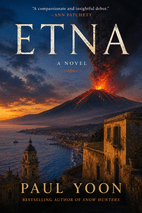
These lines from Etna move between spoken promises, quiet narration, and the raw way a person talks to herself inside her own head. Some are words exchanged between people trying to protect each other. Others feel like confessions, memories, or questions that keep circling back. What makes the book so quotable is how it carries loss and tenderness in the same breath.
Readers will find images that stay with them long after the page is turned, especially moments where the natural world gets tangled up in human grief. The sentences are simple but loaded. They do not explain everything. Instead, they open a door into a strange, hurt, hopeful place and trust you to feel your way through.
Top Quotes from Etna
“So, promise me this: survive. Both of you. Look out for each other. And when this is over, come find me. We'll go to Sicily together.”
— Soojin
Soojin names Etna and Fuji and urges them to survive the war and find her afterward.
The impossible promise of Sicily holds tenderness against the violence of war. It sounds like hope, and in hindsight like grief.
“How long do you think it takes to destroy a city?”
— Semeru
Semeru, who stayed in the city through the war, asks this while watching children play across the river.
A street dog’s plain question cuts through human war narratives and leaves the reader to measure what cannot be measured.
“The butterfly was the color Fuji’s eyes had once been, and it had black dots all over. It climbed out and balanced itself there, on the edge of the eye socket, like it had just come out of a tunnel and was seeing the world for the first time.”
A butterfly climbs out of the empty eye socket of a dead dog in the abandoned house, while Etna and Fuji watch.
The horror of the dead dog is transformed into a luminous, fragile image, capturing both loss and brief, impossible renewal.
“To remember there was a place before all this where I used to live. To remember there was a place where there were days that passed into other days peacefully, peacefully, without terror, and where other animals I knew and cared about used to live.”
— Etna
After Soojin says there is no home to go back to, Etna explains why he still wants to return.
The litany of 'To remember' gives voice to the ache for a peaceful pre-war world; it makes home not just a place on a map but in time.
“I was born near water. I can sense the deepness of it even before I open my eyes. I can hear the deep. The far deep.”
— Etna
Etna, newly arrived on the coast, senses the sea before she opens her eyes.
It immediately establishes an elemental, sensory voice and ties Etna's identity to water.
“You're here. You're breathing. You arrived and you survived.”
— the bird
The enormous bird comforts Etna after Etna wonders whether she is imagining all this.
This quiet reassurance distills survival into the simple, undeniable fact of being alive.
“I dream about being unable to find somewhere to land. I'm high in the air and peer down and there is nothing. Not even water. I mean, literally. There is nothing. I'm the last thing left.”
— the bird
The bird tells Etna what she dreams about.
It is a spare, frightening vision of displacement, aloneness, and having nowhere left to go.
Themes Behind the Quotes
One clear thread is survival. These lines are full of people trying to get through something enormous, and they are honest about what that costs. There is fear, exhaustion, and the instinct to protect the few people you love. Survival is not painted as heroic in an obvious way. It is smaller, stranger, and often shaped by promises made in the dark.
Another thread is memory and the weight of place. Characters carry old homes, old losses, and old animals with them. They recall peaceful days before destruction and cannot stop noticing how the world has changed. At the same time, a quieter theme runs underneath: staying connected to another person, even when distance or disaster gets in the way. Longing and tenderness live side by side with grief.
Quotes by Chapter
1. The Field
“I didn’t want a new home. I wanted to go back to the farm. I began to pant.”
— Etna
Etna has just been called a war dog and realizes she is being taken away from the farm.
The plain repetition makes the homesickness feel elemental. The panting turns that longing bodily, not just sentimental.
“It was in the third year, while we were on furlough in the mountains, when Fuji ran off one morning. Without warning, without explanation. Without telling me where she was going. If she knew where she was going. I never saw Fuji again.”
— Etna
Etna remembers the day Fuji vanished during the third year of the war.
Fuji’s disappearance is told in stunned, staccato sentences, and the hesitant “If she knew where she was going” leaves the loss unexplained. “I never saw Fuji again” lands with devastating finality.
“She was the one who fought the fiercest. Who was braver than the rest of us. Who fought and kept fighting. But on that first day together, Fuji had been much more frightened than I was.”
— Etna
Etna reflects on how Fuji became the fiercest dog in their unit despite her fear on the day they met.
The contrast between Fuji’s earlier fright and later ferocity makes her courage feel earned. The quiet final sentence deepens the loss of her.
2. The City
“I was aware, with a new intensity, of my aloneness.”
The dog narrator stops under the vast night sky after calculating how far he still must travel.
It isolates a flash of existential grief in an animal voice, and the vast landscape suddenly feels intimate.
“Every time I heard a human singing it felt like I was hearing the song for the first time. Maybe I was. Maybe every human had their own song they carried with them, like it was another heart, the way the men in my unit sang by themselves, wearing their headphones at night.”
The narrator listens to people sing in the cargo train as he travels toward the city.
It turns song into a private, portable heart and quietly conveys the narrator’s loneliness and longing for a voice.
“I've never seen a well, he said. In person. I just know what it is because of the dream.”
— Semeru
Semeru tells the narrator about a recurring dream of a well in the forest.
The line makes the shared dream a matter of faith rather than memory, suggesting that the dogs carry a common truth they cannot explain.
3. The Mountains
“This was the town where my mother was born.”
— Jason
In an abandoned house in a destroyed town, Jason sits at a piano and reveals that the place is his mother's birthplace.
A soldier's single private sentence makes inherited history tangible; even the most unspoken character carries loss and memory.
“Every time I see a goddamn leaf on the ground here, I think about that American dog and about talking to her. And I don’t want to think about her anymore. Do you understand, my darling?”
— Soojin
Soojin tells Semeru and Etna about a dying dog she once spoke with, whose memory still haunts her.
An ordinary leaf becomes an unavoidable trigger for grief; Soojin's gift of understanding animals is also a sentence to keep remembering.
4. The Sea
“They came and they died. And you don’t know how to feel about that. Or you're feeling many things right now. All these things that humans love to write poems about. Have you ever listened to a poem? That's how humans really sing, isn’t it?”
— the bird
The bird speaks about Etna's lost pack, Semeru and Hong, who came all the way with her.
The bird names the tangled grief of survival and the way poetry holds contradictory feelings.