Email Storyselling Playbook Quotes
by Jim Hamilton
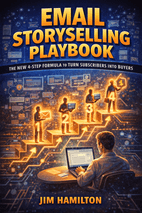
Here are the sharpest lines from Jim Hamilton's Email Storyselling Playbook. Each one captures a key insight about building a newsletter you control and using stories to drive sales without being pushy.
You will find ideas about why helpful how to content can actually hurt you, why repeating the same message is more effective than offering new ones, and why your subject line matters more than the email body. The book is quotable because it delivers hard won truths in simple, memorable packages.
Top Quotes from Email Storyselling Playbook
“Social media is rented land. Platforms like Facebook, YouTube, and LinkedIn have only one goal: To keep you on-platform for as long as possible.”
Jim Hamilton explains why social media is a risky foundation for building an audience.
It vividly captures the precarious nature of building an audience on rented land, making a compelling case for email ownership.
“An email list is something you can take with you anywhere you go. You OWN the relationship with your subscribers.”
Jim Hamilton defines the core advantage of an email list over social media followers.
It empowers readers by emphasizing ownership and control, a fundamental shift from platform dependency.
“Ironically, the better your ‘how-to’ info is, the more you'll suffer.”
Jim Hamilton warns against giving away too much free value in traditional newsletters.
This counterintuitive insight challenges conventional wisdom and highlights a key reason Email Storyselling outperforms.
“Your audience doesn’t need to hear 100 different ideas to buy. Instead, they need to hear the SAME core messages repeated in different ways until they resonate.”
Introduction to the 10 Commandments method.
It flips the obsession with novelty on its head, teaching that repetition of foundational truths is more persuasive than endless new concepts.
“Content drives consumption. Copywriting drives action. You need both to achieve Newsletter Freedom.”
One of Jim's 10 Commandments.
It draws a clear, actionable distinction between two essential skills, giving readers a simple framework for balancing engagement and conversion.
“It doesn’t matter how good your email is if your subject line sucks.”
The author recalls one of his 10 Commandments.
A blunt, unforgettable truism that forces readers to prioritize subject lines—the first gate to any email’s success.
“Your mission, should you choose to accept it, is to write one story-driven email a day for the next 30 days.”
The author presents the core challenge of the chapter.
This direct, Mission: Impossible-style call to action makes a daunting daily writing habit feel exciting and achievable.
Themes Behind the Quotes
A major theme is owning your audience through email rather than renting attention on social media. This gives you sovereignty as a creator. Another key idea is that too much free how to content can hurt your business. Stories are more effective for selling, and you need to repeat your core messages until they stick with your readers.
Another theme is the craft of writing emails that get results. This means making your writing easy to read, using curiosity in subject lines, and practicing daily. Ideas come from what you consume, and planning your topic before you sit down helps your mind work on it in the background. Remember that quantity of practice leads to quality, and it is actually a good thing if you are not a natural writer.
Quotes by Chapter
Introduction
“Think of your email newsletter as a vehicle for achieving sovereignty as a creator.”
Jim Hamilton encourages readers to view their newsletter as a path to independence.
This aspirational framing reframes email marketing as a means to freedom, motivating action.
CHAPTER 1: The 4-Step Formula
“The more relevant your story is to the topic of your newsletter, the better it will convert.”
From Step 1: Story, explaining the importance of relevance.
It gives a clear, actionable principle for email marketers to maximize conversion by aligning stories with audience interests.
“Coming up with a story is about being an observer and tuning into what's happening around you, whether that means literally right in front of you, or in your general area, or within your industry, or in the world at large.”
From Step 2: Lesson, describing how to find stories.
This expands the concept of storytelling to everyday observation, making it accessible and practical for anyone.
“By this point, the heavy lifting has usually been done. So the pitch is casual, not pushy.”
From Step 4: Call to Action, explaining the tone of the pitch.
It reinforces that a story-driven email builds trust, allowing a natural, non-aggressive call to action.
“But generally speaking, the shorter, the better.”
Final advice in the chapter about email length.
This is a universal copywriting wisdom that resonates with anyone writing for attention spans.
CHAPTER 2: Ideation
“Almost every idea you have is downstream of what you consume.”
Chapter opening quote attributed to James Clear.
This line succinctly captures the core premise of ideation—that creative output depends entirely on what you feed your mind, making it a powerful reminder to be intentional about inputs.
CHAPTER 3: Outlining
“When you try to sand off all the rough edges, you can inadvertently eliminate the authenticity or emotionally resonant content from an email.”
Author explains the inverse relationship between time and quality.
It warns against over-editing and highlights the value of preserving raw, emotional truth in writing.
“So the secret is: Knowing what you’re going to write about BEFORE you sit down to write.”
Author reveals the key to writing fast and overcoming writer's block.
This captures the core insight of the chapter—that clarity through outlining enables speed and eliminates the blank page struggle.
“When you come up with an idea and sit down to write it later, whether it’s an hour, a day, or a week later, your mind has been working on it in the background.”
Describing how subconscious processing helps writers prepare.
It empowers writers to trust their incubation period and realize they've already started 'writing' in their head.
CHAPTER 4: Writing
“Quantity brings quality. The more you do, the better you get.”
Opening epigraph attributed to Alex Hormozi.
This succinctly captures the core philosophy of practice leading to mastery, motivating readers to keep writing.
“It's actually a GOOD thing if you're not a natural writer or storyteller.”
The author addresses the reader's concern about lacking natural writing talent.
It reframes a perceived weakness as an advantage, reducing anxiety and encouraging non-writers to try.
“Your goal is to reduce the cognitive load necessary to read your writing.”
Instruction on how Email Storysellers write.
This principle is the foundation of persuasive writing in email marketing, emphasizing clarity over complexity.
“The easier it is to read, the more people will read it. And the more people who read it, the more people will buy from it.”
Explanation of the direct benefit of reducing cognitive load.
It creates a clear, logical chain from readability to sales, making the strategy compelling and actionable.
CHAPTER 5: Subject Lines
“Curiosity means teasing an insight or takeaway without revealing what it is.”
The author defines curiosity in the context of subject lines.
A clear, actionable definition that demystifies a powerful technique, making it easy for readers to understand and apply.
“The more curiosity you create in your subject line, the more clicks and sales your email will get.”
The author summarizes the bottom line after showing examples.
A direct, cause-and-effect statement that ties the abstract concept of curiosity to concrete business results, motivating immediate action.
CHAPTER 6: the 30-day challenge
“Fresh ideas are allergic to the blank page.”
Step 1 of the challenge explains why batching story ideas first is effective.
The metaphor is witty and instantly memorable, offering a simple antidote to writer’s block: start anywhere.
“Remember: the faster you start getting your reps in, the better you'll get and the more money you'll make.”
The author gives final encouragement to implement the system.
This line ties practice directly to profit, motivating readers to stop overthinking and start executing immediately.