Eat Your Ice Cream Quotes
by Ezekiel J. Emanuel MD
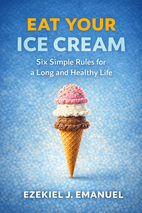
Looking for the best quotes from Eat Your Ice Cream by Ezekiel J. Emanuel MD? Below are the lines that stand out most across the book.
The quotes are organized by chapter, each with a short note on where it appears and why it stands out.
Top Quotes from Eat Your Ice Cream
“Remember the first rule of life: We're all going to die. You can waste all your time trying to extend your life by a few minutes, obsessing over scores of adjustments to your diet or exercise routines, or you can follow six straightforward, smart wellness behaviors and make the time you have healthier and more meaningful.”
The author says this to a woman at a party who asked about alcohol's health benefits.
It encapsulates the book's core message to prioritize meaningful living over obsessive longevity efforts, grounding the reader in mortality and simplicity.
“Our goal should not be to “outlive” as many people as possible. Instead, the goal should be to live a healthy and fulfilling life.”
The author critiques longevity experts who frame wellness as a competition to outlive others.
It reframes the purpose of wellness from competitive longevity to a fulfilling life, aligning with the book's philosophy that wellness is a means, not an end.
“Happiness is not a goal. .. it's a by-product of a life well lived.”
The author explains why happiness and stress are not separate goals in his wellness rules, quoting Eleanor Roosevelt.
This timeless wisdom reminds readers that true happiness arises naturally from living well, not from direct pursuit.
“Change is hard. After all, if the only thing standing between you and perfect health was being told to stop drinking soda and join a running club, we'd all be immortal by now.”
The author discusses the difficulty of adopting new habits and the power of inertia.
It humorously acknowledges human resistance to change while emphasizing that wellness requires more than just knowledge—it requires sustained effort.
“You don’t need to pack yourself in bubble wrap. Just avoid the things that carry a high risk of serious irreversible harm —dying, damaging your brain, becoming paralyzed, or losing the ability to live consciously and deliberately— without taking extra precautions.”
The author explains the balance between avoiding unnecessary risks and not eliminating all risk from life.
This line perfectly captures the chapter's core philosophy: be sensible, not paranoid. It's memorable because it uses vivid imagery to define what 'being a schmuck' truly means in the context of health and longevity.
“Struggling with an addiction doesn't make you a schmuck—but giving up does.”
The author discusses the difficulty of quitting smoking and the importance of persistence.
It offers a compassionate yet motivating message that resonates with anyone who has faced a tough habit. The sharp contrast between struggling and giving up makes it both quotable and empowering.
Quotes by Chapter
Chapter 1: Don’t Be a Schmuck: Avoiding Self-Destructive Risks
“Trading one schmuck move for another is still schmucky.”
The author argues against using vaping as a substitute for smoking, citing evidence that it doesn't help and may cause new harm.
This pithy, almost proverbial line sums up the folly of swapping bad habits. Its bluntness and rhythmic repetition make it easy to remember and apply to many situations.
“I've learned that my Dad's saying holds true for wellness, health, and longevity. Just as it is easy to get distracted by a car's polished, shiny exterior before ensuring its basic functionality, it's easy to get lost in the flood of wellness tips, diet fads, and exercise recommendations while overlooking the first true rule of a life well lived: Don’t be a schmuck.”
The author reflects on the lesson from buying a broken car and applies it to health advice.
This passage ties the personal story to the universal message, making the abstract concept concrete. It reminds readers to prioritize fundamental, evidence-based habits over trendy gimmicks.
Chapter 2: Talk to People: Cultivating Family, Friends, and Other Social Relations
“Good relationships are the single strongest predictor of both a happy life and a long life.”
The author summarizes the central conclusion of the Harvard Study of Adult Development.
This line distills decades of research into a single, memorable claim that challenges conventional wellness priorities. It empowers readers to invest in relationships as a direct path to longevity.
“Loneliness kills, while strong social relationships promote up to a 50% increase in survival.”
The author presents the stark results from multiple long‑term population studies.
The dramatic contrast between 'loneliness kills' and a '50% increase in survival' is both alarming and hopeful. It underscores the life‑or‑death stakes of social connection.
“No amount of kale or number of steps or hours of sleep can replace the importance of building and maintaining good relationships for wellness and longevity.”
The author argues against the common obsession with physical wellness at the expense of emotional wellness.
The vivid, relatable examples of kale, steps, and sleep make the point unforgettable. It reframes relationships as non‑negotiable, not optional extras.
“Spending time with people we care about is immediately enjoyable and increases life’s fulfillment. No willpower should be required: Nurturing meaningful relationships and cultivating supportive social networks make us happy right now and healthy over a lifetime.”
The author explains why prioritizing social connection does not require short‑term sacrifice.
This quote offers a liberating perspective: the best longevity habit is also the most pleasurable. It removes guilt and motivates readers to seek joy in relationships.
Chapter 3: Expand Your Mind: Staying Mentally Sharp
“I would rather be dead than have a healthy heart, lungs, kidney, and liver without the ability to think, read, or engage with my family.”
The author shares his personal fear of mental decline.
This stark statement underscores the value of cognitive health over mere physical survival, resonating with readers who prioritize quality of life.
“It is therefore that the older I grow the more apt I am to doubt my own Judgment and to pay more Respect to the Judgment of others.”
Benjamin Franklin speaking at the Constitutional Convention, acknowledging his own fallibility.
This line exemplifies humility and intellectual openness, encouraging readers to remain open to changing their minds.
“There is emerging consensus that ‘what is good for our hearts is also good for our heads,’ making aggressive control of behavioural and cardiovascular risk factors as early as possible key targets for clinical practice and public health’—a critical intervention to slowing down mental deterioration and dementia.”
Researchers summarizing the link between cardiovascular and cognitive health.
The memorable phrase 'what is good for our hearts is also good for our heads' provides a clear, actionable takeaway for holistic wellness.
“Most Americans are currently eating their way to being less mentally sharp sooner as they age.”
Author's conclusion after discussing ultra-processed food consumption.
This blunt warning connects daily diet choices to long-term mental sharpness, motivating behavior change.
Chapter 4: Eat Your Ice Cream: Consuming Healthy Food and Drink
“We Americans are fat. Over 40% of adults are obese (with 10% of adults being severely obese) and another 30% are overweight. That means that less than a third of Americans have a healthy weight.”
The author presents a stark statistic about the obesity epidemic in the United States.
This line shocks readers with the sheer scale of the problem, making it impossible to ignore the public health crisis.
“We ate ourselves into this mess, and we are going to have to eat ourselves out of it.”
The author summarizes the cause and solution of the obesity crisis after discussing calorie increases.
The clever wordplay makes the point memorable, emphasizing both personal and collective responsibility in a succinct, quotable way.
“Both sugar-sweetened and diet sodas are bad for your health. Don’t drink them.”
The author gives a clear recommendation after explaining the harms of both regular and artificially sweetened sodas.
This delivers a simple, actionable takeaway that cuts through confusion, urging readers to eliminate a major source of empty calories.
“How could a prominent, well-educated, health policy expert who knows the medical literature serve his children frozen waffles and syrup—the epitome of junk food?”
The author recounts a moment of disbelief when a colleague revealed he feeds his children frozen waffles for breakfast.
This rhetorical question highlights the gap between knowledge and behavior, even among experts, prompting readers to examine their own dietary choices.
Chapter 5: Move It!: Exercising Well and Regularly
“The real secret of exercise is simple. You don’t have to be an Olympian to reap the benefits of movement. Be like Speedy, and just do some.”
The author concludes his father's story and offers a straightforward call to action.
It demystifies exercise, making it accessible to anyone, and the personal touch of 'Speedy' makes it memorable and motivating.
“Exercise is a magical path to wellness and longevity. Plus, if you do it right, it is not arduous or burdensome but fun and fulfilling.”
The author describes the positive view of exercise that counters common reluctance.
It reframes exercise from a chore to an enjoyable gift, appealing to readers who seek both health and happiness.
“Your head is the most valuable thing you have!”
The author warns against contact sports that risk head injuries.
This blunt, memorable line drives home the importance of protecting brain health over athletic glory.
“The biggest gains in reducing the risk of death are found in people who go from no activity to doing some moderate exercise.”
The author explains the diminishing returns of exercise intensity.
It empowers sedentary readers by showing that even small, manageable increases in activity yield the greatest health benefits.
Chapter 6: Sleep Like a Baby: Getting the Rest You Need
“Nothing that leaves an animal unconscious, defenseless, and exposed to myriad dangers would have been conserved over the millions of years of mammalian history and tens of thousands of years of human evolution if it was not absolutely essential.”
The author refutes the idea that sleep is a waste of time, using evolutionary reasoning.
This line powerfully argues that sleep must be essential because evolution would not have preserved such a vulnerable state for millions of years.
“Studies have found that staying awake for 17 hours causes a similar impact on your functional abilities as having a blood alcohol level of 0.05%—what is technically called being “buzzed.””
The author explains the immediate cognitive effects of sleep deprivation.
This vivid comparison makes the danger of sleep deprivation tangible and relatable, showing that moderate sleep loss is akin to being buzzed.
“It is much, much better to forget what the sleep tracker “tells” you and listen to your body's natural cues.”
Advice from the author on how to improve sleep quality without fixating on wearable data.
This line cuts through the modern anxiety around sleep tracking and reminds readers to trust their own bodily signals over technology.
“Cultivating social relations and staying mentally engaged are even more important than eating well or exercising.”
The author argues that social and mental wellness are often overlooked in favor of physical health.
It challenges the common cultural focus on diet and exercise, elevating relationships and cognitive engagement as the real cornerstones of a long, healthy life.