Eat the Donkey Quotes
by Anthony Reeves
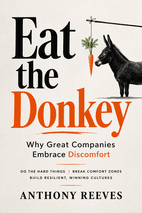
These quotes come from Anthony Reeves' book that blends personal stories with hard won business insights. They cut through conventional wisdom with brutal honesty. Many are short, punchy, and designed to make you stop and think. You will find sharp observations about foundations, principles, and the hidden cost of staying average.
What makes the book so quotable is its refusal to sugarcoat hard truths. Ideas like the title metaphor or the unexpected pairing of comfort and discomfort challenge our usual thinking. Each line feels earned through experience, not theory. They are the kind of quotes you underline and return to when you need clarity or a fresh perspective.
Top Quotes from Eat the Donkey
“In business, the rot sets in long before the numbers show it.”
The author transitions from Outback lessons to modern corporate dynamics.
It delivers a stark warning about the invisible decay of complacency, a metaphor that is immediately understandable and hauntingly true for leaders and teams.
“Growth demands discomfort. Eat the donkey. Take on what looks impossible, one brutal, honest bite at a time, and let the foundations you were raised on carry you further than comfort ever could.”
The author concludes the introduction with a direct call to action.
This is the book's core thesis in vivid, memorable language—a rallying cry that reframes difficulty as nourishment and ties personal roots to professional endurance.
“Looking for freedom, we found slavery.”
Artist Vitaly Komar reflecting on the experiment where market research led to identical paintings across different countries.
It captures the ironic tragedy of optimization: the more we chase what people say they want, the more we lose the very freedom and distinctiveness that creative expression should offer.
“You can’t optimize your way to differentiation.”
The author reflects on the limitations of optimization in business strategy after discussing McKinsey's consulting methodology.
This sharp, counterintuitive insight challenges the conventional obsession with optimization, reminding readers that true distinction requires sacrifice.
“Average is not a sustainable position. It's not a Foundation on which you can build. It's not a safe harbor to rest in. Average is where companies go to vanish into irrelevance, surrounded by other average companies, all wondering why customers can’t tell them apart.”
The author delivers a final warning about the danger of mediocrity near the end of the chapter.
The repetitive structure and stark imagery of vanishing into irrelevance make the concept of average feel tangible and dangerous, compelling readers to reject mediocrity.
“You can aim for something acceptable and achieve something invisible. If you try to please everyone, it will ultimately matter to no one.”
The author offers closing advice on brand differentiation and strategic focus.
These two sentences encapsulate the book's core message in a memorable, actionable pair that contrasts invisible safety with meaningful impact.
“This is the hard part about a brand: sometimes you have to kill what built you to save what matters.”
From the Burberry case study, after describing how they removed the iconic check pattern to protect their brand.
It captures the painful but necessary strategic decision to sacrifice a beloved asset for long-term survival, resonating with anyone facing tough brand choices.
Themes Behind the Quotes
One central theme is the tension between a stable foundation and the need for evolution. The book argues that lasting growth comes from knowing what never changes while being willing to let go of what no longer serves you. Another major theme is that discomfort is not an obstacle but a requirement for real progress. Comfort and struggle are portrayed as partners, not opposites, and the path to significance is paved with difficult choices.
A second theme is the danger of optimization and mediocrity. The quotes repeatedly warn against trying to please everyone or following best practices into irrelevance. Instead, they advocate for bold, distinctive positions that may seem risky but are the only way to stand out. Principles come with a cost, and that cost is what makes them meaningful. Sacrifice and commitment define what a company or person truly stands for.
Quotes by Chapter
Introduction
“This beautiful nothingness is where I learned everything that matters about exploration and suffering.”
The author recalls the stark Outback landscape of his childhood.
It captures the paradox that emptiness and hardship can be the richest teachers, a counterintuitive truth that resonates with anyone who has found meaning in struggle.
“That's how committed my parents were to the idea that exploration mattered more than comfort, and that seeing what was beyond the next ridge was worth any price.”
After the family ate donkey meat that had spoiled overnight, the author reflects on his parents' priorities.
This line encapsulates the extreme trade-off between safety and discovery, framing sacrifice as a deliberate choice rather than mere recklessness.
1. The Convergence Cascade
“When you optimize for what everyone says they want, when you test your way to consensus, or when you follow best practices to their logical conclusion, you don’t create something everyone loves. You make something nobody hates—and nobody remembers.”
The author summarizing the failure of Quibi and the broader effect of convergence.
This line crystallizes the central warning of the chapter: safety and consensus kill memorability, leaving only mediocrity.
“The lesson: when everyone else surrenders to the same constraints, the company that engineers around them owns the market's only distinctive position.”
After the Porsche 911 case study showing how they resisted aerodynamic conventions.
It delivers a sharp, actionable takeaway—distinction comes from refusing the easy path, not from following the herd.
2. Welcome to Average
“When strategic thinking can be automated, when optimization can be achieved by anyone with a laptop, and when best practices spread instantly, average becomes obsolete.”
The author summarizes the impact of AI on business competitiveness in the chapter's conclusion.
This vivid sentence paints the future where AI democratizes strategic thinking, making average an unsustainable position and serving as both a warning and a call to action.
3. Foundations
“You can renovate a building, but you can’t ignore its foundations. Add floors, change the facade, reimagine the interior—if the foundations crack, everything fails.”
The author uses a building metaphor to explain why foundational principles are non-negotiable for an organization.
It vividly illustrates that ignoring foundational issues leads to total collapse, making the abstract concept of organizational foundations concrete and memorable.
“The first stage of decline is forgetting. Companies forget the discomfort that forged their resilience. They drift from their foundational truths, replacing conviction with comfort.”
The author discusses the pattern of corporate decline, referencing Jim Collins' work on how great companies fall.
This captures the insidious nature of decline — not a sudden failure but a slow erosion of core identity — and serves as a powerful warning against complacency.
“Your Foundation is the unchanging truth that lets you transform without losing yourself.”
The author defines what a Foundation is near the end of the chapter.
It is a concise, memorable encapsulation of the chapter's central thesis, emphasizing stability as a prerequisite for meaningful change.
4. Principles
“When customers see you sacrifice profits to stay true to Principles, they stop comparing your prices to competitors. They're no longer buying a transaction. At least in some part, they're buying what you stand for.”
The author discusses the impact of Airbnb's decision to house Ukrainian refugees for free.
This line crystallizes how principled actions transform customer relationships from transactional to deeply loyal, making it a memorable insight for any business leader.
“Principles cost something regardless of whether they're noble or reprehensible.”
The author contrasts a racist restaurant's enforced principle with CVS's $2 billion tobacco decision.
It powerfully distills the universal truth that real principles always demand sacrifice, cutting through moral judgment to highlight the defining cost of conviction.
“Foundations are forever. Principles can evolve, if you are careful about how you do it.”
The author warns against confusing unchanging foundation with adaptable principles, using Patagonia's shift from pitons to chocks as an example.
This concise, quotable distinction provides a clear framework for staying true to core identity while remaining flexible in methods—a critical leadership lesson.
“When they work, hard decisions become easier—not because the decisions hurt less, but because you know why you're making them.”
The author concludes the chapter by describing the ultimate benefit of well-applied principles.
It elegantly captures the emotional and strategic relief of principled decision-making, resonating with anyone who has faced tough choices without clarity.
5. Characteristics
“The Foundation never changed—the quiet British craftsmanship and quality. The Principles never changed —elegance and heritage over trends. However, the way they visually expressed their Characteristics needed to die and be reborn.”
Summarizing Burberry's successful turnaround after killing the check pattern.
This clarifies the crucial distinction between unchanging core identity and evolving expression, a key lesson for brand strategy.
“Change too often, and you create chaos. Never change, and you become irrelevant.”
From the section on common mistakes with refreshing Characteristics.
A pithy, memorable warning that perfectly encapsulates the balance between evolution and stability, making it highly quotable.
“If I removed your logo from your materials, would people still recognize it as yours? If your Characteristics are strong, the answer is yes.”
From the discussion on brand distinctiveness and the Target example.
This simple test forces brands to evaluate whether their personality is truly distinctive, not just relying on a logo.
6. The Two States
“You can’t see the wind, but you can watch the trees bend.”
The author explains how to detect hidden states using observable signals.
The simple, vivid analogy makes abstract signal-detection instantly intuitive and memorable.
“What people say is optimized for politeness. What they do reveals the truth.”
The author discusses how to read signals by tracking actions over words.
It's a crisp, memorable aphorism that cuts through corporate politeness and emphasizes behavioral truth.
“When you need another brand's equity to make your product relevant, you have a positioning crisis.”
The author criticizes Lululemon's NFL licensing strategy as diluting its brand.
It's a devastatingly clear diagnosis of brand dilution, universally applicable to any company losing focus.
“Process had become the product. Structure had become the strategy. The company was optimizing its own decline.”
Describes Adidas's state before CEO Björn Gulden forced a transformation.
This line crystallizes how organizations can unconsciously optimize for bureaucracy and risk avoidance instead of progress, making it a stark warning against institutional inertia.
7. The Rhythm
“You don’t run a triathlon because it’s pleasant. You run it because the person who finishes is different from the person who started.”
The author uses athletes as an example to illustrate the purpose of choosing productive discomfort.
This line perfectly captures the transformative power of deliberate hardship, making it a memorable mantra for anyone pursuing growth through difficulty.
“You don't digest donkey meat while you're eating it. You digest it in the quiet moments after.”
Explaining why Nathan's periods of stillness were essential to consolidating the growth from his journey.
The visceral metaphor makes the need for reflection and integration unforgettable, highlighting the rhythm between action and rest.
“Comfort and discomfort aren't opposites; they're partners.”
Concluding a section on how growth requires oscillation between states.
This reframing challenges the common binary view and elegantly captures the interdependent relationship that sustains progress.
“Without knowing what never changes, every transition feels like an identity crisis.”
Discussing the importance of foundation clarity for mastering rhythm.
It pinpoints the root of organizational confusion and underscores why a stable core is essential for navigating change.