Don't Believe Everything You Think Quotes
by Joseph Nguyen
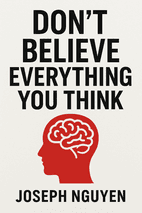
This page collects some of the most memorable lines from Joseph Nguyen's book. Each quote distills a simple but profound truth about how our own thoughts shape our experience of life. You will find short, punchy reminders about the difference between pain and suffering, and the freedom that comes when you stop overthinking.
The book is quotable because it turns complex ideas into everyday language. These phrases stick with you and often pop back into your head when you need them most. They are not just insightful; they are practical tools for finding more peace and clarity in daily life.
Top Quotes from Don't Believe Everything You Think
“In life, we can’t always control the first arrow. However, the second arrow is our reaction to the first. The second arrow is optional.”
The author recounts the Buddha's teaching on the two arrows to explain the difference between pain and suffering.
This concise metaphor empowers readers to see that while pain is inevitable, the emotional suffering we add is a choice we can reclaim.
“The root cause of our suffering is our own thinking.”
The author reveals this as the core discovery after years of searching for the source of suffering.
It pinpoints the origin of suffering as internal, giving readers the power to change it by changing their thinking.
“I think and think and think, I’ve thought myself out of happiness one million times, but never once into it.”
This is the epigraph of the chapter, attributed to Jonathan Safran Foer.
It encapsulates the chapter's central paradox — that excessive thinking often leads away from happiness rather than toward it. The vivid imagery and personal tone make it instantly memorable and relatable.
“More times than not, the solution to our problems is not the addition of action but the removal of what's causing those problems in the first place.”
The author draws a parallel between thinking and the root cause of suffering.
This counterintuitive wisdom applies far beyond thinking—to habits, clutter, and overcommitment. It invites a shift from doing less to simply letting go.
“Within the space between your thoughts and your thinking lies the peace you've been seeking.”
From the PAUSE process, step one explanation of pausing and breathing.
This line elegantly captures the book's central promise that peace is not found by fighting thoughts but by accessing the gap between them. It offers a simple, profound image that readers can immediately apply.
“Anxiety is thought without control. Flow is control without thought.”
The chapter opens with this epigraph by James Clear.
It encapsulates the chapter's central paradox in a concise, memorable aphorism, challenging the reader to reconsider the role of thought in peak experience.
“There is nothing either good or bad but thinking makes it so.”
The chapter opens with this epigraph from William Shakespeare.
It succinctly captures the core theme that our judgments create the categories of good and bad, challenging readers to question their automatic evaluations.
Themes Behind the Quotes
A central theme is that our thinking, not external events, is the root of most suffering. The book draws a clear line between a neutral thought and the act of dwelling on it, which creates anxiety and pain. It suggests that peace is available when we stop layering interpretations onto reality.
Another major idea is that true fulfillment comes from presence and flow, not from striving or controlling outcomes. The quotes emphasize letting go of the need to label decisions as right or wrong, and instead trusting the process. Compassion for yourself and removing unnecessary mental clutter are seen as more effective than force or self criticism.
Quotes by Chapter
Chapter 1: The Journey to Discovering the Root Cause of Suffering
“Pain is unavoidable, but how we react to that pain is up to us, and that reaction will dictate whether or not we suffer.”
The author clarifies the distinction between pain and suffering after introducing the two arrows concept.
It directly challenges the common belief that suffering is mandatory, offering a clear, actionable path toward emotional freedom.
“How long are you going to keep holding on to the story you don’t want to keep reliving?”
This is the author's final rhetorical question at the end of the chapter.
It pierces through denial with raw honesty, prompting deep self-reflection about the narratives we cling to that prolong our suffering.
Chapter 2: The Root Cause of Suffering
“Without our own thinking about an event, we find peace because we are experiencing exactly what reality is without our own judgments, stories, or expectations of it.”
This appears in the section explaining the Human Experience Equation.
It offers a clear, achievable path to serenity by letting go of the mental filters that distort reality.
“It's not other people, situations, or circumstances. It's not the empty boat but my reaction to it that causes my anger.”
The young monk speaks this after realizing the lesson from the empty boat that drifted into his own.
The empty boat metaphor makes the idea unforgettable: our reactions, not external events, create our anger.
Chapter 3: Why Do We Think?
“Today, the question isn't whether we will survive but whether we are happy with the time we are alive.”
The author contrasts our evolutionary past with modern life.
This line reframes the purpose of existence from mere survival to the pursuit of joy, challenging readers to reconsider their priorities. Its simple, direct language makes it a powerful call to self-reflection.
“Our mind's duty is to keep us alive. Our consciousness’s duty is to help us feel fulfilled. Our soul is the reason why we're even on this journey in the first place—to find peace within ourselves.”
The author distinguishes between the roles of mind, consciousness, and soul.
This tripartite insight provides a clear framework for understanding inner conflict and the path to fulfillment. The poetic progression from survival to meaning resonates deeply with those seeking peace.
Chapter 4: Thoughts versus Thinking
“Thoughts are intrinsically neutral. But the moment we begin thinking about our thoughts, we get taken on an emotional roller coaster.”
Author explaining the core distinction between thoughts and thinking.
It captures the essence of the chapter: thoughts themselves are harmless, but engaging with them through thinking creates emotional turmoil. This line is memorable because it uses a vivid metaphor to illustrate a universal experience.
“This is what I mean when I say that thinking is the root of our suffering.”
Author summarizing the lesson from the thought experiment about a dream.
It delivers the book's central thesis in a direct, powerful statement. Readers can immediately connect it to their own experiences of overthinking and emotional distress.
“You don’t have to ruminate on each thought that enters your mind, but when you do, that is thinking.”
Author defining thinking as the act of engaging with thoughts.
It offers a liberating reminder that we have a choice. The contrast between 'don't have to' and 'when you do' reinforces the distinction between passive thought and active rumination.
“The only useful and helpful thing was the initial thought that popped into your mind when I first asked what you dreamed of doing. All of the thinking that happened after was destructive and unhelpful.”
Author reflecting on the outcome of the thought experiment.
It provides a clear, actionable takeaway: trust the initial spark and avoid the subsequent mental chatter. The blunt contrast between 'useful' and 'destructive' makes the lesson stick.
Chapter 5: But Don’t We Need to Think Positively?
“The truth is that you do not have to have thoughts or think to feel positive emotions. Positive emotions are not a byproduct of thinking but the organic result of being fully in the present moment and connected to life rather than thinking about it.”
The author challenges the assumption that positive thinking is necessary for positive emotions.
This reframes joy as an inherent state accessed through presence, not manufactured by effort. It liberates readers from the exhausting cycle of forced positivity.
“You do not have to “try” to be present or “think positively” to experience love, joy, bliss, or any other positive emotions because those emotions are our natural state when we are not thinking.”
Near the end of the chapter, the author summarizes the key insight about natural emotional states.
It offers relief by normalizing that peace is our default, not a reward for mental labor. The simple phrasing makes a profound truth feel accessible.
Chapter 7: Practical Steps for How to Stop Thinking
“Suffering comes not from our emotions but from the thinking we attach to the emotions.”
From step five, where the author explains how to experience emotions fully without judgment.
It clarifies a critical distinction that helps readers stop blaming their feelings and instead recognize thinking as the true source of pain. This reframe can be liberating for anyone stuck in emotional turmoil.
“What we need most during difficult times is not more self-criticism but more love, compassion, and patience for ourselves.”
At the beginning of Chapter 7, the author encourages readers who struggle with stopping thinking.
This compassionate reminder counters the common tendency to self-blame when trying to change mental habits. It reassures readers that gentleness, not force, is the path forward.
“The mind and body will always restore balance and harmony naturally when we get out of the way.”
From the conclusion of the PAUSE process, after discussing how to let the body process emotions.
It instills trust in our innate ability to heal without constant intervention. The metaphor of stepping aside empowers readers to stop over-managing their inner experience.
Chapter 8: How Can We Possibly Thrive in the World without Thinking?
“When you're doing your best work and are in a total state of flow, where there is no separation between you and the work you are doing, little to no thinking is happening in the mind.”
The author asks readers to reflect on their own moments of peak performance.
This line vividly describes the counterintuitive reality that our finest achievements arise when thinking subsides, making it both relatable and profound.
“In a state of flow, grounded in the present moment, we are free from the limitations of the ego and can create the most incredible things in the world.”
The author explains the connection between flow, presence, and creativity.
This sentence inspires by linking liberation from ego to boundless creative potential, offering a hopeful vision of human capability.
Chapter 9: What about Our Goals, Dreams, and Ambitions?
“The joy comes from the act itself, not just what you externally get out of it.”
The author distinguishes between goals of inspiration and desperation.
This line reframes success by emphasizing intrinsic fulfillment over external rewards, a powerful shift in perspective.
“Love will take you further than sheer effort ever will.”
The author explains that falling in love with the work leads to greater happiness and achievement.
It's a concise, memorable truth about sustainable motivation, contrasting passion with mere willpower.
“Goals from desperation are typically rooted in fear and make your happiness conditional on achieving them. Goals from inspiration are rooted in love and focus more on the joy of doing over the outcome.”
The author compares the two types of goals.
This provides a clear, actionable framework for evaluating one's own ambitions and their emotional impact.
“To a mind without the limits of thinking, anything is possible.”
The author reflects on removing barriers of fear and self-doubt.
This inspiring statement encapsulates the chapter's thesis that unconstrained thinking opens infinite possibilities.
Chapter 10: Nothing Is Either Good or Bad
“Just like how there are no wrong keys on the piano, there are no “wrong” decisions in life.”
The author uses the metaphor of piano keys to illustrate that decisions are not inherently wrong.
This relatable analogy makes the abstract idea tangible, freeing readers from the anxiety of making a 'mistake'.
“If we categorize paths as right or wrong, we close ourselves off from the ocean of opportunities available to us.”
The author explains the limiting effect of binary thinking on life choices.
It vividly warns how judgment narrows our perspective, encouraging openness and exploration instead of fear-based decision-making.