Darwin Quotes
by Janet Browne
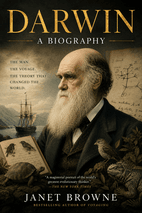
These quotes, drawn from Janet Browne's biography, offer a glimpse into Charles Darwin's remarkable life. You will find his own words alongside moments of self reflection, sharp wit, and raw excitement. The collection includes his father's harsh rebuke, his delight at discovering a new beetle, and his astonishment at the power of nature.
What makes this book so quotable is how Browne lets Darwin speak for himself while providing the context that brings each line to life. The quotes reveal a man who was deeply human: uncertain, ambitious, and endlessly curious. They are memorable because they capture the personal side of a scientific revolution.
Top Quotes from Darwin
“Darwin’s proposals hit Victorians where it hurt the most, unsettling their ideas about God and nature and especially focusing attention on the origin of humankind.”
This sentence describes the immediate impact of Darwin's theory on Victorian society.
It vividly captures the core controversy Darwin stirred, using a memorable metaphor that resonates with anyone understanding how deeply his ideas challenged existing beliefs.
“At the end of his life, he said, “With such moderate abilities as I possess, it is truly surprising that thus I should have influenced to a considerable extent the beliefs of scientific men on some important points.””
Darwin himself speaking at the conclusion of his life, reflecting on his own achievements.
This direct quote reveals Darwin's remarkable humility and self-assessment, making his monumental impact all the more striking and human.
“You care for nothing but shooting, dogs, and rat-catching, and you will be a disgrace to yourself and all your family.”
Dr. Darwin, Charles Darwin's father, scolds him for his lack of ambition and idle pursuits.
This harsh parental rebuke encapsulates the tension between Darwin's youthful passions and his family's expectations, foreshadowing his unconventional path.
“Considering how fiercely I have been attacked by the orthodox it seems ludicrous that I once intended to be a clergyman.”
Darwin later reflected on his early plan to enter the church, after the publication of On the Origin of Species.
The irony of Darwin's clerical intention versus his later role as a scientific revolutionary highlights the unpredictability of his life and the dramatic shift in his beliefs.
“No poet ever felt more delight at seeing his first poem published than I did at seeing in Stephens’ JI- lustrations of British Insects the magic words, “captured by C. Darwin, Esq.””
Darwin describes his elation when his first beetle captures were recorded in a scientific publication.
This vivid comparison reveals the depth of Darwin's passion for natural history and the personal joy he found in collecting, which became the foundation of his scientific career.
“He was an ardent disciple of Lavater, and was convinced that he could judge a man’s character by the outline of his features; and he doubted whether anyone with my nose could possess sufficient energy and determination for the voyage. But I think he was afterwards well-satisfied that my nose had spoken falsely.”
Darwin recalls FitzRoy's belief in phrenology and how his nose nearly cost him the voyage.
This witty, self-deprecating anecdote reveals Darwin's humor and resilience, while also illustrating the quirky prejudices of the era. It resonates because it transforms a superficial judgment into a triumph of character over appearance.
“Delight,” he wrote in his diary, “is a weak term to express the feelings of a naturalist who for the first time has wandered by himself in a Brazilian forest.... such a day brings a deeper pleasure than he can ever hope to experience again.”
Darwin writes in his diary about his first solo walk in a Brazilian forest.
It captures the profound joy and wonder of scientific discovery, illustrating Darwin's emotional and aesthetic appreciation of nature.
Themes Behind the Quotes
A central theme is Darwin's personal transformation from a young man expected to become a clergyman or doctor into the father of evolutionary theory. Many quotes show his struggle with expectations, his growing confidence, and the joy of scientific discovery. Another strong thread is the importance of observation and firsthand experience, whether in the Brazilian forest or examining fossil bones.
Equally prominent are themes of human nature and society. Darwin confronts the brutality of slavery, the cultural gap between European and indigenous peoples, and the delicate bonds of friendship and mentorship. His own self doubt and humility appear alongside moments of profound insight. Together these themes paint a picture of a man who changed the world while remaining deeply tied to the world around him.
Quotes by Chapter
Introduction
“Lution— however it might be understood—is recogniz- ably one of the central narratives of modernity.”
This line appears in a reflection on the long-term cultural significance of evolutionary thought.
It succinctly declares evolution's enduring importance, acknowledging its varied interpretations while affirming its foundational role in modern thinking.
“Darwin was the most human of men, supported by circles of friends, relatives, and correspondents.”
This is the concluding characterization of Darwin in the introduction.
It personalizes a towering historical figure, reminding readers that behind the revolutionary ideas was a relatable, everyday person embedded in relationships.
1 Bobby
“1 Bobby CHARLES DARWIN was born into Jane Austen’s England.”
The opening line of the chapter, introducing Darwin's birth and setting.
It immediately places Darwin in a familiar literary world, creating a contrast between the idyllic surface and the harsh realities to come.
“This pleasant costume-drama version of history nevertheless obscures the reality of early nineteenth-century life in Britain.”
The narrator after describing the charm of Shrewsbury.
This line signals the book's critical approach, reminding readers that privilege and suffering coexist beneath the surface.
“If nothing else, these two figures provided him with social status and financial security, along with a vigorous mind just like theirs.”
Referring to Darwin's eminent grandfathers, Erasmus Darwin and Josiah Wedgwood.
It succinctly captures the dual inheritance—wealth and intellect—that shaped Darwin's opportunities and worldview.
“Perhaps the way his mother died delivered the blow from which Darwin never quite recovered.”
The author reflects on the lasting impact of Susanna Darwin's death on her son Charles.
This line encapsulates a profound psychological wound, suggesting that a single childhood tragedy shaped Darwin's lifelong anxieties and worldview.
2 From Medicine to Seaweed
“Also attended on two occasions the oper- ating theatre in the hospital at Edinburgh, and saw two very bad operations, one ona child, but I rushed away before they were completed. Nor did I ever attend again, for hardly any inducement would have been strong enough to make me do so; this being long before the blessed days of chloroform.”
Charles Darwin describing his traumatic experience watching operations in Edinburgh.
This passage vividly captures Darwin's visceral revulsion to surgery and marks the turning point away from a medical career. The phrase 'blessed days of chloroform' is both ironic and poignant, highlighting his lasting sensitivity to suffering.
“I became convinced from various small circumstances that my father would leave me property enough to subsist on with some comfort, though I never imagined that I should be so rich a man as I am; but my belief was sufficient to check any strenuous effort to learn medicine.”
Charles Darwin reflecting on his realization that he would inherit enough money to avoid the need to study medicine.
This honest self-assessment exposes the practical motivation behind Darwin's shift away from medicine. It underscores how financial independence enabled his scientific pursuits, a moment of clarity that changed the course of his life.
“Would be a misfortune if we all had the same way of think- ing,” admitted Jameson to a Royal Commission in 1827. “Dr Hope is decidedly opposed to me, and I am opposed to Dr Hope, and between us we make the subject interesting.”
Professor Robert Jameson explaining the value of scientific disagreement to a Royal Commission.
Jameson's remark celebrates intellectual conflict as a driver of engagement and progress. It foreshadows Darwin's own revolutionary thinking, which thrived on challenging established views.
“The sole effect they produced on me was the determination never as long as I lived to read a book on geology or in any way to study the science.”
Darwin dismisses the university geology lectures he attended in Edinburgh.
This line captures Darwin’s youthful rebellion against conventional education, and his ironic later transformation into a pioneering geologist.
3 “An Idle Sporting Man”
“I remember wondering why every gentleman did not become an ornithologist.”
Darwin reflecting on his early pleasure in watching birds and making notes.
It captures Darwin's innocent, youthful passion for natural history and his charming surprise that others did not share it.
4 The Professors
“He is quite the most perfect man I ever met with.”
Darwin writing to his cousin Fox about his mentor John Stevens Henslow.
This line captures Darwin's deep admiration and the profound influence Henslow had on him, highlighting the importance of mentorship in shaping his scientific career.
“Nothing before had ever made me thoroughly realise, though I had read various scientific books, that science consists in grouping facts so that general laws or conclusions may be drawn from them.”
Darwin reflecting on a lesson from geologist Adam Sedgwick during a field trip in Wales, after Sedgwick dismissed a supposed fossil find.
It articulates a fundamental principle of scientific methodology—that science requires grouping facts to derive general laws—and shows a pivotal moment in Darwin's intellectual development.
“Burning zeal to add even the most humble contribution to the noble structure of natural science.”
Darwin describing his inspiration after reading works by Alexander von Humboldt and John Herschel.
This phrase encapsulates Darwin's passionate drive to contribute to science, a motivation that later led to his revolutionary work.
“He would bring Christianity and civilization to the uncivilized, as he thought, and help the people of Tierra del Fuego step onto what he and others of the day believed to be a ladder of cultural progress.”
FitzRoy's motivation for taking the Fuegians to England and returning them as missionaries.
It encapsulates the paternalistic and Eurocentric ideology of the era, showing how benevolence and domination were intertwined.
5 New Horizons
“Like what I see and hear of him, much, and I now re- quest that you will apply for him to accompany meas a Naturalist. I can and will make him comfortable on board, more so perhaps than you or he would expect, and I will contrive to stow away his goods and chattels of all kinds and give him a place for a workshop.”
Captain Robert FitzRoy writes to Beaufort, requesting Darwin as the Beagle's naturalist after their first meeting.
This letter captures the decisive moment when Darwin's voyage was secured, showing FitzRoy's genuine enthusiasm and practical care. It highlights the professional trust and personal arrangement that made the historic journey possible.
“It has been for mea glorious day, like giving to a blind man eyes.”
Darwin describes his first experience of tropical vegetation on St. Jago in the Cape Verde islands.
This visceral simile conveys the overwhelming sensory revelation of Darwin's first tropical landing. It resonates with anyone who has experienced a transformative moment of discovery, capturing the joy of seeing the world anew.
“Hen first dawned on me that I might per- haps write a book on the geology of the vari- ous countries visited, and this made me thrill with delight.”
Darwin reflects on the moment while resting on Quail Island when he first conceived of writing a scientific book.
This line marks the birth of Darwin's ambition as a scientific author, a pivot from collector to thinker. It resonates because it shows how a simple, happy realization can set the course for a lifetime of groundbreaking work.
6 Naturalist on the Beagle
“Instantly, with a frightened look and half-shut eyes, he dropped his hands. I shall never forget my feelings of surprise, disgust, and shame, at seeing a great powerful man afraid even to ward off a blow, directed, as he thought, at his face. This man had been trained to a degradation lower than the slavery of the most helpless animal.”
Darwin describes his reaction to a free African ferryman who flinched in fear of a blow.
This passage powerfully conveys Darwin's horror at the dehumanizing effects of slavery, showing his deep empathy and moral outrage.
“FitzRoy’s temper was a most unfortunate one,” Darwin later wrote in his autobiographical memoir, with this episode in mind: “he was extremely kind to me but was a man very difficult to live with on the intimate terms which necessarily followed from our messing by ourselves in the same cabin.”
Darwin reflects on his difficult relationship with Captain FitzRoy.
This quote shows Darwin's balanced view of FitzRoy, acknowledging kindness alongside temperamental challenges, and highlights the interpersonal dynamics of the voyage.
“Some of the animals must have been of great dimensions: I am almost sure that many of them are quite new; this is always pleasant, but with the antediluvian ani- mals it is doubly so.”
Darwin writing to his sisters after digging up fossils at Punta Alta.
It captures Darwin's youthful excitement and his recognition that these extinct giants could be scientifically novel.
7 Almost Another Species of Man
“I would not have believed how entire the difference between savage & civilised man is. It is greater than between a wild & domesticated animal, in as much as in man there is greater power of improvement.”
Darwin reflects after seeing Jemmy Button with his unacculturated relatives, realizing the transformative power of civilization.
This line crystallizes Darwin's early belief in a hierarchical scale of human improvement, using a stark animal metaphor that foreshadows his later evolutionary thinking about human potential.
“It was quite painful to behold him; thin, pale, & without a remnant of clothes, excepting a bit of blanket round his waist: his hair, hanging over his shoulders; & so ashamed of himself, he turned his back to the ship as the canoe approached.”
Darwin describes the shocking transformation of Jemmy Button when the Beagle returns to Tierra del Fuego.
This poignant observation underscores the failure of the civilizing mission and the cultural dislocation experienced by the Fuegians, evoking deep sympathy.