Dangerous, Dirty, Violent, and Young Quotes
by Zayd Ayers Dohrn
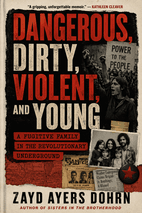
This collection brings together the most striking lines from Zayd Ayers Dohrn's memoir about growing up in a revolutionary family. You'll find raw declarations, quiet confessions, and sharp observations about inheritance, violence, and loyalty. The book is endlessly quotable because it captures the wild contradictions of being raised by people willing to risk everything for a cause.
Dohrn's writing is personal and political at the same time. He lets us into the private world of a child navigating the fallout of his parents' radical choices. These quotes stick with you because they are unflinching. They don't romanticize or apologize. They simply tell the truth about the weight of history and the cost of belief.
Top Quotes from Dangerous, Dirty, Violent, and Young
“I was born during that decade, and spent the first years of my life underground.”
The narrator summarizes his early life while describing his mother's decade-long fugitive existence.
This line encapsulates the central, haunting reality of the narrator's childhood—a life hidden from society and government—and sets the stage for the entire memoir.
“Because this is a funny thing about inheritance. It starts as something you receive, maybe reluctantly, from the past. But it becomes something you have to decide how to pass on to the future.”
The narrator muses on the nature of legacy as he begins to question his parents about their shared history.
This passage offers a universal, poignant insight into how we grapple with family stories and personal identity, resonating with anyone who has had to choose what to carry forward.
“Bring the revolution home,” he shrugged. “Kill your parents.”
Bill Ayers responds to a rival at a 1969 SDS meeting after being reminded that his own parents were rich.
This shocking, succinct phrase encapsulates the radical rejection of family and authority, embodying the era's militant ethos and the personal cost of political conviction.
“It takes two to tango, motherfucker,” he told reporters outside. “As soon as you kick that door down, I have to kick it back on you. We don't lock our doors. We just get us some good guns and leave them motherfuckers open.”
Fred Hampton's defiant response after Chicago police raided Black Panther headquarters and beat members.
The raw, profane bravado encapsulates the armed resistance stance of the Panthers and the escalating violence between police and activists.
“We were illuminated in ways that are rare and precious. But also blinded. Because if you can’t see nuance and complexity around the edges, you make enemies of people who aren’t your enemies. And you take actions that you shouldn't take. And we did both.”
Bill Dohrn, a former Weather Underground leader, reflects on the group's revolutionary insight and its drawbacks.
This line shows a rare moment of self-critique from a radical, acknowledging the blindness that comes with ideological certainty and the regret of misdirected actions.
“Many years later, when I turned seventeen and was a junior in high school, Bill mentioned to me, in a kind of offhand, casual way, that he had always hoped, when I turned eighteen and came of age, that the two of us might go south together to kill the man who had murdered Medgar Evers.”
The author remembers her father casually suggesting they assassinate Byron De La Beckwith when she turned eighteen.
It reveals the profound intergenerational transmission of revolutionary violence and the chilling normalization of vigilante justice within a family.
“Grow up to be good revolutionaries. Remember that it is the Revolution which is important and that each of us, taken in isolation, is worth nothing.”
The epigraph of a section of the book, taken from Ernesto "Che" Guevara's letter to his children.
This line encapsulates the revolutionary ethos that subsumes individual worth to the collective cause, a central tension in the book's exploration of family and activism.
Themes Behind the Quotes
The quotes reveal a central tension between inheritance and rebellion. The narrator and his parents are shaped by a legacy of political violence and ideological commitment. They struggle with the burden of the past while trying to forge a new future. Another major theme is the collision between personal love and political duty. Family relationships are tested by extreme beliefs and dangerous actions. The quotes also explore the cost of certainty, showing how unwavering conviction can lead to both profound connection and devastating blindness.
A recurring thread is the experience of growing up in a world of secrets and constant movement. The narrator's childhood is defined by instability and a deep awareness that normal rules do not apply. Finally, there is a persistent questioning of what it means to be a revolutionary. The quotes challenge simplistic heroism and instead show the messy, painful reality of trying to live out radical ideals. The book does not offer easy answers but lays bare the contradictions of a life dedicated to change.
Quotes by Chapter
Prologue: Underground (Harlem, 1980)
“She was like that—a fighter, a protector, and a natural-born leader, if those things can be born—with an icy calm and decisiveness that preempted any discussion or disagreement.”
The narrator reflects on his mother's character after she calmly handled a medical emergency that saved his eye.
It crystallizes the mother's formidable presence and paradoxical blend of fierce protectiveness and unflappable authority, making her both awe-inspiring and deeply human.
“We ditched cars and apartments constantly, kept everything we owned in a few plastic milk crates by the door, and I carried my prized possessions in a backpack: a stack of comics, some crayons and paper, a couple of Star Wars action figures.”
The narrator describes the material realities of his family's life on the run.
The juxtaposition of a fugitive's sparse, mobile existence with a child's innocent treasures—comics and action figures—creates a vivid, heartbreaking image of normalcy under extraordinary circumstances.
Part 1: The Most Dangerous Woman in America
“Men make their own history, but they do not make it as they please; they do not make it under self-selected circumstances, but under circumstances given and transmitted from the past. The tradition of all dead generations weighs like a nightmare on the brains of the living.”
The chapter opens with this epigraph from Karl Marx.
It establishes the theme that individuals are constrained by historical circumstances, a core idea for understanding the characters' lives and the choices they make.
“He believed in the Horatio Alger myth of hard work and the self-made man.”
Describing the author's grandfather Barney's unwavering belief in the American Dream despite his setbacks.
This line encapsulates the myth of self-made success that drives Barney's aspirations and later influences his daughter's trajectory.
“You have to take action,” she remembers telling herself. “You have to do something.”
Bernardine recalls her internal motivation as she considers taking a more militant direction in SDS.
It captures the urgent, personal call to activism that defines her radicalization and resonates with anyone facing a moral imperative to act.
“The whole nation seemed to be disintegrating, coming apart under the centrifugal forces of war and racism, like a jet engine cracking up and spinning out of control.”
The author describes the national mood after Martin Luther King Jr.'s assassination and the intensifying protests.
The vivid metaphor conveys the chaos and urgency of the late 1960s, a pivotal moment for Bernardine's involvement in the movement.
Part 2: Kill Your Parents
“I understood, without having to ask, that our family life was precarious, that if their relationship lost its gravitational pull, my brothers and I, small satellites orbiting around their twin planets, would spin out into the abyss.”
The narrator reflects on their childhood awareness of their parents' fragile marriage.
The vivid metaphor of planets and satellites captures the deep insecurity a child feels when family stability is threatened, making the abstract concept of divorce visceral and memorable.
“And there’s something that feels uncomfortable—disloyal—about this kind of investigation. Even now, poring over my parents’ private histories feels risky, and a bit dangerous.”
The narrator describes the emotional difficulty of researching his own parents' pasts.
This intimate confession of guilt and danger makes the act of storytelling itself a rebellious act, resonating with anyone who has struggled to reconcile love for family with the need to uncover hard truths.
Part 3: Bring the War Home
“In times of revolution, just wars and wars of liberation, I love the angels of destruction and disorder!”
Eldridge Cleaver, Black Panther Party minister of information, in a 1969 statement supporting the Weathermen's Days of Rage.
This line captures the romanticization of chaos and violence that fueled revolutionary movements of the era, making it both powerful and disturbing.
“I believe I'm going to be able to die doing the thing I was born for... that I will die as a revolutionary in the international proletarian revolutionary struggle.”
Fred Hampton speaking to fellow Black Panthers about his anticipated death.
Hampton's prophecy of martyrdom is hauntingly prescient given his murder weeks later, and it embodies the total commitment demanded by the movement.
“For people to be able to enjoy Christmas in this country?” Bernardine snarled in front of the news cameras that month. “Without taking action about a blatant murder that takes place in this city against a revolutionary Black leader? /s an obscenity!”
Bernardine Dohrn reacting to Fred Hampton's murder, criticizing holiday shopping in Chicago.
This visceral expression of grief and rage highlights how Hampton's death pushed Weathermen toward extremism and justified violence in their minds.
Part 4: Underground(s)
“In trying to bring the war home, the New York Weathermen turned themselves into soldiers and nearly became murderers; instead, Diana and Terry and Teddy destroyed themselves—three more casualties in a war that was already killing thousands every week.”
The author reflects on the fate of Weathermen after the townhouse explosion.
This line poignantly captures the tragic irony of revolutionaries who aimed to stop a war but became its casualties, humanizing the cost of extremism.
“Ask yourself how difficult it would be for a 23-year-old beauty to place her handbag with 5 sticks of dynamite in the ladies' room in the Residence while going through on a White House tour?”
A White House aide warns President Nixon about the vulnerability to female Weathermen bombers.
It underscores how gender stereotypes were used as a tactical advantage, making the threat seem both mundane and terrifying.
Part 5: Children in My Mind
“Already, i talked to it and worried about it and wondered how it was feeling and what it was thinking . . . It has always intrigued me how the world can be so beautiful and so ugly at the same time.”
Assata Shakur in her autobiography, contemplating her unborn child while imprisoned.
The juxtaposition of beauty and ugliness captures the profound paradox of hope and despair in revolutionary struggle, making it deeply relatable and thought-provoking.
“It's stripping away skin and then bone until you feel like... You don’t know who you are, and maybe they're right.”
Bernardine Dohrn describing the psychological impact of the criticism/self-criticism sessions she endured.
The visceral metaphor for identity destruction resonates powerfully with anyone who has experienced group pressure or cancellation, highlighting the danger of ideological certainty.
“I didn't want to be told bad things about people that I loved.”
Delia, a child in the underground, reacting to being told that Bernardine was now an outcast.
This simple, heartbreaking line perfectly captures a child's loyalty and innocence against the harsh realities of adult political conflicts.
“The United States government is not invincible. It didn’t exist for all time and it’s not going to exist for all time. And that lesson is a very powerful lesson. That lesson is an explosive lesson.”
Bernardine Dohrn speaking after the Vietnam War ended, reflecting on the implications for revolution in America.
The rhythmic repetition and bold assertion of impermanence inspire defiance and hope, challenging readers to question the inevitability of any system.
Part 6: One Last Job
“Such is your luck, such you are called to see, and let it come rough or smooth, you must surely bear it.”
Epigraph at the beginning of the chapter from Nat Turner's confession.
Sets a tone of fate and endurance, foreshadowing the struggles and sacrifices of the revolutionaries in the chapter.
“I shall come back. I shall return to my country. And there shall be change!”
Kathy Boudin's final diary entry after saying goodbye to friends in Cuba.
Captures the poignant blend of youthful idealism and determination, showing her commitment to revolution despite heartbreak.
“Given the system which perpetuates such harsh oppression and suffering, rebellion is inevitable and continuous.”
Bernardine Dohrn's statement in court after surrendering.
Succinctly articulates the revolutionary belief that systemic oppression justifies ongoing rebellion, a core justification for their actions.
“I was determined to not have being a mother stop me from also being a revolutionary.”
Kathy Boudin explaining her decision to participate in the Nyack heist despite having a baby.
Highlights the struggle between motherhood and political activism, showcasing her refusal to be limited by traditional gender roles.
Part 7: Children of the Revolution
“Will you now so comply with the grand jury's direction and the Court order?” “No. I will not comply.”
A prosecutor asks Bernardine Dohrn if she will comply with the grand jury's direction, and she refuses.
This direct act of civil disobedience captures the uncompromising spirit of a revolutionary who accepted imprisonment rather than cooperate with the state.
“She told them she was willing to do almost anything—plead guilty, denounce her role in the crime, apologize directly to the victims’ families—but she wouldn't testify against her Black comrades.”
When FBI agents pressured Kathy Boudin to cooperate after a breakdown in jail, she told them she would do almost anything except testify against her Black comrades.
It reveals a profound moral boundary even under extreme duress, highlighting loyalty and the ethical lines that radical activists would not cross.