Crown Me Dead Quotes
by Liv Zander
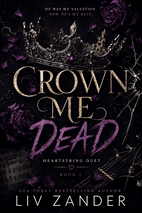
The quotes here come straight from a world where death is a currency and rot is a constant companion. You'll find narration that paints decay in stark, poetic imagery, inner monologues that refuse to sugarcoat hunger, and snappy dialogue that puts power in its place.
What makes these lines so quotable is their raw, unapologetic voice. They mix the grotesque with the poetic, turning maggots and decay into unforgettable imagery. Each line feels earned, like a truth carved out of desperation. Whether it's a sharp comeback or a grim observation, the writing never flinches.
Top Quotes from Crown Me Dead
“E wrap the dead with our hands steady and our mouths shut, because the living moan and scream enough for everyone.”
Opening of the chapter describing the family's work with the dead.
Sets the tone of grim acceptance and the contrast between the silent dead and the noisy living.
“If you don't look at rot, then rot can't find you. It always does.”
Elara's inner thought about pretending and denial.
Powerful truth about the inevitability of decay and the futility of ignoring it.
“If death wants my respect, then he should send food instead of lectures.”
Elara responds to her mother's scolding about blasphemy.
Highlights Elara's defiance and dark humor in the face of poverty and death.
“Hunger makes thieves of the gentle and beasts of the rest.”
Mother says this after discovering their home has been robbed, explaining the thieves' desperation.
A poignant, universal truth about desperation and moral compromise, delivered with quiet wisdom amid the family's crisis.
“Death is a man, and he bargains like one: keeps ledgers, honors debts, takes what's owed. And what is owed is blood.”
When Elara questions the nature of Death, Vale explains the crown's origin.
A memorable, poetic line that introduces the dark fantasy lore and stakes of the story.
“If you wanted honeyed lies, then maybe you shouldn't have scared off whoever was before me. From me, the best you'll get is salted truths.”
Elara defiantly responds to the king's order to leave, refusing to be cowed.
Showcases her sharp wit and courage, establishing her as a fierce protagonist.
“Because if he truly wants me to go away, he'll have to slit my throat and bleed me over his stupid crown.”
The narrator leaves the chamber, resolved to continue her care despite the king's threats.
This defiant internal thought reveals her fierce determination and dark humour, making her a compelling protagonist.
Themes Behind the Quotes
A central theme is the inescapable nature of rot and death. The characters live with decay as a daily reality, yet they do not wallow in despair. Instead, they adopt a practical, almost darkly humorous approach, setting out buckets for a leaking roof rather than questioning why it leaks. This theme extends to the physical body, which is portrayed as something that constantly betrays and decays, yet must be endured.
Another key theme is the interplay of power and defiance. The quotes reveal a world where power is cruel and arbitrary, but the protagonist refuses to bow. She offers salted truths instead of honeyed lies, and her voice is a constant act of rebellion. Death itself is personified as a bargainer, demanding blood, but the response is not submission; it is a stubborn refusal to go quietly. Hunger and poverty also drive the action, turning gentle people into thieves and beasts, highlighting the moral compromises forced by survival.
Quotes by Chapter
Chapter 1
“He chuckles. Low. Amused. Pleased? Squinting through the dim light of the city, I turn back once more. The space is empty now. Silent. Only maggots rustle somewhere at my feet. And for a moment, I swear they’re chuckling, too.”
After the mysterious man disappears, Elara perceives maggots chuckling.
Creepy and atmospheric, emphasizing the omnipresence of death and the narrator's dark whimsy.
Chapter 2
“The graveyard fence crouches like a rib cage, iron spikes crowned in rust.”
At the start of the chapter, the narrator describes the graveyard as they return home to find their house robbed.
The vivid metaphor compares the fence to a rib cage and rust to a crown, establishing a macabre, decayed tone that permeates the chapter.
“If Daron dies—no... when Daron dies, how will I ever smile again?”
The narrator squats between graves, overwhelmed by the certainty of her brother Daron's impending death from the rot.
The raw self-correction from 'if' to 'when' and the aching question encapsulate the hopelessness and depth of her grief.
“The city lies to itself like a lovesick drunk.”
The narrator observes the palace smoke and the city's false hope that King Kael will end the pestilence.
A sharp, bitter line that captures the theme of delusion and the chasm between royal propaganda and grim reality.
Chapter 3
“I swallow, put my ass back on the chair, and pick up my wooden spoon as I watch Mother fill two bowls. Then she sits without sitting, her spine like a spear that won't bend, and stares into her porridge.”
Elara observes her mother hiding grief after being rebuked for wanting to wake Daron.
The image of a spine like a spear that won't bend captures quiet resilience and the weight of unspoken sorrow.
“What should a woman whose roof leaks care why it leaks? She sets out buckets.”
Mother dismisses Elara's curiosity about the palace and king, focusing on survival.
This line distills the pragmatic wisdom of the poor, prioritizing action over pointless speculation.
“A moth kisses the glass and leaves the powder of its wings.”
Elara looks out the window as sunset approaches, noticing a moth.
The delicate, poetic image evokes fleeting beauty and the fragility of hope in a grim setting.
Chapter 4
“I like to see the blade pointed at my belly.”
After Vale grabs her and extinguishes her lamp, she shoves at his chest and says this.
Shows her defiance and courage in the face of danger, refusing to be intimidated.
“If you expected me to arrive like an obedient fool, then perhaps you asked the wrong girl to come.”
Immediately after she shoves him, she retorts to his criticism of her bringing light.
Highlights her sharp wit and refusal to be controlled, establishing her character.
“You have something the other didn’t have.”
After Elara asks why the king would marry a peasant, Vale hints at her unique quality.
Creates suspense and intrigue, making readers wonder what sets Elara apart.
Chapter 5
“I stand with my hand on the latch and look back. Our house makes itself small in the distance the way animals do when they're shrinking from a predator.”
Elara pauses at the carriage door to glance back at her home before leaving her family for the palace.
This vivid simile captures the vulnerability of leaving a loved place and the instinctive shrinking of hope in the face of danger.
“It's not fair how I'll get to sleep on starched linen tonight with my belly full of bread while my family beds down with rats, their stomachs twisting.”
Elara reflects on the guilt of her own comfort while her family remains in poverty.
The raw contrast between luxury and suffering highlights Elara's moral conflict and the painful sacrifice she makes for her family.
“And because I dislike the way light invents me when I’m not paying attention.”
Vale explains why he draws the curtain in the carriage, citing a dislike for how light reveals him unawares.
This poetic self-awareness reveals Vale's guarded, introspective nature and adds a layer of mystery to his character.
“Power does not quicken every pulse the way songs promise.”
Vale responds to Elara's suggestion that girls line up for the king despite the rotting kingdom.
The line subverts romanticized notions of power, hinting at deeper truths about desire and the king's isolation.
Chapter 6
“I have seen rot. I've seen men drowned in their own lungs, women eaten from the inside, and boys with half their faces wasted to something that had the poor taste to smile, anyway. Never have I seen this. Not alive.”
Elara first sees the king's rotting face and is stunned despite her experience with decay.
Contrasts her familiarity with death against the unprecedented horror of the king, building dread and sympathy.
“Yes, I have seen rot. Never did I have to seduce it!”
Elara internally realizes she must get close to the decaying king as part of her task.
Darkly humorous and raw, capturing the absurdity and revulsion of her mission.
“The crown sits on his head, dull, and the place where it touches the skin looks soft and new at the edges, pink and wet, as if the flesh keeps healing to meet it, only to die anew.”
Elara observes the king's crown and the perpetual wound it creates on his skin.
Poetic and grotesque imagery that symbolizes the curse of royalty and the cycle of decay and restoration.
Chapter 7
“He baptized me with a splash of maggots carved from his festering chest!”
Elara yells at Vale after the king splashed maggots on her.
Vivid, grotesque imagery captures her horror and the king's decay in a single, unforgettable line.
“I haven’t bled in a year, maybe longer.”
Elara reveals to Vale that she hasn't menstruated, implying infertility.
Reveals a deep vulnerability and raises the stakes, showing the personal cost of her sacrifice.
“I was never afraid of corpses. I won't start with this one.”
Elara resolves to return to the king after braiding her hair and gathering her courage.
A powerful declaration of determination that ties her past as a gravedigger to her present challenge.
Chapter 9
“The chamber is a lung that forgot how to exhale, trapping stale air and the sicknesses that cling to it.”
The narrator enters the king's chamber for the first time this morning.
The visceral metaphor immediately establishes the oppressive, suffocating atmosphere and foreshadows the king's decaying state.
“He hides the wince the way men hide all weaknesses: by being louder.”
The narrator observes the king's reaction to pain as he tries to scoff.
This sharp observation captures the gender performance of stoicism and the king's fragile pride.
“The pustules give with a wet, obscene pop, the sound bursting against the silence like a scream drowned in muck.”
The king presses the narrator's hand down onto his infected wounds.
The grotesque, sensory detail makes the moment unforgettable and emphasizes the horror of his condition.
Read Crown Me Dead (Heartstring Duet Book 1) in context on the summary page.