Build Quotes
by Tony Fadell
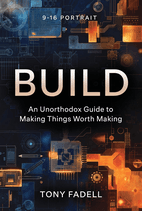
The quotes in this collection come from Tony Fadell's book Build. They are practical, blunt, and often funny. You will find advice on career, leadership, and life. Many lines challenge conventional wisdom. They are the kind of sayings you want to pin on your wall or send to a friend.
What makes Build so quotable is its honesty. Fadell draws from decades of experience building iconic products. He does not sugarcoat failure or success. Each quote feels earned. They are short, direct, and memorable. That is why they stick with you.
Top Quotes from Build
“Adulthood is your opportunity to screw up continually until you learn how to screw up a little bit less.”
The author opens the chapter by redefining adulthood as a period of continuous learning through failure.
It reframes adulthood as a liberating process of trial and error, resonating with readers who feel pressured to have everything figured out.
“The only failure in your twenties is inaction. The rest is trial and error.”
The author recalls a quote he wishes he'd known when deciding to leave his startup for General Magic.
This succinct advice encourages bold action and reframes all outcomes as valuable experiments, reducing fear of failure.
“If you're not solving a real problem, you can’t start a revolution.”
The author explains a key criterion for joining a revolutionary company.
It distills the core lesson of the chapter into a single, punchy truth: real impact requires solving actual problems, not just chasing cool tech.
“The only thing that can make a job truly amazing or a complete waste of time is the people.”
The author explains what truly determines the quality of a job.
This line cuts through common distractions like money and perks, reminding readers that the people they work with shape their experience most.
“But pushing for greatness doesn’t make you an asshole. Not tolerating mediocrity doesn’t make you an asshole. Challenging assumptions doesn’t make you an asshole.”
The author defends his own intense style while explaining the difference from real assholes.
This triplet is empowering and validation for driven people who are often mislabeled, turning a critique into a badge of honor.
“Hating your job is never worth the money.”
The author emphasizes that no amount of pay or perks justifies staying in a miserable job.
This line cuts through rationalization with stark clarity, reminding readers that financial compensation cannot offset daily unhappiness.
“People won't remember how you started. They'll remember how you left.”
Advice on leaving a job professionally and with integrity.
This aphorism underscores the lasting impact of one's exit, shifting focus from initial achievements to the legacy of a graceful departure.
Themes Behind the Quotes
One central theme is embracing failure as part of growth. Many quotes emphasize that mistakes are inevitable and valuable, especially early in your career. Inaction is the real failure. The book encourages you to get hands on, solve real problems, and love the work itself. Another theme is the critical role of people. Who you work with can make or break a job. Being part of a great team is a joy and a privilege.
Build also explores the tension between data and intuition. Data is useful but not decisive. You must combine it with gut feeling. The book challenges the idea that being demanding makes you an asshole. It distinguishes between ego driven toxicity and a passion for excellence. Finally, there are pointed insights about knowing when to leave. Hating a job is never worth it, and the way you exit matters more than how you started. These themes weave together a philosophy of purposeful work and human connection.
Quotes by Chapter
Chapter 1.1: Adulthood
“Throwing yourself out there and having everything blow up in your face is the world's best way to learn fast and figure out what you want to do next.”
The author urges young people to take big risks during the brief window of early adulthood when consequences are lowest.
It empowers readers to embrace spectacular failure as a fast track to growth and self-discovery, making risk-taking feel necessary rather than reckless.
Chapter 1.2: Get a Job
“You have to get your hands dirty. You have to care about every step, lovingly craft every detail. You have to be there when it falls apart so you can put it back together. You have to actually do the job. You have to love the job.”
The author contrasts hands-on work with management consulting, emphasizing the need to get involved in the details.
This rhythmic list captures the grit and devotion required to build something lasting, contrasting shallow consulting work with genuine craftsmanship.
“If you love it, don't worry about all my advice, don’t worry about the timing.”
The author encourages following one's passion even if it goes against practical advice.
It shows the author's humility and nuance—acknowledging that passion can override all rules, as his own career illustrates.
“What you do matters. Where you work matters. Most importantly, who you work with and learn from matters.”
The author concludes the chapter with a summary of what matters in a job.
This trio of simple, parallel statements drives home the chapter’s central message about purpose, environment, and relationships.
Chapter 1.3: Heroes
“I can’t make you the smartest or the brightest, but it's doable to be the most knowledgeable. It's possible to gather more information than somebody else.”
VC Bill Gurley offers advice on how to stand out.
It empowers readers by reframing success as a matter of effort and curiosity rather than innate talent, making excellence feel achievable.
“And if that seems impossible—if you follow your heroes on Twitter but can’t imagine they'll ever pay any attention to you—I'm excited to tell you that that is complete bullshit.”
The author directly addresses the common fear that heroes are unreachable.
This blunt, energetic statement shatters self-limiting beliefs and motivates readers to take action and connect with their role models.
“Being in that lifeboat with people you deeply respect is a joy. It is the best time you can have at work. It might be the best time you can have, period.”
The author describes the unique experience of working in a small, focused company with people you admire.
The vivid metaphor and repetition create a powerful, memorable conclusion that elevates meaningful collaboration above all other work experiences.
Chapter 1.4: Don’t (Only) Look Down
“Your job isn’t just doing your job. It's also to think like your manager or CEO.”
The author advises individual contributors to take ownership beyond their immediate tasks.
This line encapsulates the chapter's core message that career growth requires thinking beyond your role and understanding the bigger picture.
“When you look up and around, you can see if your medium- and long-term goals still make sense, and understand the needs and concerns of the teams around you.”
The author summarizes the two recommended actions—looking up and looking around—for individual contributors.
It provides a clear, actionable takeaway that balances short-term focus with strategic awareness and cross-team collaboration.
“I hadn't realized it, but all those people working parallel to me could see things I couldn't. They had a completely different view of our world—a view that I wanted to understand.”
The author reflects after a revealing lunch conversation with Tracy Beiers about the 'walking lemon' feature.
This moment of self-awareness illustrates the power of seeking diverse perspectives and the humility needed to learn from others.
“The most wonderful part of building something together with a team is that you're walking side by side with other people. You're all looking at your feet and scanning the horizon at the same time. Some people will see things you can’t, and you'll see things that are invisible to everyone else.”
The author concludes the chapter by reflecting on the value of teamwork and shared vision.
The vivid metaphor of walking together while scanning different angles captures the beauty and necessity of collaboration in achieving shared goals.
Chapter 2.1: Just Managing
“When you’re a manager, you're no longer just responsible for the work. You're responsible for human beings.”
The author reflects on the fundamental shift in responsibility when becoming a manager.
It distills the essence of management into a stark, human-centered truth that resonates with any leader who has felt the weight of that transition.
“I constantly have to remind people: If you’re doing what you loved in your old job, then you're probably doing the wrong thing.”
The author warns new managers against falling back on their former individual-contributor tasks.
This line is a blunt, memorable admonition that cuts through denial and forces managers to reevaluate where they focus their energy.
“The outcome is your business. How the team reaches that outcome is the team’s business.”
The author defines the boundary between effective oversight and micromanagement.
It offers a clear, actionable principle that empowers managers to trust their teams while staying accountable for results.
“What loving parent wants their child NOT to succeed? You want your kids to be more successful than you, right?”
Kwon Oh-hyun, former CEO of Samsung Semiconductor, uses a parenting metaphor to reframe the manager's attitude toward team members' success.
This analogy makes a counterintuitive idea intuitive: a manager's pride and success come from cultivating successors, not from outshining them.
Chapter 2.2: Data Versus Opinion
“But data can’t solve an opinion-based problem. So no matter how much data you get, it will always be inconclusive.”
The author explains why relying solely on data fails when the core decision is opinion-driven.
This line cuts to the heart of the tension between data and intuition, reminding leaders that data cannot substitute for a clear vision.
“The data wasn't a guide. At best, it was a crutch. At worst, cement shoes.”
The author reflects on his experience at Philips, where over-reliance on customer panels led to paralysis.
The vivid metaphor captures how data can either weakly support or actively sink a project, urging readers to use data wisely.
“You can’t wait for perfect data. It doesn't exist. You just have to take that first step into the unknown.”
The author concludes the chapter by emphasizing the necessity of action despite uncertainty.
This is a rallying cry for anyone stuck in analysis paralysis, offering permission to move forward with imperfect information.
“It's not data or intuition; it’s data and intuition.”
The author quotes designer Ivy Ross to summarize the chapter's core lesson on balancing facts with gut feeling.
This simple, quotable phrase encapsulates the entire argument that effective decision-making requires both evidence and instinct.
Chapter 2.3: Assholes
“The amount of energy needed to refute bullshit is an order of magnitude higher than to produce it.”
Brandolini's law is cited when discussing how to counter the narratives of political assholes.
This line perfectly encapsulates the frustrating asymmetry in workplace battles, making it a memorable and useful principle for anyone dealing with misleading narratives.
“Real assholes always make it personal. Their motivation is their ego, not the work.”
The author distinguishes true assholes from mission-driven 'assholes' who focus on the product.
It offers a sharp, clarifying litmus test that helps readers identify toxic behavior versus passionate intensity.
“That's the thing about assholes—they’'re so incredibly unpleasant that they stand out in your memory. They get a whole chapter in your book.”
The concluding reflection on how assholes dominate our recollections despite being a minority.
The line is wry and relatable, acknowledging the outsized impact of toxic people while reinforcing the book's central theme.
Chapter 2.4: I Quit
“Most people know in their gut when they should quit and then spend months—or years—talking themselves out of it.”
The author observes a common pattern of self-doubt among those stuck in bad jobs.
It validates the internal conflict many feel and encourages trusting one's instincts rather than suppressing them.