Breath Quotes
by James Nestor
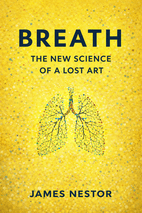
On this page you will find the most striking lines from James Nestor's book Breath. These quotes capture the book's central argument: that how we breathe has a profound effect on our health, and most of us are doing it wrong. Nestor mixes science, history, and firsthand adventure to make his case, and the result is a collection of statements that are both surprising and shareable. Some will make you laugh, others will make you rethink a lifetime of habits. Each one pulls back the curtain on a process we barely notice but one that shapes our bodies and minds.
Top Quotes from Breath
“Overall, humans have the sad distinction of being the most plugged-up species on Earth.”
The narrator reflects on the state of human nasal obstruction after seeing his own X-ray and deformities.
This line is striking because it contrasts human exceptionalism with a surprising biological failing, making the reader immediately aware of a widespread but overlooked health issue.
“90 percent of us—very likely me, you, and almost everyone you know—is breathing incorrectly and that this failure is either causing or aggravating a laundry list of chronic diseases.”
The narrator opens the chapter by summarizing a startling finding from breathing researchers.
It immediately grabs attention with a high percentage and personalizes the problem, making readers question their own breathing habits.
“No matter what we eat, how much we exercise, how resilient our genes are, how skinny or young or wise we are—none of it will matter unless we're breathing correctly.”
The narrator concludes the initial research summary by elevating breath above all other health factors.
This strong, sweeping statement challenges conventional health wisdom and positions breathing as the foundational pillar of well-being.
“The nose is the silent warrior: the gatekeeper of our bodies, pharmacist to our minds, and weather vane to our emotions.”
Dr. Nayak explains the multifaceted role of the nose to the author.
This poetic metaphor concisely summarizes the nose's critical but overlooked functions, making it a memorable and powerful encapsulation of the chapter's theme.
“What our bodies really want, what they require to function properly, isn't faster or deeper breaths. It's not more air. What we need is more carbon dioxide.”
Olsson tells the author during an interview in Stockholm.
This flips conventional wisdom about breathing, emphasizing the misunderstood importance of carbon dioxide for health.
“The key to optimum breathing, and all the health, endurance, and longevity benefits that come with it, is to practice fewer inhales and exhales in a smaller volume. To breathe, but to breathe less.”
The author summarizes the core principle after discussing various breathing techniques and research.
This line captures the paradoxical essence of the chapter—that doing less (breathing) can achieve more. It is memorable and counterintuitive, making it highly quotable.
“Within just a few generations of eating this stuff, modern humans became the worst breathers in Homo history, the worst breathers in the animal kingdom.”
The author describes the rapid decline in breathing due to industrialized food after visiting the Paris catacombs.
The stark comparison to all of human history and the animal kingdom makes this a shocking indictment of the modern diet's impact on our airways.
Themes Behind the Quotes
A major theme is the decline of human breathing over centuries. Modern diets and lifestyles have shrunk our airways and made us chronic mouthbreathers, leading to a host of health problems. Nestor argues that this is not inevitable and that we can retrain ourselves to breathe the way our ancestors did. Another theme is the hidden power of carbon dioxide. Contrary to popular belief, we need it to regulate oxygen release and calm the nervous system. Overbreathing, or taking in too much air, actually starves our cells. The book also emphasizes the nose as an essential filter, warmer, and humidifier that activates the body's natural balance. Finally, breathing is presented as a direct control switch for the autonomic nervous system, offering a simple way to influence stress, heart rate, and overall health.
Quotes by Chapter
One: The Worst Breathers in the Animal Kingdom
“Forty percent of today’s population suffers from chronic nasal obstruction, and around half of us are habitual mouthbreathers, with females and children suffering the most.”
The narrator explains the prevalence of mouthbreathing before beginning his experimental ten days of forced mouthbreathing.
The statistic is both alarming and concrete, grounding the abstract concept of poor breathing in measurable reality and emphasizing that this is a common, not fringe, problem.
“I'll be lulling my body into a state it already knows, that half the population knows, only multiplying it many times.”
The narrator describes the purpose of his upcoming mouthbreathing experiment—to amplify the chronic breathing dysfunction shared by many.
The metaphor of 'lulling' and the repetition of 'knows' create a visceral sense of familiarity and inevitability, making the reader feel the cumulative damage of habitual mouthbreathing.
“Of the 5,400 different species of mammals on the planet, humans are now the only ones to routinely have misaligned jaws, overbites, underbites, and snaggled teeth, a condition formally called malocclusion.”
Dr. Marianna Evans compares ancient and modern skulls, noting this striking difference.
This line highlights a unique and widespread human physical degradation that is both surprising and thought-provoking, making readers question why we alone suffer from these problems.
Two: Mouthbreathing
“Mouthbreathing, it turns out, changes the physical body and transforms airways, all for the worse.”
The narrator reflects on the results of Harvold's monkey experiments and the broader implications.
It delivers a concise, alarming truth about the physical consequences of a common habit, reinforcing the chapter's central warning.
“What we heard weren't the sounds of happy Dickensian drunks, but of men being strangled to death by our own bodies.”
The author and his colleague Olsson listen to recordings of themselves sleeping, initially laughing then growing frightened.
This vivid, darkly humorous metaphor captures the terrifying reality of sleep apnea, making a medical condition deeply relatable and memorable.
Three: Nose
“I smell the sour, old-sock stink of mud. The black-label ChapStick of the damp doormat. A Lysol whiff of the lemon tree and the anise tinge of dying leaves.”
The author, after removing nasal plugs and rinsing his sinuses, takes his first full breath through his nose and experiences heightened smell.
This vivid sensory description captures the rich, textured world that nasal breathing unlocks, making the abstract benefits of nose breathing feel immediate and tangible.
“To breathe is to absorb ourselves in what surrounds us, to take in little bits of life, understand them, and give pieces of ourselves back out.”
The author reflects on breathing while standing in his backyard after returning to nasal breathing.
This philosophical statement elevates breathing from a biological process to a profound act of connection and reciprocity with the world, resonating deeply with readers.
“It’s a method our bodies use to stay balanced and grounded to the rhythms of the cosmos, and each other.”
The author describes the ancient Tantric text's explanation of nasal cycles and their purpose.
This line beautifully ties human physiology to cosmic rhythms, suggesting a shared, grounding connection that feels both ancient and universally relevant.
Four: Exhale
“The smaller and less efficient lungs became, the quicker subjects got sick and died. The cause of deterioration didn’t matter. Smaller meant shorter. But larger lungs equaled longer lives.”
Researchers from the Framingham Study discovered this correlation between lung capacity and longevity.
This quote powerfully distills the central finding of the Framingham Study, directly linking lung capacity to lifespan in stark, memorable terms. It reinforces the book's core message that breathing capacity is a measure of life itself.
“Emphysema, he realized, was a disease of exhalation. The patients were suffering not because they couldn't get fresh air into their lungs, but because they couldn’t get enough stale air out.”
Carl Stough's realization about the emphysema patients at the East Orange VA hospital.
This insight reframes a common misconception about breathing problems, shifting focus from inhalation to exhalation. It's a pivotal moment that explains Stough's therapeutic approach and the importance of fully emptying the lungs.
“You know, I exhale, which kept my energy up. I didn’t get tired. ... But after the game, I found that this was for my life.”
Olympic sprinter Lee Evans explaining how Stough's breathing technique affected him.
This simple, personal testimony transforms an athletic technique into a life-changing revelation, making readers reflect on the profound power of breath beyond physical performance.
“It didn't matter that saxophonist David Sanborn and asthmatic opera singers, Olympic runners, and hundreds of emphysema survivors praised his treatments as a lifesaver. Stough wasn’t a doctor; he was a self-made pulmonaut, a choir conductor. He was just too far out there. His therapy was just too weird.”
The author reflecting on why Carl Stough's breathing method never gained mainstream acceptance despite its successes.
This passage captures the tragic irony of a revolutionary healer being dismissed as 'too weird,' resonating with anyone who has seen valuable ideas ignored because they defied convention.
Five: Slow
“Carbon dioxide is, in fact, a more fundamental component of living matter than is oxygen.”
Henderson wrote this after experiments on dogs.
This bold statement redefines the hierarchy of gases in the body, emphasizing carbon dioxide's essential role.
“I realized then that breathing was like rowing a boat: taking a zillion short and stilted strokes will get you where you're going, but they pale in comparison to the efficiency and speed of fewer, longer strokes.”
The author reflects after his own slow breathing experiments.
The simple analogy makes the concept of slow breathing immediately relatable and memorable.
“They were stunned to find that the average number of breaths for each cycle was “almost exactly” identical, just a bit quicker than the pace of the Hindu, Taoist, and Native American prayers: 5.5 breaths a minute.”
Researchers analyzing the rosary prayer cycle discovered a common breathing rhythm across traditions.
It reveals a surprising universal pattern that connects ancient spiritual practices through their respiratory pacing.
Six: Less
“What if overbreathing wasn’t the result of hypertension and headaches but the cause?”
Buteyko asks himself this question during a moment of insight in a hospital room.
This question flips conventional medical thinking on its head, making it a powerful turning point in the narrative. It resonates because it challenges readers to reconsider fundamental assumptions about health.
“Most of us breathe too much, and up to a quarter of the modern population suffers from more serious chronic overbreathing. The fix is easy: breathe less. But that's harder than it sounds.”
Early in the chapter, the author introduces the prevalence of overbreathing in modern society.
The simplicity and honesty of the solution ('breathe less') paired with the admission of difficulty makes this relatable. It succinctly states the problem and the challenge.
“In essence they are taking in too much air. But the sensation that they get is shortness of breath, choking, air hunger, as if they're not getting enough air. It's almost like a biological system error.”
Dr. Alicia Meuret, director of the Anxiety and Depression Research Center, explaining the paradoxical experience of hyperventilation.
This line captures the fundamental paradox of overbreathing—the felt sensation contradicts the physical reality—making it a memorable insight into why breathing less can be counterintuitive yet healing.
Seven: Chew
“It was the constant stress of chewing that was lacking from our diets—not vitamin A, B, C, or D.”
The author explains the real cause of modern airway problems after examining Weston Price's work and his own observations.
This line reframes nutritional debates, highlighting that mechanical chewing stress is more critical for facial development than vitamins alone.
“What looked like human progress—all that milling, mass distribution, and preservation of food—had horrible consequences.”
The author reflects on the unintended damage of food industrialization while leaving the Paris catacombs.
It captures the tragic irony of technological advancement undermining human health, a central theme of the chapter.
“Breathing slow, less, and exhaling deeply, I realized, none of it would really matter unless we were able to get those breaths through our noses, down our throats, and into the lungs.”
The author synthesizes his Stanford experiment findings with the realization that airway anatomy is the bottleneck to effective breathing.
It succinctly ties the book's core breathing techniques to the structural problems caused by soft, processed food, emphasizing the foundational importance of airway space.
Eight: More, on Occasion
“You are not the passenger,” McGee keeps yelling at me. “You are the pilot!”
Chuck McGee III is yelling encouragement as the author practices Tummo breathing in a park.
This line empowers readers to take conscious control over their stress response, shifting from passivity to active mastery. It encapsulates the chapter's theme that extreme breathing can transform our relationship with the autonomic nervous system.
“Breathing is a power switch to a vast network called the autonomic nervous system.”
The author explains the fundamental role of breathing in regulating the body's automatic functions.
It succinctly conveys the core insight that breathing is not just mechanical but a master controller of our physiology. This metaphor makes a complex scientific concept instantly understandable and memorable.