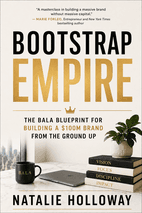
Bootstrap Empire Key Takeaways
by Natalie Holloway
As an Amazon Associate, we earn from qualifying purchases.
5 Main Takeaways from Bootstrap Empire
Embrace the Bootstrapper's Mindset for Long-Term Success
Start with a personal hustle mantra to fuel early efforts, but remember that entrepreneurship is a marathon. Hustle intensely in the beginning so you can later enjoy freedom, and never agonize over decisions—make them quickly and move forward.
Launch a Minimum Viable Version and Iterate Fast
Rather than waiting to be ready, break operations into manageable pieces and launch a basic version of your product. Bootstrap by keeping a day job, negotiating everything, and using partnerships and commission-based compensation to grow without upfront cash.
Master the Art of Saying No to Protect Your Path
Create a yes filter based on ROI, customer excitement, and team efficiency, and learn to say no even at the signing table. Avoid FOMO—others' highlight reels are not your roadmap—and remember that every no is a 'maybe later' that protects your focus.
Empower Your Team and Build Systems for Freedom
Establish clear rules for meetings, deep work, and delegation to create freedom, not rigidity. Empower your team to own their roles, use habit stacking and outsourcing to maximize time, and treat every no as a way to protect your path forward.
Keep Innovating and Engaging Your Customer Base
Map out a five-year product roadmap and don't fear pivoting when something isn't working. Surprise your customers with drops, seek their input, and make time for silence and creativity so you can try new channels, partners, and platforms.
Executive Analysis
These five takeaways together form the book's central argument that bootstrapping is not merely a financial constraint but a comprehensive philosophy for building a sustainable business. The journey begins with cultivating a resilient, decision-oriented mindset (Takeaway 1) before moving to tactical execution through MVPs and resourceful growth (Takeaway 2). As the business scales, the bootstrapper must master the discipline of saying no to protect resources (Takeaway 3), then create systems and empower others to reclaim time (Takeaway 4), all while keeping innovation at the core (Takeaway 5). Each insight reinforces the others, showing that bootstrapping success comes from integrating grit, frugality, and strategic focus.
This book matters because it fills a gap in startup literature that often assumes venture capital is necessary. Holloway provides a concrete playbook for entrepreneurs who want to build on their own terms—without giving up equity. By blending mindset shifts with tactics like negotiating everything, saying no to FOMO, and using surprise drops, Bootstrap Empire offers practical wisdom for self-funded growth. It stands out for its honest tone and emphasis on long-term freedom over short-term hustle.
Chapter-by-Chapter Key Takeaways
PART I: The Bootstrapper's Mindset (Chapter 1)
Come up with a hustle mantra for your early stages of business.
Entrepreneurship is a marathon, not a sprint.
Hustle in the early days so you can have freedom later on.
Harness your determination.
Be the model for grit and grind you want your employees to embody.
Don't agonize or stew; make the decision and move on.
Try this: Create a personal hustle mantra to embody grit and grind, remember that entrepreneurship is a marathon, and practice swift decision-making to avoid agonizing.
PART II: Building Your Empire from Scratch (Chapter 2)
Break operations into manageable pieces.
Launch a minimum viable version, then iterate.
Bootstrap by keeping a day job; negotiate everything.
Use partnerships, affiliate marketing, and organic social.
Prioritize commission-based compensation.
Pitching is a state of mind.
Know your desired outcome before every pitch.
Confidence is built through preparation and practice.
Rejection is a numbers game.
Don’t wait to be ready.
Treat product launches as tests.
Ruthlessly put yourself out there.
Try this: Keep your day job while launching a minimum viable product, negotiate every expense, and pitch with confidence by knowing your desired outcome before each interaction—treat rejection as a numbers game and always put yourself out there.
PART III: Scaling Without Selling Out (Chapter 3)
It’s never too late to say no, even at the signing table. Trust your gut over sunk costs.
Create a yes filter with clear criteria (ROI, customer excitement, team efficiency) to evaluate every opportunity.
Say no to FOMO—other people’s highlight reels are not your roadmap.
Establish rules for meetings, deep work, personal time, and team delegation. They create freedom, not rigidity.
Empower your team to own their roles—you’ll get back hours of your life and build loyalty.
Use habit stacking, outsourcing, and location efficiency to maximize time with what matters most.
Every no is a “maybe later.” You’re not closing doors—you’re protecting your path forward.
Think about the future as soon as possible—map out your product roadmap for at least five years.
If something isn’t working, there’s always a pivot to be made—try a new channel, a new retailer, a new partnership.
Keep your customer base excited and engaged through surprise drops, community input, and consistent newness.
Don’t be afraid to try new things—whether it’s a new ad platform or a collaboration with an unexpected brand.
Make time for silence so you can get creative—great ideas come when you’re not busy.
Try this: Establish a yes filter with clear criteria (ROI, customer excitement, team efficiency) to evaluate every opportunity, and set rules for meetings and deep work to protect your time—then empower your team to own their roles while you map a five-year roadmap and make creativity a priority.