Blood of Truth and Traitors Themes
by Aria Ashbrook
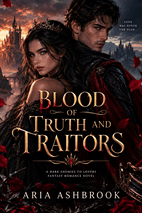
Underneath its battles and vows, Blood of Truth and Traitors wrestles with identity you inherit versus identity you choose, loyalty that cannot speak, and love that keeps demanding sacrifice. Rose's hidden Sanning heritage, blood bindings, poisoned lace marks, and magic that erupts from rage or grief keep forcing impossible choices.
On this page, theme breakdowns cover hidden heritage, binding vows and betrayal, protective sacrifice, dangerous magic, torn family duty, and wartime prejudice, using moments like Rose's Child of Four reveal and her need to protect William and Kay. It also tracks the Veil, the three daggers of Vindrun, black lace markings, and Fen and Elska's dire wolf bond.
Major Themes in Blood of Truth and Traitors
Identity and Hidden Heritage
Rose is hailed as the lost Issen princess, then learns she is part Sanning and the 'Child of Four,' while her family history is revealed through rings, daggers, Veil visions, and Magnus's accounts. The book repeatedly tests whether identity is bloodline, chosen loyalty, or a role imposed by prophecy.
- Rose insists, 'I'm not royalty... I'm a slum rat,' even as Issen guards kneel and her ring seems to confirm her mother's Issen blood.
- Magnus calls Rose his possible grandchild and later his kin and granddaughter after she survives the Veil; he reveals he married a Sanning, making Rose part Sanning.
- Uzra describes children in Isthyr with mixed Issen and Morathkian powers; Rose realizes Raven Sight comes from her Sanning heritage and that she is a quarter Sanning.
Trust, Secrets, and Binding Vows
Blood vows, priestess bindings, hidden identities, and political betrayals keep characters from speaking truth even when they want to. The plot turns on revelations about who knew what and on characters breaking or exploiting vows.
- Kyor cannot tell Rose what Ryne said because of his vow; Fen says, 'Vows bind wolves and their bonded alike.'
- Magnus reveals Rose was the anchor of her friends' blood vow, that speaking of it would forfeit their lives, and that the vow can be broken only if all parties agree or through death.
- Kyor stops his own heart to break the vow that was eating away at him; Orla revives him, and he then reveals Korvane sealed him to secrecy about the Rottings and Mila bound him.
- Ruben reveals Benny has been listening to Ranveeg and Stefan's plans to destabilize Korvane for Eastern Isles independence, and Rose confronts Benny.
Sacrifice, Grief, and Protective Love
Characters repeatedly risk or give their lives for loved ones, and the narrative dwells on the grief and commemoration that follow. Love is shown as both a motivation for sacrifice and a source of terrible loss.
- Kyor offers to take Rose's place in the Rite even though Magnus says he would die; Rose kisses him goodbye and asks Ruben to look after Kay if she dies.
- Rose endures the Veil while thinking of Kay and her baby and William, because they will never be safe unless she does this.
- Ruben demands more power from Rose to save Benny, forms a condensed ball of destruction that kills the jétunn, tells Benny he will never stop loving him, and dies; his body becomes blue ice shards lifted into dawn light at his funeral.
- Kyor weeps over dead Morathkian soldiers he killed, and Rose grieves Ruben and blames herself while Benny says Ruben accepted his proposal the morning he died.
Power, Control, and the Burden of Magic
Magic is inherited, gifted, poisoned, trained, and tied to emotion; Rose's powers often erupt when she is angry, afraid, or grieving. Control is both a practical goal and a measure of maturity.
- Rose accidentally creates blizzards, cages Stefan and Kyor in ice spears, and freezes the river when frustrated; Stefan teaches that creation is not her problem, control is.
- Rose's hands pain her when she tries to eat because the incomplete Veil marks will poison and kill her unless she completes the Rite within one moon.
- Oel touches Rose and gives her a large amount of Issen magic; her power tears loose as a thousand ice spears, and Magnus redirects them upward.
- Rose combines Morathkian and Issen magic to grow roots and slow the collapsing ice wall while Kyor unleashes a massive lightning blast.
Family, Duty, and Impossible Choices
Rose is torn between her found duty as an Issen heir and prophesied figure and her need to protect William and Kay. The book repeatedly forces characters to choose between loved ones, thrones, wars, and their own survival.
- Rose tells Kyor she fears the prophecy may force her to choose between duty and keeping William and Kay safe.
- Linnea tearfully asks Rose to make sure her daddy comes back from the war, and Rose fears people expect her to end a centuries-long war just because she can make an ice wolf.
- Rose considers giving the dagger to the Morathkian knights because her family is safest if she does what they ask, but she cannot let innocent people die.
- At the end, Rose must choose between saving William and saving Galreck or getting the dagger before Mila.
Prejudice, Betrayal, and the Human Cost of War
Issen and Morathkians carry deep enmity, and characters are judged by bloodline, heritage, or parentage even when they seek peace. Betrayal and war bring visible costs to ordinary people.
- A crowd shouts 'No more Morathkian murderers!' and 'Kill them!' while Ranveeg threatens that Rose's friends will pay for sullying Issen lands with their Morathkian stench.
- Ranveeg calls for killing Kyor after learning he is Korvane's son, and a Morathkian officer calls Rose an abomination because Issen blood is in her veins.
- Magnus says he will judge Kyor for who he is, not for his father's actions, but Ranveeg confesses she showed the Morathkians through the pyrrhic and wants Rose dead.
- Rose sees soldiers hugging loved ones and weeping children before they march to the front line, and notices wounded veterans in Isthyr.
Symbols and Motifs
The Veil / Rite of the Veil
A trial of fire and memory that proves identity, exposes painful truths, and can poison or kill if incomplete. It represents acceptance, self-knowledge, and the cost of belonging.
- Magnus explains the Veil is the highest Issen accolade, normally limited to one acceptance per sun rotation, but heirs can be accepted at any time; it has three stages.
- Rose steps into the flames and survives, seeing black lines mark her arms; Magnus gives her white gloves to cover the Veil markings.
- Caz reveals Rose must complete all stages within one moon or the marks will poison and kill her.
- In the third stage, Rose sees visions of her younger mother and Dinah, learns two lessons, and fails when she refuses to relive the worst night of her life.
The Three Daggers / Blades of Vindrun
Divine weapons from Etta that can 'bind, free, or kill,' possibly even a God; they drive the plot's race between Rose, Mila, and Galreck.
- Benny translates the page as 'One to bind, one to free, one to kill,' and the group deduces the blades might be able to kill, bind, or free a God such as Sanrott.
- Benny recalls his grandfather's story about a Galreckian Rettling receiving three daggers from Etta.
- Rose connects Mila's identical blade and Jai's death, theorizing the blade judged Jai a thief and killed him.
- Kyor recalls a matching dagger kept on display in Galreck, confirming the three blades are with Mila, Rose, and Galreck.
Black Lace Markings / Veil Marks / Issen Lace Patterns
Visible signs of Issen or Morathkian heritage that also mark poison, danger, and the countdown to death; they tie Rose's body to William's fate and to political prejudice.
- After surviving the Veil, Rose sees black lines mark her arms and thinks 'An Issen princess.'
- Uzra says Issen face markings appear around fourteen to sixteen and always spread to the face and hands, with no way to stop them, making Rose fear for William.
- Caz reads that the marks are a slow-acting poison; Rose's hands throb when she touches the table, and Nettie cannot touch the poison in her black-laced hands.
- In Rose's dream, William is covered in Issen markings and stands before Korvane awaiting his death blow; later a vision shows him trapped with his lace patterns exposed.
Dire Wolf Bond (Fen and Elska)
A soul-bond of shared fate, telepathy, and loyalty that mirrors the novel's themes of chosen family and mutual sacrifice. The wolves also embody instinct, protection, and grief.
- Fen crosses the river despite his fear because Rose needs him, and Rose notes that if she dies, so does Fen; Fen says it will be an honour to die with her.
- Fen and Elska split roles to protect Rose and search for the shade; Fen guards Rose's dagger, coaches her through panic, and calls her 'Little Raven.'
- Elska howls in agony when Kyor stops his heart, then barks joyously and licks his face after he revives.
- Fen kills Morathkian warriors and their wolves in battle, then feels anguish and asks forgiveness for killing those he once fought alongside.