Beginning Middle End Book Club Questions
by Valeria Luiselli
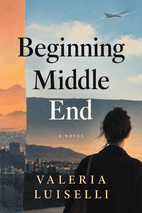
Valeria Luiselli’s Beginning Middle End is the kind of novel that stays with you after the last page. It asks big questions about memory, motherhood, and the stories we inherit, without offering easy answers. The relationship between the narrator, her daughter, and her own mother is rich material for book clubs, especially if you like talking about unreliable memory and moral gray areas.
These questions are meant to open up conversation, not to test you. You don’t need to answer them in order. Pick the ones that spark debate, skip any that feel too personal, and let the group wander. Many questions are intentionally open ended. If you disagree with each other, that’s a good sign. Let the book, and your own experiences, guide the discussion.
Memory, Storytelling, and What We Pass On
- 1.The narrator opens by asking her mother what she fears in old age and gets 'Perder la mente' and 'Perder claridad.' How does the Grandmother's fear of losing clarity shape the novel's treatment of memory, especially in contrast to the daughter's fear of fabricated memories?
- 2.The daughter's theory that Nanna used the Proteus mosaic to travel to the future and then wanted to forget it is presented alongside the narrator's more rational explanations. Did you find the daughter's magical theory convincing, or is it a way for both of them to cope with Grandma's memory loss? What does it say about fiction as 'where memory and imagination meet'?
- 3.The novel ends with the narrator finishing Ma's book, titling it Proteus: Prima Materia (Mistral), and heading to the shore to return Proteus as fires close in. Did the ending feel like a beginning, middle, or end to you? What does the act of writing and finishing the book mean for the transmission of memory between generations?
- 4.The narrator often refuses to correct her daughter: she lets her call moths 'fireflies,' allows the embellished tooth story to stand, and retells the fish-tank story even when it may be false. Did you agree with this approach to memory and storytelling? What might it preserve or endanger in their relationship?
- 5.Ma's mother sends increasingly scattered messages—'M ETA?', 'TA?', 'Pirandello! Chaos!'—while also joining an eco-radical group to fight a border canal. How do you interpret her story arc? Is her political commitment a form of clarity or a symptom of her confusion?
Mothers, Daughters, and Agency
- 6.The narrator says her daughter's behavior is 'a strange mirror' of her capacity to raise her alone. Did you read the daughter's early refusals—not sending postcards, not swimming, crying over spilled books—as signs of grief or as resistance to the mother's 'new beginning'? What do they suggest about the daughter's agency?
- 7.In Chapter 7, the daughter theorizes that the narrator likes pools because she got her period in one at fourteen. The narrator reflects, 'our children are always, also, reading and writing us.' How does this reversal—daughter interpreting mother—change how you read the rest of the book?
- 8.When the daughter is stung by a jellyfish, the narrator asks, 'Am I at all capable of keeping my daughter safe?' Given that the daughter had earlier refused to swim and the narrator had been trying to protect her, how does this moment change the narrator's understanding of motherhood and risk?
Theft and Moral Inheritance
- 9.Nanna dressed as a man to work in archaeological digs and stole the Proteus mosaic, and later died alone in an asylum. The daughter questions the morality of stealing the mosaic. Do you agree with the daughter that it should be returned, or with the narrator's initial refusal? How does the theft complicate the story of inheritance?
- 10.The daughter disappears with the swordfish head for hours and asks not to be questioned; later she insists on returning the Proteus mosaic. What did you make of her unexplained act? Did it foreshadow her role as the moral driver of the plot?
- 11.The tourist assaults the narrator after she says they are leaving, and she responds by stealing his driver's license and looting Loeb Classics with her daughter, thinking 'A beginning is a great theft.' Did you agree with her choice to take the books and license? What does that act of theft say about how she reclaims agency?
History, Migration, and the Classics
- 12.The anti-migrant posters in Catania provoke the daughter to call their creators 'cretini motherfuckers,' and the narrator reflects that Europeans migrated to Latin America a century ago. How does the novel use Nanna's migration and the current migrant crisis to question who belongs to Sicily and the Mediterranean?
- 13.Throughout the book, the narrator and her daughter read Pliny, Seneca, Homer, and Virgil. How do these classical texts—especially the Proteus myth and Pliny's account of Vesuvius—function as a lens for the contemporary disasters, fires, evacuation, and migration in the story?