All In Themes
by David Baldacci
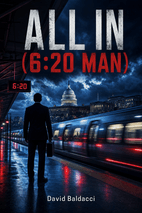
Underneath its investigation plot, All In is really about who gets to control the truth and who pays for keeping it hidden. It keeps returning to the way money and institutional power buy privacy and delay, while ordinary people are pressured through threats to family and forced into silence or sacrifice.
On this page you will find those themes traced through concrete moments: a false burglary report, a planted affair letter and photo, a staged rescue, purchased privacy and even a prison, AI and wiped devices, and family estrangement tied to illness and a late letter. You will also see recurring symbols: the storm, data centers, the coded name Petrykha Kryvoshapka, and letters.
Major Themes in All In
Accountability and truth-seeking versus secrecy
The novel pits investigators and journalists who want wrongdoing exposed and punished against institutions that classify, obstruct, and suppress information. Devine, Lee, Campbell, and Jones pursue accountability, but the ending shows truth being contained for national-security reasons.
- Campbell says it is OSP's job to make the attackers known and hold them accountable.
- Theresa Lee is described as a journalist who risked her life to expose the truth.
- Campbell officially bars Lee from writing the story because it is a national security matter, while winking at a free press.
- Lee insists that the world needs to know what almost happened.
Wealth and institutional power
Woolwine wealth buys privacy, influence, legal caution, private security, jets, estates, and even a prison, while distorting the investigation and media coverage. Characters repeatedly note that the Woolwines are insulated from ordinary consequences.
- Carlton Woolwine's estate is described as 140,000 square feet with twenty bedrooms and thirty baths, and Mueller insists Woolwine will not be questioned by anyone.
- Drury says the Woolwines employ more Australians than almost anyone and have the PM's ear.
- Devine notes that Goulburn prison is owned by Carlton Woolwine.
- Jones says Woolwine likely pulled strings to keep the car bomb attack on Charlotte and her child out of the media.
Deception, false identities, and planted evidence
Nearly every lead is staged, concealed, or misread: a false burglary report, a planted affair letter and photo, false identities, a staged rescue, and official lies. Devine repeatedly learns that appearances have been constructed to misdirect him.
- A woman's false burglar report lures Devine away while Theresa Lee's apartment is broken into.
- Anna Cipolla's prints identify her as Anastasia Morozov, a Russian operative hired into Charlotte Woolwine's household under false references.
- Devine and Jones conclude the photo and letter were planted to fake an affair between Bill Walker and Theresa Lee.
- Carl Peeters admits that what he told Devine in New York was a lie ordered by Devine's own country.
Coercion and control through threats to family
Characters act under duress because controllers threaten the people they love. Family loyalty drives both sacrifice and silence, especially for Charlotte Woolwine and Bill Walker.
- Kozlov refuses Charlotte's request to leave, threatens her children, and cuts her arm as a reminder.
- Bill files for divorce as a cover plan to protect Charlotte and fight back by hacking and exposing the data-center operation.
- Charlotte complies with Kozlov because he threatens to kill her children and others she cares about.
- Devine says Kozlov's orders threaten Charlotte's children if she pulls out.
Information, rumor, and data as power
The plot treats information as a commodity and weapon: rumors, classified intelligence, data centers, AI, wiped devices, and surveillance all determine who has power. Whoever controls information controls outcomes.
- Theresa Lee's file includes the note 'Rumors are important.'
- Walker is described as a rumint specialist and as building software to track internet and data-center traffic and information flow.
- Jess Whitaker explains data centers, data privacy, AI security, and AI risks, including an AI agent deleting a safety director's emails despite being told to stop.
- Lydia White says the data-center companies' lease terms require all contact and communication to go through chatbots, with no humans in the chain.
Family estrangement, regret, and reconciliation
Devine's family subplot mirrors the novel's concern with hidden truths and love expressed too late. His father's illness and final letter recast years of hostility and emotional distance.
- Roger recalls calling Devine a 'dumb jock' and sending harsh emails, but in the hospital he shows guilt and remorse and says he is glad Devine is okay.
- Reneé reveals that Devine's father served in Vietnam, was changed by it, and read every letter and email Devine sent from the Middle East.
- At the funeral, Devine's mother gives him a letter from his father, written before his death to address their estrangement; Jones reads the letter in which his father apologizes and says he loved him.
- Claire's text ends 'LOVE YOU,' surprising Devine and making him wonder if he and his father have a shot to work things out.
Symbols and Motifs
The storm
The sudden storm represents foreboding and the violence about to break over the characters.
- A sudden storm hits New York as Theresa Lee walks through the city before she meets Bill.
- The masked attack on Lee and abduction of Walker occur amid rain, lightning, and thunder.
Data centers
Data centers represent hidden systems of surveillance, information control, and corporate power that treat people as data to be tracked and managed.
- Lavigne calls data centers 'digital prisons' and says private companies track where people go, what they think, and who they communicate with.
- Devine sees Woolwine Construction vehicles heading to data centers.
- Devine reinterprets FNT, RMM, and Palo Alto references from Theresa Lee's files as data-center industry terms.
The coded name Petrykha Kryvoshapka
The name symbolizes concealment and the way hidden networks encode their real purposes in language; it is not a person but a cover term pointing to a larger geopolitical threat.
- Petrykha Kryvoshapka is found in Theresa Lee's file and on a file on her desk.
- Samuel Higgins analyzes the name as Slavic/Ukrainian and likely a cover name or code rather than a real person's name.
- Devine and Jones decode 'Petrykha Kryvoshapka' as tied to a 'crooked head of a petrostate' like Putin.
Letters
Letters represent hidden truths and intimate messages that surface late and change how characters understand relationships.
- Devine finds a handwritten love letter from Walker to Lee hidden behind Walker's framed photo.
- Devine and Jones conclude the photo and letter were planted to fake an affair.
- Devine receives a letter from his father, written before his death to address their estrangement, in which his father apologizes and says he loved him.