Algorithms to Live By Quotes
by Brian Christian
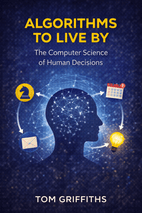
This collection brings together some of the most thought provoking lines from Algorithms to Live By, a book that blends computer science with everyday decision making. You will find quotes that range from surprisingly practical to deeply philosophical, often using math and logic to shed light on human behavior.
The book is quotable because it takes complex ideas like optimal stopping, overfitting, and the explore exploit trade off and turns them into crisp, memorable insights. These aren't just technical observations. They are reflections on love, work, time, and the limits of our knowledge. Each line invites you to see ordinary problems through a computational lens.
Top Quotes from Algorithms to Live By
“A 63% failure rate, when following the best possible strategy, is a sobering fact.”
After explaining the 37% Rule for the secretary problem, the author notes the high failure rate even with optimal strategy.
It underscores the humbling reality that even the best mathematical approach often fails, resonating with anyone facing uncertainty.
“So explore when you will have time to use the resulting knowledge, exploit when you're ready to cash in. The interval makes the strategy.”
The chapter discusses how the time horizon determines the optimal balance between exploration and exploitation.
It provides clear, actionable advice that readers can apply to their own decisions about trying new things.
“The old adage tells us that “the grass is always greener on the other side of the fence,” but the math tells us why: the unknown has a chance of being better, even if we actually expect it to be no different, or if it’s just as likely to be worse.”
The author explains the Gittins index and its implications for preferring the unknown.
It bridges intuition and rigorous proof, making the mathematical concept feel deeply human and relatable.
“In the practical use of our intellect, forgetting is as important a function as remembering.”
Opening epigraph of the chapter, attributed to William James.
Captures the counterintuitive value of forgetting, which is central to the caching trade-off between memory and speed.
“How we spend our days is, of course, how we spend our lives.”
Annie Dillard epigraph to the chapter.
Reminds us that daily choices define our existence, a profound call to intentionality.
“It's not that they have a bad strategy for getting things done; they have a great strategy for the wrong metric.”
Author rethinking procrastination as an optimal solution to the wrong problem.
Reframes a common failing as a misalignment of metrics, offering insight and forgiveness.
“Fundamentally, overfitting is a kind of idolatry of data, a consequence of focusing on what we've been able to measure rather than what matters.”
When the author draws an analogy between overfitting and religious warnings against worshipping artifacts.
This striking metaphor makes the technical concept of overfitting accessible and memorable by linking it to a universal human tendency to mistake the measure for the thing itself.
Themes Behind the Quotes
One major theme is the tension between exploration and exploitation, or knowing when to try something new versus when to stick with what works. The quotes highlight that this balance shifts over time, and that the value of discovery decreases as opportunities fade. Another theme is the power of constraints and trade offs. From sorting algorithms to scheduling, the book shows that there is no perfect solution, only better strategies for the metrics we choose.
A third theme is the humility of data, especially small data and the danger of overfitting. The quotes remind us that more complexity is not always better, and that forgetting can be as useful as remembering. Finally, there is a recurring idea that we should solve easier versions of hard problems and that understanding comes from simplicity. These themes together encourage a more thoughtful, algorithm informed approach to life's messy decisions.
Quotes by Chapter
1. Optimal Stopping: When to Stop Looking
“It seems the ultimate Catch-22 of the heart.”
The author describes the dilemma of knowing when you've met enough people to find your best match without losing the chance to choose them.
This line encapsulates the emotional paradox at the core of optimal stopping in love, making it instantly relatable and memorable.
“Thus the bigger the applicant pool gets, the more valuable knowing the optimal algorithm becomes.”
The author explains that the 37% success rate holds regardless of pool size, making the algorithm increasingly beneficial.
This highlights the counterintuitive power of a simple rule in vast, overwhelming searches, emphasizing the value of mathematical thinking.
“Gold digging is more likely to succeed than a quest for love.”
Comparing the full-information secretary problem (objective criteria) to the no-information version (love), the author draws this blunt conclusion.
Provocative and witty, this line forces readers to reflect on the difference between measurable goals and emotional ones.
2. Explore/Exploit: The Latest vs. the Greatest
“Journalists are martyrs, exploring so that others may exploit.”
The author describes the plight of music journalists like Scott Plagenhoef.
It encapsulates the sacrifice and purpose of exploration in a memorable, aphoristic way.
“Asobering property of trying new things is that the value of exploration, of finding a new favorite, can only go down over time, as the remaining opportunities to savor it dwindle.”
The chapter explains how the interval (time horizon) affects the explore/exploit tradeoff.
It is a poignant reminder of mortality and opportunity cost, encouraging readers to be mindful of their own timelines.
3. Sorting: Making Order
“Sorted lists are so ubiquitous that—like the fish who asks, “What is water?”—we must consciously work to perceive them at all.”
The author discusses how sorting is key to the human experience of information, noting its pervasive yet invisible role.
This metaphor elegantly captures how we overlook the sorting infrastructure that shapes our digital and physical worlds, prompting a moment of reflection on a fundamental but unnoticed aspect of daily life.
“Sorting involves steep diseconomies of scale, violating our normal intuitions about the virtues of doing things in bulk.”
The author introduces the first fundamental insight of sorting theory, explaining why larger sorting tasks become disproportionately harder.
This counterintuitive principle challenges common assumptions about efficiency and scale, making it a memorable and broadly applicable lesson for organization and productivity.
“It’s been proven that if we want to fully sort n items via a series of head-to-head comparisons, there's just no way to compare them any fewer than O(n log n) times. It's a fundamental law of the universe, and there are no two ways around it.”
The author explains the theoretical limit of comparison-based sorting, established as a proven lower bound.
The bold claim of a 'fundamental law of the universe' elevates computer science to the level of physics, making the constraint feel both profound and inevitable.
“Mergesort is as important in the history of sorting as sorting in the history of computing.”
A 1997 paper makes this statement about the significance of the Mergesort algorithm.
This short, balanced sentence uses a clever recursive structure to assert the algorithm's centrality, making it a memorable and powerful tribute to a foundational idea.
4. Caching: Forget About It
“Depend upon it there comes a time when for every addition of knowledge you forget something that you knew before. It is of the highest importance, therefore, not to have useless facts elbowing out the useful ones.”
Quoted from Sherlock Holmes within the section on cache eviction.
Elegantly expresses the necessity of discarding less useful information to make room for what matters, mirroring the LRU eviction policy.
“The nearest thing to clairvoyance is to assume that history repeats itself—backward.”
Author's conclusion about the Least Recently Used (LRU) caching algorithm.
A memorable and poetic summary of how LRU uses past recency to predict future needs, serving as a guiding principle for caching.
“It's our belief—and we build the company around the fact—that distance matters.”
Akamai's chief architect Stephen Ludin explaining the company's content distribution network.
Underscores that caching is fundamentally about physical proximity, not just speed, with real-world implications for internet infrastructure.
5. Scheduling: First Things First
“Before you can have a plan, you must first choose a metric.”
Author summarizing a theme in computer science regarding scheduling.
Captures the essential idea that defining your objective is prerequisite to optimization, a lesson for life.
“In other words, most scheduling problems admit no ready solution. If trying to perfectly manage your calendar feels overwhelming, maybe that’s because it actually is.”
The author summarizes the findings from scheduling theory research on the tractability of scheduling problems.
This validates the common feeling of being overwhelmed by scheduling, showing that it is a fundamental difficulty rather than a personal failing.
6. Bayes’s Rule: Predicting the Future
“Our days are full of “small data.””
In a paragraph contrasting the age of big data with the small data problems of daily life.
It succinctly captures a universal human experience—making decisions with limited information—and challenges the obsession with big data.
“Laplace's Law offers us the first simple rule of thumb for confronting small data in the real world.”
After introducing Laplace's formula for estimating probabilities from few observations.
It provides a memorable and immediately applicable takeaway, empowering readers to handle uncertainty in everyday situations.
“And the beauty of Laplace’s Law is that it works equally well whether we have a single data point or millions of them.”
Explaining the versatility of Laplace's Law across different data scales.
It highlights the elegance and scalability of the rule, making it feel both profound and practical.
“Recognizing that the Copernican Principle is just Bayes’s Rule with an uninformative prior answers a lot of questions about its validity.”
When the author explains how the Copernican Principle emerges from Bayesian reasoning with no prior knowledge.
It demystifies a counterintuitive principle by revealing its mathematical foundation, showing how a simple heuristic connects to rigorous theory.
7. Overfitting: When to Think Less
“But a better fit for the available data does not necessarily mean a better prediction.”
After showing that a nine-factor model perfectly fits marriage satisfaction data but makes absurd long-term predictions.
It encapsulates the core paradox of overfitting—that perfect fit does not guarantee predictive power—and is a simple, counterintuitive truth.
“So one of the deepest truths of machine learning is that, in fact, it’s not always better to use a more complex model, one that takes a greater number of factors into account.”
After demonstrating how adding complexity can worsen predictions in the marriage example.
It delivers the chapter's central insight in a clear, declarative sentence, challenging the intuition that more factors always help.
“If you can’t explain it simply, you don't understand it well enough.”
This anonymous quote introduces the section on penalizing complexity (regularization).
It is a widely resonant aphorism that captures the essence of simplicity and understanding, and its placement here reinforces the chapter's message.
8. Relaxation: Let It Slide
“When the problem is hard, it doesn’t mean that you can forget about it, it means that it's just in a different status. It’s a serious enemy, but you still have to fight it.”
Scheduling expert Jan Karel Lenstra, describing how computer scientists approach intractable problems.
It reframes difficulty not as a reason to give up but as a call to strategic persistence, inspiring resilience and creative problem-solving.
“If you can’t solve the problem in front of you, solve an easier version of it—and then see if that solution offers you a starting point, or a beacon, in the full-blown problem.”
The authors explaining the technique of Constraint Relaxation.
This pragmatic advice is directly applicable to life’s overwhelming challenges, offering a concrete, iterative path forward when perfect answers are unreachable.