A World Appears Quotes
by Michael Pollan
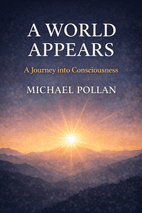
This collection brings together some of the most provocative lines from Michael Pollan's exploration of consciousness, plants, and the limits of science. You will find sharp critiques of reductionist thinking, mind bending reflections on what it means to be aware, and a deep curiosity about the inner lives of beings radically different from us.
What makes this book so quotable is how it fuses scientific rigor with a sense of wonder. Pollan has a gift for taking complex ideas and turning them into sentences that stick with you, challenging assumptions and inviting you to see the world with fresh eyes.
Top Quotes from A World Appears
“As for the shrieks and howls of the creatures he tortured, these he dismissed as the meaningless noise of automatons, having nothing to do with feelings as we—and only we—know them.”
The author describes Descartes' justification for vivisection based on his belief that animals lack souls.
This vivid, horrifying image exposes the ethical consequences of dualism, forcing readers to confront how philosophical assumptions can license cruelty. It lingers as a moral indictment of any worldview that denies sentience to other beings.
“Stripped of qualities, the material world was reduced to quantities and, eventually, to a “resource.” We know where that has led.”
The author reflects on how Galileo's methodological choice became a full-blown metaphysics of reductionism.
This line connects the abstraction of science directly to ecological devastation, making the abstract philosophical point feel urgent and concrete. It resonates because it names a trajectory we are living through.
“One of the more consistent and curious aspects of psychedelics is their ability to reanimate a world gone quiet and still.”
The author reflects on the effects of psychedelics after taking magic mushrooms.
This line poetically captures how psychedelics restore a sense of aliveness to a world often perceived as inert, resonating with anyone who has felt disconnected from nature.
“If there is “something it is like” to be a bat, or any other being, then that being must have some kind of subjective experience, and we should therefore consider that being conscious.”
The author explains Thomas Nagel's famous definition of consciousness from his article 'What Is It Like to Be a Bat?'
This line succinctly captures the core criterion for consciousness—subjective experience—and has become a touchstone in philosophy and science for extending moral consideration to non-human beings.
“There is no “view from nowhere” (to borrow from the title of one of Nagel’s books, a critique of reductive science). In other words, there is no godlike vantage from which we can objectively regard consciousness, because all views, including neuroscience's and philosophy’s, are themselves the products of consciousness.”
The author reflects on the challenge of detecting consciousness in others without an objective standpoint.
This passage powerfully reminds readers that every attempt to study consciousness is itself shaped by consciousness, undermining the illusion of pure objectivity and opening the door to more subjective methods.
“That the perfume of jasmine or basil or the scent of freshly mowed grass, so sweet to us, is the chemical equivalent of a scream?!”
The author's fearful thought after considering plant pain.
This visceral rhetorical question haunts the reader, forcing a reevaluation of our relationship with the natural world.
“We have lost our empathetic resonance with the larger universe.”
Thompson explains the cost of Western science's blind spot regarding consciousness.
It poignantly laments the disconnection from nature that results from a worldview that ignores sentience in nonhuman life.
Themes Behind the Quotes
A central theme is the critique of modern science and its tendency to strip the world of subjective experience, reducing everything to measurable quantities. Pollan argues this has left us disconnected from nature and from our own consciousness, which becomes something mysterious and almost magical when isolated from the rest of life.
Another major thread is the possibility of plant intelligence and sentience. The book asks whether our human centered definition of consciousness is too narrow, and whether plants might have their own forms of awareness, agency, and problem solving. This leads to a broader invitation to rediscover an empathetic connection with the natural world, one that psychedelics and other practices can help restore.
Quotes by Chapter
Minds Before Brains?
“Science has been constructed in such a way as to exclude it or treat it as an illusion.”
The author discusses Galileo's bifurcation of nature and its impact on the scientific study of consciousness.
This line succinctly captures the central critique that the scientific method, as historically framed, inherently denies the reality of subjective experience. It forces readers to question whether consciousness is truly absent from nature or merely rendered invisible by our tools.
“By subtracting subjective experience from “the real world,” five hundred years of reductive science and philosophical dualism have inadvertently elevated consciousness, unmoored from nature, into something very much like magic.”
The author summarizes the irony of how mainstream science has treated consciousness.
This is a brilliant inversion of the usual narrative: rather than demystifying the world, science has made consciousness seem supernatural. It challenges readers to see the blind spot in their own thinking.
Plants Awaken
“Does the animism that psychedelics appear to promote represent a return to forms of magical thinking we have outgrown? Or does it represent a relearning of something crucially important about the world that we have, to our peril, forgotten?”
The author poses a central question about the value of animistic beliefs.
This powerful rhetorical question encapsulates the book's core tension between dismissing altered perceptions as regressive and embracing them as essential wisdom, forcing readers to examine their own assumptions.
“I was as certain of the sentience of the flowering plants around me as I had been of anything up to that point.”
The author describes his own certainty during a psychedelic experience in his garden.
The visceral honesty of this statement conveys the profound, unshakable conviction that can arise from direct experience, challenging readers to consider the limits of their own certainty.
“It seemed obvious that not only were these plants cognizant of their environment, but they also had preferences, agency, and a viewpoint of their own.”
The author elaborates on his perception of plant sentience under the influence.
This line articulates a radical shift in perspective—attributing agency and viewpoint to plants—that feels intuitively true during the experience, making readers question the boundaries of consciousness.
Is It Like Anything to Be a Plant?
“It is hardly an exaggeration to say that the tip of the radicle thus endowed, and having the power of directing the movements of the adjoining parts, acts like the brain of one of the lower animals; the brain being seated within the anterior end of the body, receiving impressions from the sense-organs, and directing the several movements.”
Charles Darwin likens the tip of a plant's primary root to an animal brain.
This vivid, century-old analogy from Darwin challenges our neurocentrism by suggesting that plants possess a distributed, underground form of intelligence, inviting readers to see roots as active command centers.
“The case of plants is much, much harder. Their design and behavior, so different from our own, pose a tremendous challenge to the human imagination.”
The author compares the difficulty of imagining plant consciousness to that of imagining bat consciousness.
This line honestly acknowledges the profound gap between human and plant experience, setting up the central question of the chapter and humbling our anthropocentric assumptions.
Enter the Plant Neurobiologists
“The truly vexing issue is... what it is like for the plant to be a plant. It is the subjective character that we're after. We must put ourselves in the plant's shoes, or, I should say, in the plant's roots, if you'll forgive the pun.”
Paco Calvo, a plant neurobiologist, writes in a 2017 article titled 'What Is It Like to Be a Plant?'
This playful yet profound line challenges anthropocentrism by inviting readers to imagine a radically different form of existence, using humor to underscore the difficulty of understanding plant subjectivity.
“What if the exact opposite is the case? If running away from a threat or chasing down your next meal is not an option, you absolutely can't afford to be stupid. In fact, you might very well need to be smarter.”
The plant neurobiologists' counterargument to Churchland's dismissal of plant intelligence.
It inverts a common bias, making a compelling case that immobility may demand greater cognitive sophistication, not less.
“None of this research proves that there is something it is like to be a plant, but the picture that emerges is of highly responsive beings possessing agency, preferences, goals, and a point of view—beings into whose shoes (or roots) we could conceivably put ourselves.”
The author's conclusion after summarizing plant neurobiology findings.
This sentence elegantly balances scientific caution with a call for empathy, opening the door to moral consideration of plants without overstating the evidence.
Are Neurons Overrated?
“Neurons perhaps are overrated,” Mancuso told me. “They're really just excitable cells.”
Stefano Mancuso, plant neurobiologist, responding to the puzzle of plant intelligence without a nervous system.
It challenges the fundamental assumption that neurons are necessary for cognition, suggesting that intelligence may be a more general biological property.
“Intelligence is the ability to solve problems.”
Mancuso defining intelligence during a conversation about plant behavior.
This simple, functional definition broadens the concept of intelligence beyond humans and animals, making it applicable to plants and other life forms.
“If the root were a mouse or a dog or you,” Mancuso told me, “there would be no doubt that you or the dog or the mouse are intelligent.”
Mancuso describing the root maze experiment that demonstrates plant problem-solving.
It forces the reader to confront their own anthropocentric bias by equating plant behavior to that of animals, and questions why we are reluctant to attribute intelligence to plants.
“The bean knows exactly what is in the environment around it,” Mancuso told me. “We don't know how. But this is one of the features of consciousness: You know your position in the world. A stone does not.”
Mancuso interpreting a time-lapse video of a bean plant reaching for a pole.
It suggests that plants possess a form of consciousness and intentionality, directly questioning what it means to be a sentient being.
Plants, Conscious and Unconscious
“I cannot help but to think of plants as, in a sense, these locked-in syndrome patients that somehow cannot flag that they are mentally alive.”
Calvo told his audience at a recent talk.
This unsettling analogy powerfully challenges our assumptions about plant consciousness, comparing them to sentient beings unable to communicate.
“They can eat light, isn't that enough?”
The late ethnobotanist Timothy Plowman's exasperated reply when asked if plants are conscious.
A witty and profound reminder that plants possess extraordinary abilities that transcend human-centered concepts of consciousness.
Minds Without Neurons
“Neuroscience is no more about neurons than computer science is about your laptop.”
Michael Levin, a developmental biologist, arguing that neuroscience's principles apply beyond neurons.
This witty analogy challenges the neuron-centric view of cognition and expands the domain of neuroscience.
“Evolution, it seems, doesn't come up with answers so much as generate flexible problem-solving agents that can rise to new challenges and figure things out on their own.”
Levin writing about evolution's capacity for generating flexible problem-solving agents, inspired by his Xenobot experiments.
It redefines evolution as creative and open-ended, rather than merely reactive.
“There's no reason why meditation, psychedelics, or whatever else you use to fuse your mind with the mind of another creature wouldn't teach us something about what drives experience.”
Levin suggesting that non-traditional methods like meditation and psychedelics could be valid scientific approaches to consciousness.
It challenges the hegemony of third-person science and opens the door to experiential knowledge.
The Physics of Sentience
“Inference is a master term for Friston. He has written that “inference is actually quite close to a theory of everything—including evolution, consciousness, and life itself.””
The author describes Friston's central concept of inference.
This line condenses Friston's ambitious claim that a single principle underlies the most fundamental phenomena, making it both provocative and memorable.
“Consciousness,” Friston has written, “is nothing grander than inference about my future.”
Friston offers a deflationary definition of consciousness.
It challenges the reader to rethink consciousness as a practical, predictive function rather than a mysterious quality, striking a balance between profundity and simplicity.
“The hard problem of consciousness itself emerges,” Friston explained, “from being able to entertain the counterfactual hypothesis that we might not be conscious.”
Friston responds to the author's question about the hard problem of consciousness.
This insight reframes the hard problem as a byproduct of our imaginative capacity, offering a surprising and thought-provoking twist on a classic philosophical puzzle.
“The ability to imagine the impossible is the great gift of consciousness,” Friston said as our time together neared an end, “but it also leads to all this puzzlement and existential angst.”
Friston reflects on the dual nature of human imagination at the close of their conversation.
This line captures the bittersweet essence of consciousness—its power to transcend reality and its tendency to generate existential turmoil, making it deeply resonant.