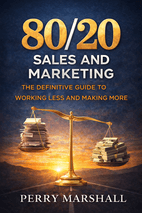
80/20 Sales and Marketing Key Takeaways

by Perry Marshall

80/20 Sales and Marketing by Perry Marshall Book Cover

5 Main Takeaways from 80/20 Sales and Marketing

Unlock exponential growth by applying the 80/20 principle in successive layers.

The 80/20 rule is not a loose heuristic but a recursive natural law where 80% of results come from 20% of causes. By applying it repeatedly (80/20², 80/20³), you can identify the tiny fraction of inputs that generate million-to-one leverage, shifting from linear to exponential thinking in business and marketing.

Focus ruthlessly on top performers to drive disproportionate business results.

Whether it's customers, employees, or marketing channels, a small minority produces the bulk of your outcomes. Use tools like RFM analysis to identify your most valuable customers, fire the bottom 10% of performers, and reallocate resources to cultivate these high-impact segments, transforming efficiency and profitability.

Prioritize quality over quantity in prospects, traffic, and daily tasks.

Stop chasing broad audiences and instead 'rack the shotgun' to find highly responsive prospects. Master one traffic source deeply before diversifying, and spend time on pre-qualified leads. In personal productivity, categorize tasks by hourly worth and eliminate low-value activities to focus on what truly moves the needle.

Continuously test and optimize using split-testing and the Power Triangle.

Embrace a testing mindset where there's no failure, only data. Use split-testing to optimize each stage of your sales funnel, from ads to landing pages. The Power Triangle (Traffic, Conversion, Economics) provides a framework to systematically improve profitability by working backward from economics.

Delegate low-value tasks to focus on your unique high-value capabilities.

Your time is your most valuable asset. Identify your innate strengths through tools like the Marketing DNA Test and delegate tasks you dislike or are not good at. Hiring a personal assistant or outsourcing allows you to concentrate on $1,000-per-hour work, accelerating growth and reducing stress.

Executive Analysis

The five takeaways form a cohesive thesis: the 80/20 principle is a recursive natural law that, when applied systematically, revolutionizes sales, marketing, and personal productivity by focusing on exponential leverage points. By shifting from averages to power curves, prioritizing quality over quantity, and embracing continuous testing, you can achieve disproportionate results with less effort. This is operationalized through frameworks like the Power Triangle and delegation, turning abstract insight into actionable strategy.

This book matters because it translates a well-known principle into a practical, data-driven playbook for exponential growth. Unlike generic business advice, it provides specific tools like the 80/20 Power Curve calculator, RFM analysis, and the Marketing DNA Test, making it essential for entrepreneurs and marketers seeking to scale efficiently. It stands out in its genre by combining mathematical rigor with hands-on steps, offering a roadmap to achieve more by working less.

Chapter-by-Chapter Key Takeaways

How 80/20 Works and Why (Chapter 1)

  • The 80/20 Principle is a recursive natural law, not a loose rule of thumb. Its true power is unlocked by applying it in successive layers (80/20², 80/20³), revealing exponential leverage that can reach million-to-one ratios.

  • Forget averages and bell curves. To drive results, you must analyze your world through the 80/20 Power Curve, which focuses on identifying and cultivating the exponentially capable top performers, not the mediocre middle.

  • Business impact is not linear; it's exponential. Adopt the mindset of Power Laws and think in multiples of ten. Your goal is to find and leverage the few inputs that create massively disproportionate outputs.

Try this: Shift your analysis from bell curves to the 80/20 Power Curve to uncover disproportionate leverage points and think in multiples of ten.

Rack the Shotgun (Chapter 2)

  • "Rack the shotgun" is the practice of sending a deliberate signal to an audience to see who responds, thereby efficiently separating the highly engaged minority from the disengaged majority.

  • Qualify, then qualify again. Use sequential offers or signals to progressively narrow your focus onto the most responsive and valuable segment of your audience.

  • Audience over technique. Identifying and targeting the right, responsive person is more critical to success than perfecting sales or marketing tactics.

  • The 80/20 rule is always in motion. People and opportunities are constantly self-identifying. Your job is to design tests ("rack the shotgun") to reveal these patterns and then act on that information.

Try this: Implement sequential qualifying offers to efficiently separate highly engaged prospects from the disengaged majority.

You Can Do Better (Chapter 3)

  • Invisible Leverage is Real: Regardless of current success, significant improvements (25-250% or more) are almost always possible by identifying hidden inefficiencies.

  • Quality Over Quantity in Outreach: Spending the majority of your time with pre-qualified, interested prospects is transformative, making selling easier and more respectful.

  • The 80/20 Rule is Exponential: It's not a simple ratio; it's a compounding law. The majority of your results come from a tiny minority of causes, and within that minority, an even smaller fraction drives disproportionate outcomes.

  • Find Someone to Sell To First: All leverage and improvement are impossible without first correctly identifying your true, receptive audience. This is the essential foundation.

Try this: Audit your current efforts to identify hidden inefficiencies and reallocate time to pre-qualified, interested prospects.

80/20 Traffic (Chapter 4)

  • Stop cold calling. The most effective sales begin with prospects who are already interested and seeking you out.

  • Become a publisher. Establish authority by creating and giving away valuable, problem-focused information (books, articles, tools, cheat sheets).

  • Build a funnel. Always attach a clear, step-by-step mechanism to your publicity to capture leads and move them toward a sale.

  • Master one traffic source. Dedicate yourself to becoming exceptionally skilled at one form of advertising or publicity before diversifying.

  • Invest in relationships. Strategic relationships, like those with media editors, can become invaluable personal assets that generate continuous, low-cost lead flow.

Try this: Create and give away problem-focused content to attract leads, then master one traffic source to build a sustainable funnel.

How to Use the “Invisible Money” Finder at www.8020Curve.com (Chapter 5)

  • The 80/20 Power Curve is a versatile, predictive tool that models customer behavior based on simple inputs, revealing untapped revenue streams.

  • Extreme customers (the top 1%) often drive a disproportionate share of revenue, especially when offered premium, passion-aligned experiences.

  • The curve is fractal, meaning its pattern repeats across different scales and contexts, from businesses to volunteer groups.

  • While universal in many areas, it doesn't apply to every scenario (e.g., family size), but it excels in fields with feedback loops like marketing.

  • Your core strategy should involve moving resources toward high-value opportunities on the right side of the curve, continuously crafting offers that resonate with deeper customer passions.

Try this: Apply the 80/20 Power Curve tool to identify and cater to your most passionate, high-spending customers.

Simplify Your Life with the Power Triangle (Chapter 6)

  • All marketing and sales operate on the three immutable forces of the Power Triangle: Traffic, Conversion, and Economics, optimized by the 80/20 Principle.

  • Think backward. Strategy starts with the end (Economics: what people value and will pay for) and works toward the beginning (how to attract them).

  • The model is fractal; every component of your business, down to a single ad, contains its own miniature Traffic-Conversion-Economics cycle.

  • Economics drives everything. Profitable math is non-negotiable and should be the first element you seek to improve in any business.

  • For acquiring Traffic, quality supersedes quantity. Investing in high-response lists is a form of pre-qualification that dramatically increases efficiency and profit.

Try this: Design your marketing strategy backward from profitable economics, using the Power Triangle to optimize traffic and conversion.

80/20 Conversion Now That You’ve Racked the Shotgun, Make ’Em MOVE (Chapter 7)

  • The secret to high conversion is ruthless disqualification, not persuasive brilliance. Your first goal is to identify who not to sell to.

  • The Five Power Disqualifiers (Money, Bleeding Neck, USP, Authority, Fit) are a rapid screening tool to find the top 1% of prospects worthy of your full effort.

  • Every sales message should be tested with the “classified ad” headline test. Does it focus on the customer’s urgent problem, or on you?

  • The Problem—Agitate—Solve formula is a timeless framework for persuasive copy. Most people under-agitate; don’t be afraid to intensify the pain before offering the remedy.

Try this: Apply the Five Power Disqualifiers to ruthlessly qualify prospects, then use the Problem-Agitate-Solve formula in your copy.

Your USP (Chapter 8)

  • A strong USP is a non-negotiable foundation for business success, allowing you to command higher prices and invest in growth.

  • Symptoms of a bad USP include constant price pressure and feeling like a nuisance to potential customers.

  • An effective USP answers four critical customer questions about uniqueness, benefit, and guarantee.

  • Your business USP should ultimately be an extension of your personal USP—your inherent passions and talents.

  • Sustainable success comes from mastering your core craft through dedicated practice, not from chasing the latest trendy "shiny object."

Try this: Craft a compelling USP based on your unique capabilities and guarantee, moving beyond price competition.

It’s Not Failure. It’s Testing. (Chapter 9)

  • Reframe "Failure": There is no failure in direct marketing, only tests that didn't work as hypothesized. Each result is valuable data.

  • Deconstruct to Fix: When a sales funnel isn't working, break it into its component pieces and test improvements for the first broken link.

  • AdWords as a Learning Tool: Your initial investment in pay-per-click advertising should be viewed as tuition for a practical, real-world marketing education.

  • The Core Secret is Split-Testing: Continuous A/B testing is the non-negotiable engine for optimization and growth.

  • Improvements Multiply: Gains made at each stage of a sales funnel (ad → landing page → sales page → order form) multiply together, creating exponential improvements in your final results.

Try this: Implement continuous split-testing on every element of your sales funnel, viewing each result as valuable data.

Scale Up-Massively (Chapter 10)

  • Market dominance often follows a winner-take-all pattern; rapid split testing can propel you to the top by exploiting the 80/20 principle.

  • Exponential growth is achievable through a methodical 10-step process that optimizes each stage of your sales funnel, potentially increasing results fifty-fold.

  • Website redesigns should focus on optimizing a handful of critical pages rather than entire sites, accepting "good enough" for less impactful areas.

  • Title and messaging testing using paid ads can lead to breakthrough success, as demonstrated by best-selling authors.

  • Scale your advertising using the expanding universe theory: begin with controllable paid search and social media, then expand to other channels once your funnel is proven.

  • Choose between Google and Facebook based on your business nature; use available tools to assess compatibility and start with remarketing for low-risk experimentation.

Try this: Optimize your sales funnel through rapid split-testing, then scale advertising from controlled channels to broader media.

Expand, Diversify, and Conquer Planet Earth (Chapter 11)

  • Unlimited Traffic Technique: When you achieve the best conversion rates in your niche, you can profitably acquire all available traffic, outbidding competitors.

  • Test Before You Trust: Always validate and optimize your sales funnel with your own capital before asking affiliates or sales partners to promote it.

  • Strategic Diversification: Creating separate brands or USPs can allow you to attack the same market from different angles, adding stability and reach without direct competition.

  • Compound Improvement: Small, consistent optimizations to your marketing funnel, driven by data, compound over time to produce staggering increases in sales and profitability.

  • The Expansion Sequence: Always move from high-efficiency, targeted marketing channels to broader, mass-media channels, not the other way around.

Try this: Diversify your market approach with separate brands only after rigorously testing and optimizing your core funnel.

Make More From Every Customer (Chapter 12)

  • The 80/20 Rule is Economic Law: 20% of your customers will spend 4x the money, and the top 4% will spend 16x the money.

  • Use the Power Curve Tool: The model at www.8020curve.com can predict your customers' full spending propensity, even with limited data.

  • Apply the Espresso Machine Principle: Your business must offer premium, high-value options to capture the immense spending potential of your top customers.

  • Stop Leaving Money on the Table: Most businesses lack a sufficient spread in their product offerings (e.g., a 100:1 price range) and are missing massive profit opportunities from their existing customer base.

Try this: Create a wide range of product offerings, including premium options, to monetize the disproportionate spending of your top customers.

Power Guarantees (Chapter 13)

  • The core of commanding higher prices is to sell results, not procedures.

  • To outperform competitors, guarantee better results than anyone else.

  • A Power USP, built on a bold guarantee, transforms high-end sales into a "takeaway" dynamic where customers pursue you.

  • The master formula is: "If you are (qualified customer) and you (commit and follow steps), then you will achieve (results) or else (penalty to vendor)."

  • If your company lacks the will to guarantee results, it's a liability; align yourself with one that does.

Try this: Guarantee specific results to command higher prices and attract qualified customers who value outcomes.

80/20 = Harnessing Natural Forces (Chapter 14)

  • The 80/20 Principle is not an abstract rule but a visible manifestation of deep natural laws, primarily driven by positive feedback loops that amplify small initial advantages.

  • Success comes from identifying and cooperating with these hidden forces (the "prevailing wind"), not from applying relentless effort against them. The goal is to find the leverage point in any system.

  • The recursive, self-similar nature of phenomena shaped by positive feedback (like fractals) explains why 80/20 patterns are found within other 80/20 patterns.

  • Whether in nature, personal habit, or business, rewarding and reinforcing a successful pattern over time is as powerful and transformative as water patiently carving stone.

Try this: Cooperate with the prevailing wind of positive feedback loops in your business to amplify small advantages.

Do You Wanna Make $10 Per Hour? Or $100, $1,000, or $10,000? (Chapter 15)

  • Apply the 80/20 Power Curve to your time: even a $20-per-hour worker delivers moments worth $900 per hour.

  • Your mission is to climb the Power Curve by shifting focus from low-value to high-value activities.

  • Categorize tasks by their hourly worth ($10, $100, $1,000, $10,000) and prioritize the highest tiers.

  • Delegate $10-per-hour tasks as soon as you consistently earn $100 per hour yourself, starting with household chores before complex business duties.

  • Outsourcing not only accelerates your growth but creates opportunities for others, turning unemployment into productive collaboration.

  • The true reward is regaining control of your time, reducing stress, and achieving both professional and personal fulfillment.

Try this: Delegate low-value tasks as soon as your time is worth more, starting with household chores to free up mental bandwidth.

Make $1,000 Per Hour Doing What You Love (Chapter 16)

  • Focus on Excellence in High-Value Areas: To command $1,000/hour, you must cultivate excellence in your unique, high-value talents, not spread competence across low-value tasks.

  • Persuade in Your Natural Style: Use the Marketing DNA Test to discover how you best communicate and sell, then design your marketing and sales efforts around that innate style.

  • Seek External Validation of Your Gifts: Conduct the Unique Capability Survey with trusted contacts to uncover the strengths others see in you, providing a clear direction for your professional focus.

  • Delegate from Your Hate List: Systematically eliminate or delegate tasks you dislike and are not good at, trusting that someone else excels at and enjoys them.

  • Build a Team on Complementary Strengths: Apply these principles to your team to create a culture where everyone operates in their giftedness zone, dramatically increasing collective productivity and satisfaction.

Try this: Build your marketing and sales efforts around your natural communication style, and delegate tasks outside your giftedness zone.

80/20 Hiring and Outsourcing (Chapter 17)

  • The 80/20 rule is inevitable in hiring; a small minority of hires will produce the majority of results.

  • Replace traditional interviews with auditions or "test drives" that focus on practical tasks to assess true capability.

  • When outsourcing online, use small paid tests to screen multiple candidates quickly, and prioritize those with proven, high ratings.

  • For essential roles, design audition projects that mirror real work to identify A-players who can deliver tangible outcomes.

  • Building a world-class team requires judging people by their actions, not their words, and creating processes that efficiently separate high performers from the rest.

Try this: Use practical auditions and small paid tests to identify top performers when hiring or outsourcing.

How to Get More $1,000 Hour Work Done with a Personal Assistant (Chapter 18)

  • Delegate to Elevate: If your time is worth more than ~$30/hour, hiring a PA is a financially savvy move that buys back your most valuable asset—your focus—for high-leverage activities.

  • Hire Through Rigorous Testing: Use a strict, instruction-based hiring funnel (letter, precise call time, trial task) to identify competent, detail-oriented candidates who can follow directions without hand-holding.

  • Prioritize Character Over Skill: Absolute trustworthiness, confidentiality, and professional boundaries are non-negotiable traits for a PA who will manage your life and business.

  • Embrace the Ecosystem Builder: A great PA does more than tasks; they manage your logistics, act as a smart gatekeeper, and become a strategic partner, freeing you to operate at your highest capacity.

  • Overcome the Guilt: It is not only acceptable but necessary to delegate tasks you can do so you can focus on what only you can do. This delegation is what enables quantum leaps in income and quality of life.

Try this: Delegate administrative and logistical tasks to a trustworthy personal assistant to reclaim time for $1,000-per-hour activities.

Fire the Bottom 10 Percent! (Chapter 19)

  • Toxic customers are a net drain. The worst clients consume resources and morale that should be devoted to good customers; firing them is a strategic liberation.

  • Employee performance must be managed ruthlessly. The bottom 10% of performers often hinder growth and breed negativity; replacing them, though tough, is an act of benefit for all parties in the long run.

  • The standard is excellence within one's capacity. Expect people to do their genuine best, not to be perfect. Subsidizing mediocrity is harmful, not charitable.

  • Discipline creates triple benefits. Holding employees and customers to clear expectations benefits the individual (through growth), the business, and its deserving clients.

Try this: Fire unprofitable customers and underperforming employees to improve overall business health and focus on excellence.

80/20 Controversy (Chapter 20)

  • In polarized markets, the 80/20 Principle manifests as a "Saddle Curve," where two vocal extreme minorities (for and against) dominate over a silent majority.

  • Taking a bold, controversial stand is the fastest way to gain attention, media coverage, and celebrity status within your niche.

  • The energy and opposition from your detractors can be harnessed to raise your profile and strengthen loyalty among your supporters.

  • To achieve lasting impact and respect, one must move beyond caricature and deeply understand the opposing side's legitimate viewpoints.

  • The ultimate opportunity lies in finding and presenting a solution that addresses core concerns for both sides, thereby permanently shifting the market landscape.

Try this: Harness controversy by taking a bold stand, then use the energy to elevate your profile and address core market concerns.

80/20 Market Research in a Single Afternoon (Chapter 21)

  • The most painful business mistake is trying to sell something no one wants. Effective market research is your first and most crucial step.

  • You can gain immense, high-value market insights for free by strategically listening to online conversations on social media platforms.

  • Identify your single, core "bull's-eye" keyword to focus your research and establish a strong market position.

  • True opportunity lies in answering questions that nobody else is answering—finding and filling the "market gap" with a unique "Point of Difference" benefit.

  • Survey prospects not just on what they need, but why it matters and how difficult it's been to find a solution. This reveals hyper-responsive customers.

  • The language of your most frustrated and engaged prospects is your most powerful marketing copy. Echo their exact words to build immediate trust and relevance.

Try this: Listen to online discussions using your bull's-eye keyword to discover market gaps and craft copy from prospect language.

1,000 Things to Pay Attention to—Only Three or Four Matter Right Now (Chapter 22)

  • Focus is Force Multiplication: Disciplined tracking is essential, but its purpose is to identify the 3-4 things that matter most right now—be they keywords, web pages, funnel steps, or products.

  • Apply 80/20 Ruthlessly: Cause and effect are always disproportionate. Systematically identify the 20% of inputs generating 80% of your results and devote the majority of your attention there.

  • Build a Simple Matrix: Model your business with an 80/20 Sales Matrix to visually distinguish high-impact activities (big squares) from low-impact ones (small squares). Prioritize optimizing the big squares.

  • Optimize in Sequence: First, gain absolute clarity on your core economics (Money In/Money Out). Then, optimize Traffic and Conversion for your key segments. Finally, return to Economics to scale and find the next major opportunity.

  • Eliminate to Elevate: Progress often comes not from more ideas, but from eliminating distractions to focus intense effort on the few levers that move the entire business.

Try this: Focus intensely on the 3-4 critical inputs in your business that generate the majority of outputs, using an 80/20 matrix.

RFM: The 3-D 80/20 of Profitable Marketing (Chapter 23)

  • RFM (Recency, Frequency, Money) is the fundamental 80/20 lens for identifying your most valuable customers.

  • Visualizing your customers in a 3-D "Power Cube" makes it clear that a tiny fraction (often 1-5%) generates the vast majority of your profits.

  • Applying RFM scores to paid marketing lists can dramatically reduce waste and cost.

  • Even "free" email requires RFM discipline. Blasting your entire list with every offer trains most people to ignore you and hurts deliverability.

  • The path to massive leverage is segmenting your audience into precise sublists based on behavior and interests, then serving them highly relevant content and offers.

Try this: Use RFM scoring to segment your audience and send highly relevant offers, avoiding blasts to your entire list.

“My Latte’s Too Foamy!” (Chapter 24)

  • Inequality is Natural, Indifference is Not: The 80/20 principle ensures persistent inequality, but a purely Darwinian worldview is corrosive and unsustainable.

  • Generosity is the Voluntary Antidote: True change comes from the inside—from the conscious, generous decisions of successful individuals, not from government coercion.

  • Balance is Crucial: Use 80/20 pragmatically to build a profitable business, but use the fruits of that success to defy it through generosity.

  • Uphold a Higher Principle: The spiritual ideal of human equality must actively temper and guide the application of material principles like 80/20.

  • You Are an Alchemist: Your primary economic role is not to divide a scarce pie but to bake new ones through ideas, innovation, and creative energy.

Try this: Balance the pragmatic use of 80/20 for profit with voluntary generosity to create sustainable success and positive impact.

Finally Achieving Breakthrough (Chapter 25)

  • Failure often stems from a lack of focus on innate strengths. Both of Boswell’s failures were caused by him trying to perform every business function instead of dedicating himself to his unique, high-value skills.

  • True breakthrough comes from rigorous self-assessment and focus. His success began when he and his wife analyzed past failures and he later used the Marketing DNA Test to scientifically identify his core competencies: selling LIVE and EMPATHY.

  • The highest leverage is in “system acceleration.” The most dramatic results came not from complete overhauls, but from identifying and manipulating one or two critical “hinges” in an existing system—a small feature, a segmentation strategy, a few sentences in a letter.

  • Your unique capabilities can create miracles beyond profit. Applying the 80/20 principle to your talents allows you to generate disproportionate value, whether for corporate clients or for saving a community institution that changes a child’s life.

  • Implementation is a personal choice. The book provides the tools, but only the reader can decide to put on the “80/20 lenses,” eliminate the trivial 80%, and harness their unique top 1% to achieve more by working less.

Try this: Focus on your innate strengths and identify small leverage points in existing systems to achieve disproportionate improvements.

EPILOGUE (Epilogue)

  • Profound insights can arrive through a combination of persistent inquiry, prepared curiosity, and unexpected, seemingly divine guidance.

  • The 80/20 Principle is not a mere heuristic but a fundamental, fractal mathematical law (a Power Law) that governs the distribution of outputs in most complex systems.

  • With the 80/20 Power Curve formula, one can make remarkably accurate predictions about an entire population from just one or two known data points.

  • Significant anomalies exist: the "King Effect" at the very top and frequent breakdowns at the very bottom of markets, where practical constraints interrupt the theoretical model.

  • The rewards for being #1 are disproportionately vast compared to #2 or #5, validating the immense value of striving for market leadership.

Try this: Strive for market leadership by leveraging the 80/20 Power Law, recognizing that #1 captures vastly more value than #2.

Continue Exploring