Your Emergency Contact Key Takeaways
by Jonathan Hung
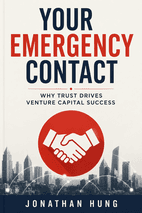
5 Main Takeaways from Your Emergency Contact
Hustle and Resilience Outweigh a Perfect Resume
Success in VC and startups isn't about having a flawless background; it's about relentless hustle, bouncing back from losses, and admitting what you don't know. Jonathan Hung argues that most people are faking it, and your ability to ask for help and keep showing up matters far more than your pedigree.
Build Pattern Recognition Through Volume and Second Meetings
Never invest after a single pitch—always take a second meeting to avoid rushing. By seeing many deals, tracking follow-through, and setting weekly meeting targets, you develop the instinct to separate genuine execution from polished presentations.
Execution Beats Charisma Every Time
Charisma opens doors, but only consistent delivery keeps them open. Treat others' money as your own, promise only what you can prove, and verify that your sizzle will hold up under deep diligence. Your word is currency—spend it wisely.
Your Inner Circle and Emergency Contacts Define Your Ceiling
Relationships are the real currency in venture capital. Identify the people who would be in your corner when things go sideways, invest in believers over bystanders, and mentor with the care you once needed. Trust outlasts every title.
Channel Your Grudge Into Purpose and Maintain Hope
Every builder has a personal wound that fuels them. Name your grudge, let it evolve from winning to serving, and hold onto hope when uncertainty strikes. The patient work done in quiet hours—without trading values for quick wins—will eventually produce headlines.
Executive Analysis
The five takeaways form a cohesive argument: sustainable success in VC and startups is not about innate talent or flawless execution, but about a mindset of continuous learning, disciplined relationship-building, and resilient adaptation. They create a pipeline—starting with hustle and resilience, then building decision-making through volume, prioritizing execution over showmanship, anchoring yourself in trusting relationships, and finally sustaining your drive by harnessing your personal grudge and maintaining hope. Together, they present a holistic, human-centered approach that values character over credentials.
This book matters because it shifts the focus from tactical advice to the emotional and relational underpinnings of the industry. It offers practical frameworks like the 70% confidence rule, quarterly check-ins, and the emergency contact concept that any founder or investor can apply immediately. Its emphasis on vulnerability, admitting ignorance, and building trust makes it a refreshing antidote to typical 'hustle culture' narratives. For anyone in or supporting the startup ecosystem, it provides a compassionate yet rigorous guide to navigating uncertainty and building something that lasts.
Chapter-by-Chapter Key Takeaways
Introduction (Introduction)
Success in VC and startups isn’t about having a perfect background; it’s about hustle, resilience, and the willingness to ask for help.
Admitting what you don’t know is a superpower. Most people are faking it—stop pretending and start learning.
Losses are inevitable. Bounce-back ability matters more than an undefeated record.
The book is a practical guide for founders, new VCs, LPs, students, and anyone who supports someone in the industry.
Every builder has a “grudge”—a personal wound or chip that drives them. Identifying yours gives your work direction and meaning.
Try this: Identify the personal wound that drives your work and commit to learning openly from every loss, admitting what you don't know to accelerate growth.
Chapter 1 | Go on Lots of Dates (Chapter 1)
Don’t rush the relationship. You wouldn’t propose after two dinners, so don’t invest after one pitch. Always take a second meeting.
Build pattern recognition through volume. Learn what you like (and what to avoid) by seeing a lot of deals. Set a weekly target for new founder or investor meetings.
Watch the follow-through. Missed emails or vague answers now mean bigger issues later. After every meeting, ask: Did they deliver on what they said?
Get a second opinion. Even solo GPs need sounding boards. Involve one trusted voice in every early-stage decision.
Qualify the plan, not the pitch. Focus on what happens after the check clears. Ask founders to walk through their first ninety days post-funding.
Protect your time and capital. Don’t fund vibes. Fund clear execution. Before wiring, verify: Is there progress? A path? A plan?
Keep showing up. Finding the right fit takes time and misfires. That’s normal. Log your meetings, lessons learned, and instincts after each pitch.
Try this: Set a weekly target for new meetings and always take a second meeting before any investment decision; track follow-through and log lessons after each pitch.
Chapter 2 | Develop Your One Sigma Confidence (Chapter 2)
Confidence is earned, not assumed. Having capital doesn't make you an investor; time in the seat does. Track your reps—deals, pitches, founders engaged. Reps matter more than résumés.
Learn to move at 70 percent. Certainty kills deals. Use a scoring system to quantify your belief and green-light at 70 percent or higher.
Evaluate the evaluator—start with you. Your own clarity, discipline, and trust signals matter as much as the founder's pitch. After every deal review, rate your own confidence on a scale of one to ten. Be honest.
Separate instinct from insight. Gut calls are fine only if backed by experience and reflection. Log each decision and revisit it quarterly to see how your instincts held up.
Challenge shiny surface thinking. A polished deck isn't proof. Dig into traction, plans, and execution—not just vision or style.
Filter advice by experience. Smart people will have opinions, but that doesn't mean they've earned the right to guide you. Before taking advice, ask about their track record in that space.
Show up after the wire hits. Investing doesn't end with a check. Create a post-investment dashboard and track updates, engagement, and founder momentum quarterly.
Trust can outweigh traction. When a deal looks great on paper but something feels off, slow down. Rescore. Ask around. Clarity often comes from a second look.
Try this: Score your confidence on every deal at 70% or higher to move forward, and separate gut instinct from real insight by logging decisions quarterly for review.
Chapter 3 | Deliver More Than Just Sizzle (Chapter 3)
Charisma opens doors, but execution keeps them open. After every pitch, write down exactly what you promised and track delivery weekly.
Treat OPM like your own. Run a quarterly thought experiment: “If this were my last dollar, would I still spend it this way?”
Protect your reputation like a line item. Send a meaningful update to key partners every four to six weeks.
Promise only what you can prove. Before bold projections, do a premortem: What could prevent this from happening?
Delegate before you burn out. List recurring tasks, circle only what you alone can do, and delegate two of the others this week.
Your word is a currency—spend it wisely. If you miss a target, own it early and explain your plan.
The steak must match the sizzle. After every pitch, ask: “Will this hold up under deep diligence?”
Keep a student mentality. Schedule a monthly reflection: What did you learn this month that changed your mind or revealed a blind spot?
Try this: Write down every promise you make in a pitch and track delivery weekly; run a quarterly thought experiment treating every dollar as your last to protect your reputation.
Next chapter: “Chapter 4 | Embrace the Good, the Bad, and the Ugly” is locked
Keep learning from Your Emergency Contact — and unlock all 600+ book summaries with audio, mindmaps and AI Q&A.
$0.00 due today · 7 days free, then $89.99/year ($7.49/mo) · Cancel anytime before day 7
plus sales tax where applicable