Ultra-Processed People Quotes
by Chris van Tulleken
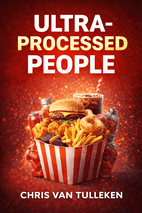
Welcome to a collection of quotes from Chris van Tulleken's Ultra Processed People. This page gathers the most striking lines from a book that challenges everything we think we know about food and health. You will find sharp observations about willpower, addiction, and the engineered nature of modern eating. The book is highly quotable because it mixes science with blunt honesty, making you look at your grocery cart differently. Each quote here captures a piece of that argument whether it is about the brain, the food industry, or the simple act of eating. Expect to be surprised and maybe a little unsettled. These are the words that stick with you long after you close the cover.
Top Quotes from Ultra-Processed People
“If you're living with obesity, it isn’t due to a lack of willpower; it isn’t your fault.”
Directly addressing the reader living with obesity, after explaining that the blame narrative doesn't hold up.
This clear, compassionate statement directly counters pervasive stigma and offers relief and validation to those who have internalized blame.
“Diet-related diseases come from the collision of some ancient genes with a new food ecosystem that is engineered to drive excess consumption and that we currently seem unable, or perhaps unwilling, to improve.”
The author explains the deeper causes of obesity and diet-related disease.
The metaphor of a 'collision' vividly captures how our evolutionary biology clashes with a profit-driven food environment, shifting responsibility from individuals to systemic design.
“It is the ultra-processing, not the nutritional content, that's the problem.”
Rachel Batterham summarizing the conclusion after reviewing epidemiological evidence with Sam Dicken.
This concise, authoritative statement reframes the entire debate, shifting focus from nutrients to processing, and is highly quotable for its clarity.
“Food intake is under little more conscious control than breathing or drinking, and this is why it is nearly as hard to limit food intake as it is to limit water or oxygen intake.”
The author explains that the conscious control of eating is largely an illusion, similar to other physiological drives.
This line reframes the struggle with overeating as a biological imperative rather than a failure of willpower, challenging common assumptions about diet and self-control.
“You can avoid carbs in the same way you can hold your breath, but eventually most people will crack.”
The author's conclusion about the difficulty of sustaining low-carb diets.
This simple, visceral analogy perfectly explains why willpower alone fails against biological drives.
“Some ultra-processed foods may activate the brain reward system in a way that is similar to what happens when people use drugs like alcohol, or even nicotine or morphine.”
Nicole Avena, an associate professor studying food addiction, said this to the author.
It directly links UPF to addictive substances, challenging the idea that overeating is simply a failure of willpower.
“Most UPF is not food, Chris. It's an industrially produced edible substance.”
Fernanda Rauber, a researcher on Carlos Monteiro's team, corrected the author when he called his meals 'food'.
This stark redefinition forces readers to reconsider what they consume, highlighting the artificial nature of UPF.
Themes Behind the Quotes
A central theme is that obesity and diet related diseases are not failures of personal discipline but rather a mismatch between ancient human biology and a modern food system designed for profit. The quotes repeatedly argue that ultra processed foods exploit our unconscious eating drives, making it nearly impossible to resist overconsumption. Another theme is the idea that these foods are not real food at all but engineered substances that hijack our brain reward systems, similar to addictive drugs. The book also highlights how the industry uses marketing and lobbying to keep these products everywhere while obscuring their harm. Finally, the quotes stress that the problem is the processing itself, not just the nutritional content, and that our bodies simply cannot handle these concoctions.
Quotes by Chapter
Introduction
“The idea that there has been a simultaneous collapse in personal responsibility in both men and women across age and ethnic groups is not plausible.”
The author discusses the dramatic increase in obesity in the US since the 1970s across all demographics.
This line powerfully refutes the simplistic blame narrative that weight gain is solely a failure of willpower, using population-wide data to show the argument is logically unsustainable.
“By buying UPF, we're continuously driving its evolution. We take the risk in this experiment while the benefits are handed to the owners of the companies producing UPF and the results are largely concealed from us — apart from the effects on our health.”
The author describes the hidden experiment of consuming ultra-processed food and the imbalance of risks and rewards.
This quote exposes the exploitative dynamic of the food system, framing consumption as an involuntary experiment where corporations profit while consumers bear the health costs, which is both unsettling and empowering.
1. Why is there bacterial slime in my ice cream? The invention of UPF
“The last of these is, revoltingly, a bacterial exudate: slime that bacteria produce to allow them to cling to surfaces.”
Paul explaining the nature of xanthan gum, a common additive in UPF.
The vivid description of bacterial slime is revolting and unforgettable, revealing the unappealing origins of a ubiquitous ingredient.
“The only remaining problem,’ Paul told me, ‘is the bugs — bugs love ice cream.”
Paul discussing the challenge of keeping ice cream stable at room temperature.
This line is humorous and memorable, emphasizing that despite advanced processing, spoilage remains a fundamental issue.
“It's a fantastic food,’ Paul said. ‘It would have transformed early human societies.”
Paul describing the value of butter as an inverted emulsion that keeps without refrigeration.
This quote contrasts traditional food like butter with modern UPF, showing how natural preservation allowed historical advances.
“You can’t make Nutella with spicy red oil.”
The author explains why ultra-processed food manufacturers need bland, flavourless oils rather than natural ones with taste and colour.
This concise, almost humorous line vividly illustrates how natural qualities become obstacles in industrial food production, making readers rethink what goes into their favourite spreads.
2. I’d rather have five bowls of Coco Pops: the discovery of UPF
“Processes and ingredients used to manufacture ultra-processed foods are designed to create highly profitable (low-cost ingredients, long shelf life, emphatic branding) convenient (ready-to-consume) hyperpalatable products liable to displace freshly prepared dishes and meals made from all other NOVA food groups.”
The author quotes the NOVA definition of ultra-processed foods from Carlos Monteiro's paper.
This definition crystallizes the idea that UPF is engineered for profit and convenience, not nutrition, and explains why it displaces real food.
“Lyra and I were drawn to our next mouthfuls just like smokers to the next drag. The experience of the first pull couldn't be replicated, yet something about the cereal made us keep trying.”
The author watches his daughter and himself eat Coco Pops, noting the addictive pattern.
The smoking analogy powerfully conveys the addictive, diminishing-returns nature of UPF consumption, making the concept visceral.
“Both Lansley and his special adviser had previously worked for firms that advised many of the companies that the ban would have affected, such as Pizza Hut, Kraft and Tesco. Some might feel that this is a conflict of interest.”
The author discusses the UK government's rejection of a trans fat ban and the background of those involved.
Highlights regulatory capture and the influence of the food industry on public health policy, undermining trust in official decisions.
“But imagine driving a car with a three-year-old in the back seat and being faced with four lights, two of which are green and two of which are amber. Do you drive or not?”
The author critiques the UK's voluntary traffic-light nutrition labeling system by comparing it to an ambiguous driving signal.
This vivid analogy exposes the absurdity and confusion of relying on oversimplified nutritional labels to guide real-world eating decisions, especially for children.
3. Sure, ‘ultra-processed food’ sounds bad, but is it really a problem?
“On the grey, tinned, ultra-processed diet, people ate an average of 500 calories more per day than those on the unprocessed diet, and they gained weight in line with that.”
Describing the striking results of Kevin Hall's controlled feeding experiment comparing an ultra-processed diet to an unprocessed one.
The concrete number—500 extra calories—makes the impact of ultra-processing tangible and undeniable, powerfully illustrating the core problem.
“If the packaging can persuade Ryan, it can persuade anyone.”
The narrator reflects on his brother-in-law Ryan, an internationally renowned psychology professor, being fooled by Alpen's 'natural' packaging.
This witty, relatable line highlights how effective marketing can deceive even the most skeptical, underscoring the insidious power of UPF branding.
“You almost never see an ad for beef or mushrooms or milk, and there are no health claims on their packaging. But you do see cartoon characters and vitamin-enriched claims printed all over UPF.”
The author contrasts the marketing of whole foods with the aggressive advertising of ultra-processed foods.
This sharp observation makes a powerful point about the ubiquity and manipulative nature of UPF marketing, resonating strongly with readers' everyday experience.
5. The three ages of eating
“This is why it is useful to consider the effects of UPF by thinking about them in the context of the very long history of how we stay alive.”
The author introduces the three ages of eating framework to analyze ultra-processed food.
It grounds the discussion of UPF in deep evolutionary time, making the stakes of modern eating habits vividly clear.
“And that, as they say, is life. All life. From bacteria living on volcanic vents on the ocean floor to my fingers typing these words on my keyboard, that's what is happening: life captures the energy released by passing electrons from food to breath.”
After explaining the mitochondrial electron transport chain and ATP production.
This poetic description unites all living things in a single fundamental process, making the science of eating feel both universal and intimate.
“The cow microbiome is so crucial to its survival that you could invert your idea of a cow and think of it as simply a vehicle for its own microbiome, a fourlegged vessel transporting the microorganisms to the plants of their choice.”
During a visit to a beef farm, the author reflects on the role of gut bacteria in herbivores.
This startling metaphor reframes our understanding of animal biology and hints at our own dependence on microbes, making the concept instantly memorable.
“The main point is not that they are themselves harmful, it’s that the additives are a proxy for UPF. They signal a method and purpose of food production that we now know is linked to disease.”
After noting that people consume 8kg of food additives per year in industrialised countries.
This insight refocuses concern from individual chemicals to the entire system of ultra-processing, which is a more powerful and nuanced critique.
6. How our bodies really manage calories
“We smear a conscious layer over all this, but eating is far less of a choice than it appears.”
The author summarizes how unconscious neuroendocrine systems dominate our eating behavior.
It succinctly captures the book's central thesis that eating is not a simple rational choice, making it a powerful and memorable insight.
“The system didn’t evolve to handle the concoctions that arrived with the third age of eating.”
The author concludes that our evolved regulatory mechanisms are mismatched with ultra-processed foods.
This line crystallizes the evolutionary mismatch theory, explaining the obesity epidemic as a systemic problem rather than an individual failing.
7. Why it isn’t about sugar ...
“I just think a terrible injustice has been done. I feel like a whistle blower. Hundreds of millions of people are getting the wrong advice about how to eat. It's hard to walk away from.”
Gary Taubes speaking to the author about his crusade against carbohydrates.
This quote captures Taubes' passionate conviction and moral urgency, making it memorable for anyone who has felt driven by a cause.
“Let that sink in. In England, more than 10 per cent of three-year-olds, and a quarter of five-year-olds, have tooth decay.”
The author describing the dental crisis caused by ultra-processed foods.
The shocking statistic forces readers to pause and confront the preventable epidemic of childhood tooth decay.
“The most common operation we do in children — ahead of fixing bones broken on trampolines, hernia repairs and appendix removals — is for rotten teeth.”
The author comparing tooth extractions to other common childhood surgeries.
The vivid contrast between mundane injuries and rotting teeth makes the scale of the problem stark and unforgettable.
10. How UPF hacks our brains
“These foods are like a fantasy. They are not home-made foods.”
Maria Laura da Costa Louzada explained that even technically non-UPF products still lack the reality of home cooking.
It captures the deceptive allure of packaged foods that mimic homemade meals, making readers wary of their idealized image.