The Sweaty Startup — Interactive Mindmaps

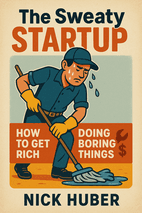
The Sweaty Startup by Nick Huber Book Cover

by Nick Huber

Nick Huber's The Sweaty Startup provides a practical guide for building service-based businesses with minimal capital, emphasizing sweat equity and bootstrapping over venture funding. It's for determined entrepreneurs seeking financial independence through hands-on, sustainable growth.

On Insta.page you also get an Apply This Book tool that lets you combine insights from up to 3 books to solve your specific situation.

Chapter mindmaps

Free preview: chapters 1–4 are fully interactive. Click any node to expand or collapse. Subscribe to unlock the rest.

Chapter 1: Chapter 1: Leverage

Key concepts: Chapter 1: Leverage

1. Chapter 1: Leverage

The Illusion of Traditional Success

  • High-status careers often sacrifice autonomy (e.g., millionaire lawyer forced to miss child’s birth)
  • Wealth without freedom is hollow—golden handcuffs trap people in unfulfilling systems
  • Societal definitions of success prioritize status over health/relationships

The Three Pillars of Leverage

  • Network: Reciprocal relationships that amplify reach and delegate effort
  • Skills: Mastery of high-value abilities (sales, leadership) to become indispensable
  • Capital: Financial runway to take risks and invest in growth

The No-Asshole Rule

  • Early career demands tolerating toxic relationships; leverage lets you walk away
  • Examples: firing abusive clients, buying out micromanaging investors
  • Prioritize peace of mind over short-term gains as leverage grows

Time vs. Wealth Calculus

  • Evaluate opportunities by financial return per hour (short-term vs. long-term upside)
  • Passive income (e.g., franchises, rentals) decouples time from earnings
  • Goal: Design systems where money flows without active work

Limitations of Traditional Employment

  • W-2 jobs lack leverage—income stops when work stops
  • Even high earners face time-for-money traps (70-hour workweeks)
  • Exceptions: Residual income careers (sales, wealth management) offer partial leverage

Core Principles of Leverage

  • True wealth = autonomy, not status or Lamborghinis
  • Build asymmetry: Shrink input (time), grow output (income/impact)
  • Escape replaceability by developing unique skills/assets
  • Leverage compounds—play the long game for exponential freedom

Defining Your Ideal Lifestyle

  • Visualize your 'perfect week' to determine what true freedom looks like for you.
  • Quantify the monthly income needed to sustain your ideal lifestyle (e.g., $30,000/month post-tax for the author).
  • True wealth is about aligning income with personal freedom, not chasing status symbols.
  • Most people overestimate the income required for their ideal lifestyle—focus on practicality over extravagance.

The Poker Analogy: Strategic Investment of Time

  • Time is finite—treat it like poker chips in a tournament, allocating it carefully.
  • Low-leverage activities (e.g., traditional jobs) are like 'folding' on high-potential opportunities.
  • Prioritize ventures that generate passive income over moonshot startups or corporate promotions.
  • Avoid high-failure-rate ventures (e.g., 95% of venture-backed startups) in favor of predictable cash flow.

Choosing the Right Opportunity: The Sweaty Startup

  • A 'sweaty startup' is a hands-on, unglamorous business with lower risk and faster revenue (e.g., logistics or service-based work).
  • Start small (e.g., a $2,000/month side hustle) and reinvest profits to scale strategically.
  • Focus on practicality and scalability over prestige—boring businesses often yield reliable freedom.
  • Build systems that eventually generate passive income (e.g., $30,000/month) without constant involvement.

Key Takeaways

  • True wealth = freedom + time—control your schedule, not just your income.
  • Start small and scale incrementally (e.g., $2,000/month side hustle → $30,000/month passive income).
  • Quantify your 'freedom number'—the exact monthly income needed for your ideal lifestyle.
  • Invest time like poker chips—prioritize high-leverage, unsexy opportunities.
  • Choose 'sweaty startups' (practical, cash-flow-positive) over glamorous high-risk ventures.

Chapter 2: Chapter 2: Business Is a Race

Key concepts: Chapter 2: Business Is a Race

2. Chapter 2: Business Is a Race

The Entrepreneurial Crossroads

  • Facing a pivotal decision: corporate job vs. startup commitment
  • Setting an audacious goal (250 customers) as proof of concept
  • Juggling academics, athletics, and business simultaneously
  • Early-stage uncertainty with minimal revenue and resources

The Make-or-Break Expansion

  • Rapidly scaling to three new university locations
  • Implementing an untested profit-sharing model
  • Hitting the 253-customer target under extreme pressure
  • Decision to continue despite barely meeting the goal

Speed as Competitive Advantage

  • Contrast between 'act now' vs. 'analysis paralysis' approaches
  • Examples of rapid execution leading to quick wins
  • 'Aim, fire, adjust' philosophy over perfectionism
  • Early mistakes being more survivable than hesitation

Developing Entrepreneurial Resilience

  • Facing ridicule and skepticism from peers
  • Learning to tolerate judgment and low-status work
  • Thick skin developed through repeated challenges
  • Embracing discomfort as part of the process

The Compound Effect of Momentum

  • From moving boxes to $52M acquisitions
  • How early risks create leverage for bigger opportunities
  • Non-linear progression of entrepreneurial success
  • Skills, networks and confidence building over time

Core Entrepreneurial Principles

  • Urgency and speed trump perfect planning
  • Execution and cash flow validate ideas faster
  • Resilience is developed through practice
  • Momentum creates compounding opportunities
  • Immediate action tests real market demand

Chapter 3: Chapter 3: Not All Businesses Are Created Equal

Key concepts: Chapter 3: Not All Businesses Are Created Equal

3. Chapter 3: Not All Businesses Are Created Equal

Market Logic Over Passion

  • Success hinges on solving problems efficiently, not personal interests.
  • Passion projects often lead to burnout or failure due to irrational persistence.
  • Choose business models with proven demand and profitability.

Three Dealbreakers to Avoid

  • Venture capital dependence (high risk without existing resources).
  • Untested 'new ideas' with no market precedent.
  • Physical product manufacturing (capital-intensive and competitive).

The Pitfalls of 'Fun' Businesses

  • High passion industries (e.g., restaurants, gaming) attract excessive competition.
  • Margins shrink due to emotional attachment overriding logic.
  • Boring or unpleasant industries (e.g., waste management) offer steadier demand.

Low-Status Business Advantage

  • Low-status industries (e.g., garbage collection) repel ego-driven competitors.
  • Test viability: If older relatives are unimpressed, it’s likely a good sign.
  • High-status ventures (e.g., AI startups) attract overfunded rivals and delusion.

Evaluating Business Viability

  • Assess competition strength (avoid savvy, well-funded players).
  • Target industries with 20%+ profit margins.
  • Check failure rates (e.g., self-storage vs. restaurants).

Red Oceans vs. Blue Oceans

  • Ignore 'blue ocean' strategies; focus on improving existing markets.
  • Out-execute competitors by modernizing operations (e.g., better customer service).
  • Target industries with inefficiencies (e.g., outdated tech, poor online presence).

Playing the Easy Game

  • Prioritize high-odds, low-competition opportunities over moonshots.
  • Copy proven models instead of inventing untested ideas.
  • Example: Local HVAC companies > venture-backed apps for early-stage founders.

Developing Business Curiosity

  • Analyze local businesses for revenue, costs, and operational gaps.
  • Ask: How could this run more efficiently? Where are profit leaks?
  • Avoid complex, low-margin ventures even if they seem glamorous.

Key Takeaways Summary

  • Solve problems, not egos; avoid passion-driven traps.
  • Boring niches = less competition + higher profitability.
  • Copy and improve existing models; don’t reinvent the wheel.
  • Red oceans (existing markets) > blue oceans (untested innovation).
  • Geographic moats (local focus) protect from global competitors.

Chapter 4: Chapter 4: Idea Generation 101

Key concepts: Chapter 4: Idea Generation 101

4. Chapter 4: Idea Generation 101

Competitive Advantage Fundamentals

  • Dominate in two of three areas: price, speed, or quality—never all three
  • Examples: Price + Speed (fast, affordable), Speed + Quality (premium, rapid), Quality + Price (affordable, slower)
  • Identify underserved niches (e.g., high-demand services with limited competition)

Personal Situation Assessment

  • Assess urgency: Immediate income needs vs. longer runway
  • Evaluate capital: Investment capacity without financial risk
  • Leverage location: Unique local opportunities (e.g., event-based demand)
  • Utilize skills/network: Existing expertise or relationships for advantage

Business Idea Tiers

  • Level 1: Low skill, minimal investment (e.g., lawn care, car detailing)
  • Level 2: Moderate investment/skill (e.g., wedding DJ, Airbnb management)
  • Level 3: High capital, specialized skills (e.g., arborist services, dumpster rentals)
  • Start at Level 1 to minimize risk, then scale to higher tiers

Validation Tactics

  • Call competitors to gauge demand (e.g., wait times, pricing)
  • Analyze quotes to estimate hourly rates and profitability
  • Assess market saturation via reviews and competitor responsiveness

Key Takeaways

  • Focus on two competitive pillars—never all three
  • Begin with low-risk Level 1 businesses
  • Validate ideas through competitor research and local demand checks
  • Capitalize on location-specific opportunities
  • Gradually scale to higher-tier businesses as resources grow

Chapter 5: Chapter 5: Become an Expert Operator

Mindmap locked. Subscribe to unlock all chapters of The Sweaty Startup.

Subscribe to unlock

Chapter 6: Chapter 6: Sales Is the Foundation of Every Business

Mindmap locked. Subscribe to unlock all chapters of The Sweaty Startup.

Subscribe to unlock

Chapter 7: Chapter 7: Life Is Short

Mindmap locked. Subscribe to unlock all chapters of The Sweaty Startup.

Subscribe to unlock

Chapter 8: Chapter 8: Get Your Shit Together

Mindmap locked. Subscribe to unlock all chapters of The Sweaty Startup.

Subscribe to unlock

Chapter 9: Chapter 9: The Attributes of Winners

Mindmap locked. Subscribe to unlock all chapters of The Sweaty Startup.

Subscribe to unlock

Chapter 10: Chapter 10: How to Find High-Performing People

Mindmap locked. Subscribe to unlock all chapters of The Sweaty Startup.

Subscribe to unlock

Chapter 11: Chapter 11: Hiring—The Key to Ultimate Leverage

Mindmap locked. Subscribe to unlock all chapters of The Sweaty Startup.

Subscribe to unlock

Chapter 12: Chapter 12: Management and Delegation

Mindmap locked. Subscribe to unlock all chapters of The Sweaty Startup.

Subscribe to unlock

Chapter 13: Chapter 13: What Is This All About?

Mindmap locked. Subscribe to unlock all chapters of The Sweaty Startup.

Subscribe to unlock

Continue exploring The Sweaty Startup