The Next Perfect Trade Quotes
by Alex Gurevich
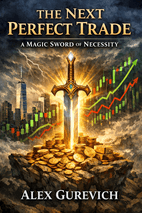
These quotes capture the raw, unfiltered wisdom of a seasoned trader. You will find sharp one liners that cut through the noise and deeper insights that challenge how you think about risk and reward. The book is quotable because it blends hard earned practical advice with a philosophical edge. Gurevich uses vivid analogies and straight talk that sticks with you, whether you are a beginner or a veteran. The lines here are the kind you want to underline and share with someone who gets it.
Top Quotes from The Next Perfect Trade
“A magic formula (or magic weapon in this context) will be wasted if you get killed by the market's first arrow.”
The author compares investing to a battle, emphasizing the need for preparation before using any advanced strategy.
This line vividly underscores that no strategy can succeed without foundational discipline and risk management, making it a memorable warning against overconfidence.
“All else being equal, would you rather be a gambler or the house?”
The author advises traders to align with long-term market tides rather than fight them, using the casino analogy.
The rhetorical question is simple yet profound, instantly reframing the trader's mindset toward seeking structural edges instead of relying on luck.
“Trend is Markets 101. Trend is Markets 000.”
Opening of the chapter, establishing the fundamental importance of trend.
This succinct, memorable line emphasizes that trend is the most basic and essential concept in trading, resonating with both beginners and professionals.
“Over a given day, the carry is negligible compared to the price movements. But just like the rake collected by casinos, it accumulates. And over a lifetime of trading, it may suck you dry or make you rich.”
The chapter summary, emphasizing the long-term significance of carry.
The casino rake analogy is vivid and memorable, powerfully illustrating how small, steady costs or gains compound over time to determine trading success.
“Markets are young: Every time you think you have figured something out, the paradigm changes, and you are in uncharted territory. And markets are old: The more things change, the more they stay the same.”
The author opens the chapter by contrasting the dual nature of markets.
This line captures the perpetual tension between novelty and recurrence in trading, reminding readers that no discovery is permanent and that ancient patterns still hold sway.
“The only thing worse than going bust buying into a bubble is going bust selling into a bubble.”
The author, in a blog post dated February 3, 2015, warns about the symmetrical danger of both buying and selling into bubbles.
This line succinctly captures the trader's dilemma that both bullish and bearish bets can be ruinous if mistimed, making it a memorable cautionary aphorism.
“Am I telling you that there is no way to take advantage of recognizing a bubble? No. There is one sure way. SIT IT OUT.”
The author answers a rhetorical question about profiting from bubbles by advocating for staying in cash.
The emphatic command 'SIT IT OUT' delivers a counterintuitive yet powerful piece of advice, highlighting patience and capital preservation as a superior strategy.
Themes Behind the Quotes
A central theme is survival and risk management. The market punishes those who ignore its first warning, and no strategy works if you are blown up. Another theme is the power of trend and momentum versus fundamental value. The book stresses that fighting the trend is foolish, yet true opportunity often lies where momentum and fair value diverge. Also recurring is the subtle but massive impact of carry and compounding, like a casino rake that saps or builds wealth over time. The quotes also highlight cognitive biases: hindsight judgment, intellectual arrogance when selling winners, and the dangerous gap between wishful thinking and a real trading strategy. Finally, there is a constant call for humility, to sit out bubbles and accept that markets are both timeless and ever changing.
Quotes by Chapter
Introduction
“Most people judge trades post-factum: “I wish I’d bought Apple stock at $20 like I wanted to,” or “What a genius, she got out of stocks right before the crisis,” or “Euro vs. dollar in 2003 was a no-brainer.””
The author reflects on how hindsight bias colors people's evaluation of trades.
It perfectly captures the universal human tendency to rationalize past outcomes, reminding readers that true skill is about ex-ante decision-making, not after-the-fact storytelling.
“Trading is often compared to poker; both involve making a move that gives you the best odds of success. But the outcome of any individual trade or poker hand is usually beyond a single player's control.”
The author discusses the role of luck versus skill in trading and poker.
This distinction forces readers to confront the uncomfortable reality that even correct decisions can lose money, shifting focus from outcomes to process.
1. Trend
“Don’t trade against the trend in a market which tends to be trending.”
The author refines the common phrase 'don't trade against the trend' to add nuance.
It provides a more precise and actionable rule, acknowledging that not all markets trend equally, which helps traders avoid blind adherence to clichés.
“To give up on a trade at the economically “fair value” point (the bottom of the pendulum) is to give up precisely when the momentum is at its greatest.”
The author explains the pendulum analogy for currency trends.
This insight highlights a critical psychological pitfall—exiting too early at perceived fair value—and reinforces the idea that momentum often carries prices beyond equilibrium.
“The Perfect Trade will demonstrate step-by-step that this error was not a mistaken economic view, but an irrefutable failure of logic.”
The author declares being short US bonds in 2014 as the worst trade ever.
It sets up the book's central thesis with bold clarity, promising a logical framework rather than mere opinion, which intrigues readers and challenges their assumptions.
2. Carry
“Carry is the net yield on your position. You can think of it as the net income being earned by your portfolio, which is separate from any profits or losses incurred from market fluctuations.”
The author defines the core concept of carry early in the chapter.
It provides a clear, foundational definition that sets the stage for the entire discussion, making a technical concept accessible.
“When you establish a speculative position you borrow one currency (the one you are going short) to buy another currency (the one you are going long). For as long as this position is open, you pay interest on the currency you borrowed and receive interest on the currency you bought.”
The author explains the mechanics of a currency carry trade.
It clearly defines the dual interest rate exposure in currency speculation, making the concept tangible for traders. The simplicity of the explanation helps demystify a core strategy in forex markets.
“Depending on the tax bracket of a bondholder, a 2% yield on a US Treasury may be equivalent to, say, 1.5% post-tax yield, which is lower than current inflation, In this case, the person who owns the Treasury notes and pays taxes, actually sees the real purchasing power of their investment diminish with time.”
The author discusses the real after-tax return of Treasury bonds during inflation.
It highlights the hidden erosion of purchasing power, a sobering reminder for fixed-income investors. This passage forces readers to consider taxes and inflation when evaluating supposedly safe returns.
3. Valuation Pull
“There is always a story. Momentum, technical flows, investor sentiment, and political uncertainty. But stories notwithstanding, there is an economic gravity—a fundamental pull toward reasonable valuations.”
Opening of the chapter on valuation pull.
It captures the central thesis that market narratives are temporary but valuation is a persistent force, resonating with anyone seeking clarity amid noise.
“My observation is that some larger markets are driven by people who transact as they have to.”
Author discussing forced transactions versus rational choice in markets.
A succinct insight that challenges efficient market theory by highlighting involuntary trading, making readers reconsider market dynamics.
“If the Fed expects higher inflation, it will take measures to suppress it, and therefore, the market should price in lower, not higher, inflation than previously predicted.”
Author discussing negative predictive power of central bank opinions.
A counterintuitive but logical argument about interpreting central bank signals, offering a valuable framework for anticipating market reactions.
4. Historical Pattern
“Hence, during times of uncertainty, it's profitable to assume that historical patterns are likely to repeat, until proven otherwise.”
The author explains a profitable heuristic for navigating uncertain market conditions.
It offers a simple, actionable principle that balances skepticism with pattern recognition, giving traders a clear rule of thumb when data is ambiguous.
“IF INTEREST RATES ARE LOWER TODAY THAN THEY WERE TWO YEARS AGO, IS THE STOCK MARKET LIKELY TO BE HIGHER TWO YEARS IN THE FUTURE THAN IT IS TODAY?”
The author formulates the precise question needed to test the predictive relationship between interest rates and stock market performance.
This all‑caps question cuts through common correlation errors and directly poses a testable hypothesis, embodying the shift from vague intuition to rigorous strategy.
“WHENEVER THE FED IS ACTIVELY CHANGING THE RATE POLICY, THE MARKET IS VERY RELUCTANT TO PROJECT MOVES INTO THE FUTURE. THE FORWARD RATE EXPECTATIONS WILL DECOUPLE FROM CURRENT POLICY.”
The author distills a key historical lesson learned from painful curve trades during the 2001‑2005 period.
This insight warns traders against extrapolating Fed actions too linearly, highlighting a recurring market behavior that can catch even experienced players off guard.
5. Growth and Progress
“For every John Paulson, there are a lot of bear skeletons littering financial thoroughfares.”
The author contrasts the rare success of John Paulson's subprime bet with the many failed short sellers.
The vivid imagery of 'bear skeletons' underscores the high failure rate of short-selling strategies, reinforcing the chapter's theme that betting against growth is perilous.
“If Iam proven wrong and stocks continue to rip higher, at least I can say I exercised caution in fighting against this particular tide.”
In a 2025 note, the author reflects on his modest short position and acknowledges the risk of being wrong.
This line reveals the author's humility and disciplined risk management, showing that even when fighting the trend, one can take comfort in prudence.
6. Tax Advantage
“If you worry too much about taxes and don’t do your best trades at the best times, you could end up with no revenues to be taxed.”
The author warns against letting tax concerns override trading decisions.
This line captures a counterintuitive truth: excessive focus on taxes can destroy the very profits one seeks to protect, making it a memorable caution.
“But gradually, I understood there may be an unwarranted intellectual arrogance involved in selling a considerably appreciated stock to buy another.”
The author reflects on his own evolution in trading approach.
It resonates because of its self-awareness and critique of overconfidence, a common pitfall for traders and investors.
“The new investment, the $80 of ABC stock, will have to outperform by more than 25% to beat the future capital gains and dividends generated by $100 of XYZ.”
The author illustrates the mathematical penalty of paying taxes on gains when switching positions.
A clear, concrete example that makes the tax disadvantage visceral and easy to grasp, emphasizing the hidden cost of trading.
“Yet our trading decisions often reflect such implicit arrogance.”
After asking if any trader would claim to beat the market with a 20-25% premium on every purchase.
A punchy, damning observation that connects a logical fallacy to common behavior, forcing self-reflection.
7. Stopping Out of Success
“It is impossible to establish whether a trade was successful or not unless the strategy associated with the trade was Clearly stated at the moment of inception.”
The author argues that a trade's success can only be judged if the strategy was clearly defined at the start.
This line crystallizes the need for pre-defined criteria in trading, a cornerstone of disciplined decision-making. It forces traders to move beyond vague outcomes and evaluate performance objectively.
“A trading strategy requires a response to every possible price action, while wishful thinking involves an assumption about price action without contingency planning.”
The author distinguishes between a true trading strategy and wishful thinking.
It succinctly captures the difference between professional preparedness and amateur hope, making it a powerful reminder to always plan for all scenarios.
“I SEE A FUNDAMENTAL PROBLEM WITH THIS APPROACH SINCE THERE IS NO LIMIT TO THE NUMBER OF TIMES YOU CAN BE “WHIPSAWED.””
The author critiques the common practice of entering a trade only after a trend is established and then stopping out if it reverses.
The emphatic capitalization and vivid metaphor of being ‘whipsawed’ highlight an often-overlooked cost of stop-loss strategies—repeated small losses that can destroy a trade before it moves.