The Four Brains of Money Quotes
by Dr. Alok Trivedi
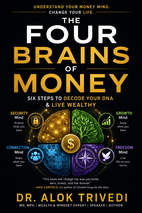
You will find lines that reframe money struggles not as character flaws but as biological mismatches. The book strips away shame and replaces it with clarity about how your nervous system actually works around money. What makes it quotable is how each sentence lands like a small revelation. It gives you a new lens in just a few words. These quotes stick because they name something you have felt but could never articulate. They are honest, direct, and oddly freeing. Expect a tone that feels like a friend telling you a hard truth with kindness.
Top Quotes from The Four Brains of Money
“At gap, between knowing and doing, between wanting and having, is not an issue with your character. It’s a biological mismatch.”
The author describes the core problem that mindset alone cannot solve.
It challenges the common belief that failure to change is a moral failing, grounding the struggle in biology instead.
“You don’t have a money problem. You have a wiring problem. Wiring can be changed.”
The closing thesis of the introduction.
This is the central, empowering message of the book—it names the real issue and offers hope that transformation is possible.
“The knowledge lives in the mind. The built-in beliefs and reactions live in the body. And the body always wins.”
The author describes why typical financial advice fails if the underlying neurochemical state hasn't shifted.
This pithy sequence captures a universal truth about behavior change, making it memorable and validating why willpower alone often falls short.
“The Chaser/Leader is not afraid of failure. They're afraid of stillness.”
From the 'Fear of Stagnation, Not Failure' section.
It reframes the archetype's deepest fear, shifting the focus from common anxieties to the biological aversion to stillness that drives self-sabotage.
“I've been building everyone else's bridge.”
Diane, a business development executive, says this after recognizing her archetype in the chapter.
This simple, poignant statement captures the core struggle of the archetype in a memorable way that resonates with anyone who neglects their own interests while helping others.
“Nothing about her changed. She just stopped building bridges for free.”
The author concludes Diane's story, summarizing her financial transformation.
This punchy, powerful line delivers the chapter's key lesson with clarity and impact, inspiring readers to value their own contributions.
“You cannot logic your way out of Rationalization. You can only regulate your way out of it.”
From the section on the Rationalizing state, where the mind constructs plausible stories for incoherent behavior.
This piercing observation cuts through the trap of overthinking, offering a clear and actionable path: stop trying to think differently and start regulating the nervous system first.
Themes Behind the Quotes
A central theme is that your financial behaviors are driven by inherited biological wiring, not by lack of willpower or intelligence. The book argues that knowing and doing are separated by a biological gap that can be bridged through regulation, not more information. Another key idea is that each person has a dominant archetype, a default pattern of reacting to money, and recognizing it is the first step to change. The quotes also emphasize moving from a dysregulated state to coherence, where your body stops running on threat responses. Finally, abundance is framed as a natural result of aligning with your true self rather than forcing a version of success that does not fit you. The call is to show up fully as who you already are, not to become someone else.
Quotes by Chapter
Introduction: You Don’t Have a Money Problem
“Your relationship with money does not mean something is fundamentally wrong with you.”
The author explains that financial struggles are not a sign of personal defect.
This line relieves shame and self-blame, offering a compassionate reframe that opens the door to real change.
1. The Science of DNA and Wealth
“No, there is absolutely nothing wrong with you.”
The author responds to Sarah and Dana, who each asked if something was wrong with them for hitting a financial ceiling.
This line relieves the shame of financial struggle by shifting blame from personal flaw to biological wiring, offering hope and validation.
“Your genes do not determine your financial destiny. They determine your financial starting point: the default series of assumptions, fears, and reactions your nervous system loops through repeatedly when money enters the conversation.”
The author explains the role of genetics in financial behavior, distinguishing fixed destiny from a starting point.
It reframes genetics from a fatalistic limitation into a launchpad, empowering readers to work with their biology rather than feel trapped by it.
“If you've known exactly what you should do financially and still found yourself frozen or defaulting to the safest possible choice, even when a bigger move was clearly warranted, your serotonin system may be the reason.”
The author explains the role of the serotonin system in financial anxiety and avoidance.
It gives a name and a biological cause to a frustrating pattern many experience, normalizing the struggle and pointing toward a targeted solution.
2. The Four Brains of Money Archetypes
“The archetype is not the problem. Not knowing your archetype is the problem.”
The author explains that each archetype has strengths and weaknesses, and the real issue is ignorance of one's own wiring.
It's a succinct, memorable statement that shifts blame from inherent flaws to lack of self-awareness, empowering the reader to seek knowledge.
“The state in which your nervous system is no longer running threat responses, no longer chasing relief, no longer managing the gap between who you're and who you think you need to be.”
The author defines the Integrated State as a biological state of love, describing what it feels like when the nervous system is fully regulated.
This poetic description of a regulated nervous system resonates as a powerful vision of inner peace and wholeness, moving beyond transactional motivations.
“This is not a call to become a different person, but rather the full version of the person you already are.”
In the section on the Integrated State, the author clarifies that integration is about becoming more of oneself, not changing identity.
It offers hope and self-acceptance, reassuring readers that growth means embracing their authentic self rather than trying to be someone else.
“The paragraph that makes you feel seen in a way that’s slightly uncomfortable is almost always pointing at your dominant type.”
The author advises readers on how to identify their archetype by paying attention to which description feels most true.
It's relatable and insightful, acknowledging that discomfort is often a sign of truth, which encourages honest self-reflection.
3. The Protector/Guardian
“The Protector/Guardian's relationship with money is defined by one primary biological directive: preserve and protect.”
Describing the core motivation of the Protector/Guardian archetype.
This line succinctly captures the essence of the archetype, making it instantly relatable for anyone who feels a deep instinct to safeguard resources.
“It's not catastrophizing for no reason; it's a biological system designed to keep them alert to threats.”
Explaining the neurobiology behind the GAD1 variant and the 3 a.m. worry spiral.
It reframes anxiety as a survival mechanism rather than a character flaw, offering readers relief and understanding of their own reactions.
“Mark knew the math was fine. He could calculate it a hundred ways, and the answer was always fine. But the math wasn’t the problem. The problem was that Mark's COMT gene was running the show.”
From Mark's story, a 54-year-old with $2.1 million who felt financially insecure.
This powerfully illustrates how biological wiring can override rational analysis, making the reader see their own financial fears in a new light.
4. The Chaser/Leader
“When Chasers/Leaders don't understand this cycle, they interpret the crash as evidence that the goal wasn't big enough, the business wasn't right, or the partner wasn't good enough. They make changes to the external environment in response to an internal biological cycle. This is expensive, both financially and relationally.”
From the 'Excitement Followed by Crash' subsection.
It exposes the costly mistake of misattributing an internal biological crash to external failures, a pattern that leads to repeated financial and relational losses.
“The critical failure point is the transition from growth to scale. When a business stops being new and starts requiring systems, processes, and consistent execution, the Chaser/Leader’s biology begins to check out.”
From the 'Entrepreneurship' wealth dimension.
It pinpoints the exact moment when a Chaser/Leader's natural strengths become liabilities, offering a clear warning for sustainable business building.
“The crash is not failure or depression. It's a biological signal that the system needs structured recovery and a new, appropriately sized target.”
From the section on the Chaser/Leader's nervous system tone.
It normalizes the post-achievement crash as a biological phase, reducing shame and providing a constructive path forward rather than panic.
5. The Bridge Builder/Visionary
“They're also, in my experience, the archetype most likely to be financially undercompensated for the enormous value they create.”
The author describes a key financial tendency of the Bridge Builder/Visionary archetype.
This line validates the often-unacknowledged experience of being undervalued despite creating immense value, making it deeply relatable for many readers.
“Before you do anything else, linger here a moment. You've probably spent this whole chapter thinking about everyone else. Now take a moment for yourself.”
The author directly addresses the reader at the end of the chapter, prompting self-reflection.
This gentle but firm call to action breaks the pattern of self-neglect typical of the archetype, making the reader feel seen and encouraged to prioritize themselves.
6. The Receiver/Connector
“I've been so focused on creating flow that I never built a container.”
Jason, a Receiver/Connector, recognizes his pattern after mapping to the archetype.
This line perfectly encapsulates the archetype's core challenge and the solution in one memorable sentence.
“The flow was always there. Now it had a destination.”
The author summarizes Jason's transformation after implementing financial systems.
It poetically conveys that abundance already exists and only needs structure to become lasting wealth.
“You aren’t more generous when you give from a place of scarcity. You're more generous when you give from abundance.”
Advice from the section on boundaries around giving for the Receiver/Connector.
This reframes generosity from a scarcity-driven impulse to a sustainable, abundance-based practice, a key insight for the archetype.
“The Receiver/Connector's deepest financial fear is not poverty. It's isolation.”
Explanation of the emotional world of the Receiver/Connector archetype.
It reveals the biological root of many counterproductive financial behaviors, making the reader understand the true stakes involved.
7. The Integration State
“The problem isn’t the wiring. The problem is that most people are running that wiring in a dysregulated state, amplifying every shadow, suppressing every superpower, and exhausting themselves trying to perform a version of financial success that their biology was never built for.”
Opening of the chapter, explaining why financial struggles persist despite good wiring.
This reframes financial failure from a personal defect to a biological mismatch, offering a compassionate and scientific lens that resonates with anyone who has felt stuck despite effort.
“Your body has been sending you a signal about this for years. You feel it as the three a.m. spiral that no savings account can quiet.”
Describing the bodily signals of dysregulation.
The visceral image of the 3 a.m. spiral instantly connects with readers who have experienced anxiety that money cannot soothe, validating their internal experience as biological data rather than weakness.
“Authenticity isn’t just a feeling. It's a frequency your body emits when you're living in complete coherence with who you are.”
Explaining the biological basis of authenticity during cardiac coherence.
This reframes authenticity from a vague emotional concept into a measurable, impactful physiological signal, empowering readers to see self-alignment as a powerful influence on others.