The E-Myth Revisited Key Takeaways
by Michael E. Gerber
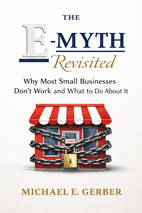
5 Main Takeaways from The E-Myth Revisited
Technical skill alone guarantees business failure, not success.
The 'E-Myth' is the fatal assumption that proficiency in a trade equates to running a business. This misconception leads owners to neglect entrepreneurial vision and managerial systems, resulting in burnout and collapse.
Balance your inner Entrepreneur, Manager, and Technician roles.
Every business owner must consciously allocate time to visionary dreaming, organizational planning, and hands-on execution. Letting the Technician dominate turns the business into a stressful job, while integrating all three builds a sustainable enterprise.
Work on your business by building systems, not in it doing tasks.
Shift from being the chief doer to the chief designer by creating a franchise prototype—a replicable system that delivers consistent results. This allows the business to operate without your constant involvement, enabling scalability and freedom.
Systematize growth through innovation, quantification, and orchestration.
Continuously improve customer experiences with practical innovations, measure outcomes with data, and standardize proven methods. This cycle transforms your business into a predictable, scalable model that competes on reliability, not just hustle.
Align your business with your life's primary aim and vision.
Define your personal purpose and desired lifestyle before building your business. Then, design your enterprise to serve that aim, ensuring it enhances your life rather than consuming it with endless work.
Executive Analysis
The five takeaways form a cohesive argument: small business failure stems from the 'E-Myth'—the mistaken belief that technical expertise ensures success. Gerber contends that owners must instead balance internal roles, systematize operations, and work on the business as a product, all while aligning it with a personal life vision. This transforms the business from a job into a scalable asset.
This book matters because it provides a actionable framework for achieving both commercial success and personal fulfillment. It bridges entrepreneurship, management, and self-development, offering a timeless blueprint for building owner-independent businesses through deliberate design rather than luck or labor.
Chapter-by-Chapter Key Takeaways
Introduction (Introduction)
The staggering failure rate of small businesses is caused by owners doing the wrong work, not a lack of effort.
The E-Myth is the fatal misconception that technical skill equates to business competence.
The Turn-Key Revolution favors systematic, replicable business models over purely entrepreneurial gusto.
Lasting success requires implementing a deliberate Business Development Process, moving from "Management by Luck" to management by design.
Fundamental change in a business must begin with the owner, as the business is a mirror of the owner’s habits, thinking, and organization.
Try this: Acknowledge that business success requires a deliberate development process, not just hard work.
Chapter 1. The Entrepreneurial Myth (Chapter 1)
The typical small business owner is not a born entrepreneur but a skilled technician suffering from an "Entrepreneurial Seizure."
The Fatal Assumption—confusing technical proficiency with business acumen—is the primary cause of small business failure and burnout.
Starting a business based solely on a technical skill often destroys the technician’s love for that skill, burying it under a mountain of unforeseen managerial and operational duties.
The emotional journey for the technician-turned-owner is predictable: exhilaration, terror, exhaustion, and despair.
To survive, the technician must recognize that the problem isn't just the work—it's their entire approach to what a business is and how it should run.
Try this: Diagnose if you started your business from an 'Entrepreneurial Seizure' and commit to learning business skills.
Chapter 2. The Entrepreneur the Manager, and the Technician (Chapter 2)
Every business owner houses three conflicting internal personalities: The Entrepreneur (visionary), The Manager (organizer), and The Technician (doer).
Business dysfunction often stems from an imbalance among these three, with The Technician usually dominating, turning the business into a stressful, all-consuming job.
The cyclical conflict between these personalities (like the Fat Guy/Skinny Guy analogy) is a normal part of the human experience, not a personal failing.
The Entrepreneur's essential work is the practice of "Future Work"—asking "I wonder" questions to dream up and design a business apart from oneself.
Achieving a conscious balance and giving each personality its proper role is critical for building a business that works for you, not one that merely gives you a job.
Try this: Schedule time weekly for your inner Entrepreneur, Manager, and Technician to ensure balanced growth.
Chapter 3. Infancy: The Technician’s Phase (Chapter 3)
Infancy is defined by the owner's identity with the business: The business and owner are inseparable, leading to initial success but eventual burnout.
The Technician's mindset is tactical, not strategic: Focusing solely on hands-on work neglects the entrepreneurial and managerial roles needed for growth.
Dependency spells doom: If a business relies entirely on the owner's direct labor, it becomes a job rather than a true enterprise, limiting freedom and scalability.
Realization triggers change: The end of Infancy comes when the owner acknowledges the need for change, often amidst overwhelm, separating those who fail from those who progress.
Growth demands role expansion: To move forward, owners must nurture their Entrepreneur and Manager personas, shifting from doing the work to building a system that works without them.
Try this: Identify when your business is overly dependent on you and start documenting one key process today.
Chapter 4. Adolescence: Getting Some Help (Chapter 4)
Hiring your first employee marks the start of adolescence, but relief can quickly turn to disorder without proper management.
Management by abdication—handing off tasks without guidance or systems—leads to a breakdown in quality and accountability.
Owners often revert to doing everything themselves, fueled by the belief that no one else shares their dedication or skill.
The ultimate challenge is awakening and integrating the entrepreneur and manager roles alongside the technician to build a sustainable, delegable business.
Try this: Create clear systems and training before hiring your first employee to avoid management by abdication.
Chapter 5. Beyond the Comfort Zone (Chapter 5)
Every business hits an "Adolescent" crisis when it grows beyond the owner's personal Comfort Zone and ability to control everything directly.
Unprepared owners typically react in one of three destructive ways: retreating to a dead-end job ("Getting Small Again"), burning out in hyper-growth ("Going for Broke"), or exhausting themselves in a state of stagnant survival.
These failures are not inevitable. They stem from starting a business with a Technician's mindset, focused on the work, rather than an Entrepreneur's mindset, focused on building a business.
The owner's critical job is to prepare for growth through intentional vision and planning. Writing down a plan—however imperfect—is essential to shaping a sustainable future.
The goal is to build a Mature Company that operates systematically and can thrive independently of the owner's constant direct involvement.
Try this: Write a simple strategic plan to guide your business beyond your personal comfort zone.
Chapter 6. Maturity and the Entrepreneurial Perspective (Chapter 6)
Maturity is a mindset, not a final stage. Great businesses start with the Entrepreneurial Perspective; they don't evolve into it after years of technical work.
Your perspective dictates your business. The Entrepreneur builds a business that works, while the Technician builds a job for themselves.
The Entrepreneurial Model treats the business itself as the primary product, focusing on how it works as a system to serve a specific customer, not on the commodity it sells.
Lasting success requires balancing the three internal roles: the dreamer (Entrepreneur), the planner (Manager), and the doer (Technician). Awakening the inner Entrepreneur is the first critical step.
Try this: Shift your mindset to view your business as a product to be perfected, not just a job.
Chapter 7. The Turn-Key Revolution (Chapter 7)
The Turn-Key Revolution centers on treating your business as a product—a systems-dependent model that can be replicated and scaled, moving beyond reliance on individual people or products.
Business Format Franchises, exemplified by McDonald's, provide complete operational systems, leading to significantly higher success rates compared to independent businesses or traditional trade name franchises.
Ray Kroc's insight to sell the business itself, not just its offerings, transformed franchising by ensuring predictability and consistency, akin to engineering a mass-producible prototype.
Developing a Franchise Prototype—a tested, foolproof system—is crucial for creating a business that works reliably, fostering growth and integrity across multiple locations.
Integrity in business means consistently keeping promises, a principle demonstrated by McDonald's' global consistency, offering a scalable model for any entrepreneur seeking order and excitement in their ventures.
Try this: Model your business after a franchise prototype, focusing on replicability over individual heroics.
Chapter 8. The Franchise Prototype (Chapter 8)
The system is the true product. The proprietary operating system, perfected in a prototype, is the core asset of a successful business, not just its goods or services.
Test everything in reality. The Franchise Prototype is a pragmatic incubator where ideas are validated by the only question that matters: "Does it work in practice?"
Consistency breeds success. Extraordinary businesses compete on flawless, predictable customer experiences delivered through disciplined, standardized processes.
Build a "Turn-Key" operation. The ultimate aim is to create a business so systematized that a trained person can successfully "turn the key" and run it.
Freedom through formalization. By building this prototype, you satisfy the needs of your inner Entrepreneur, Manager, and Technician, and liberate yourself from the business's day-to-day tyranny.
Try this: Test a new business process in a small, controlled setting to validate its practicality before scaling.
Chapter 9. Working On Your Business, Not In It (Chapter 9)
Your business is a separate entity designed to serve your life, not consume it.
Working on your business means developing systems; working in it means doing the tasks.
Adopt the "Franchise Prototype" mindset: design your business as a flawless, replicable model.
Build systems so robust that ordinary people can use them to achieve extraordinary, consistent results.
Value, order, documentation, predictability, and intentional design are not optional; they are the pillars of a business that can run without you.
Try this: Block out regular time in your calendar to work on system design, not just task execution.
Chapter 10. The Business Development Process (Chapter 10)
Sustainable business growth relies on the continuous, integrated cycle of Innovation, Quantification, and Orchestration.
Innovation is practical, often simple, and focuses on improving the customer's experience of how business is done.
Quantification is non-negotiable; you cannot manage what you do not measure. It provides the objective data to validate or reject innovations.
Orchestration is the systematization of proven methods to ensure predictable, scalable results. It is the core of a replicable business model.
Without the ongoing context of innovation and quantification, orchestration becomes deadening routine. Within the cycle, it becomes the foundation for mastery, learning, and personal transformation.
The ultimate goal of the Business Development Process transcends operational excellence; it is a framework for creating more fulfillment and life for the business owner, employees, and customers.
Try this: Implement one innovation this week, measure its impact with data, and standardize it if it works.
Chapter 11. Your Business Development Program (Chapter 11)
Embrace the mindset that your business should be built as a prototype for mass replication, ensuring it can operate successfully without your direct involvement.
The Business Development Program provides a systematic seven-step framework to transform your business into a sellable, franchise-ready model.
Beginning with your personal Primary Aim ensures that the business aligns with your deepest values and long-term vision, setting a solid foundation for all subsequent strategies.
Try this: Outline how your business would operate as a franchise, even if you never plan to franchise.
Chapter 12. Your Primary Aim (Chapter 12)
Your life precedes your business. Your business should serve your life vision, not the other way around.
Define your Primary Aim first. Use the funeral visualization and reflective questions to create a clear, written vision for the life you want to live. This is your ultimate benchmark.
Live intentionally, not passively. Greatness comes from actively creating your life against this vision, not from being passively shaped by circumstances.
Lift your own "curtain." Challenge the assumption that others have it figured out. Your unique experiences and perspective are valuable. Self-discovery is a prerequisite for building a meaningful business.
Integrate purpose. Infuse your Primary Aim into your business so that daily work contributes directly to the life you want.
Try this: Write down your primary life aim to ensure all business decisions align with your personal vision.
Chapter 13. Your Strategic Objective (Chapter 13)
A Strategic Objective can be powerfully anchored in personal values or cherished memories, serving as an authentic compass for decision-making.
Clarity in strategy often emerges from heartfelt, relatable stories rather than abstract concepts.
Seeking external perspective can help validate that one's strategic direction is being communicated effectively and inspiring others.
The process of defining and refining a Strategic Objective is an ongoing dialogue, with each insight paving the way for subsequent steps.
Try this: Anchor your strategic objective in a personal story or value to make it authentic and guiding.
Chapter 14. Your Organizational Strategy (Chapter 14)
Lead by Example: Systems must be designed around universal needs, not personal preferences, requiring leaders to model desired employee behaviors.
Intentional Detachment: Successfully scaling a business involves separating yourself from roles to create structures that function independently of you.
Conscious Leadership: Embrace the “driver” role—organize with purpose and clarity to combat automatic, dysfunctional habits.
Integrity is Foundational: An Organization Chart is only as powerful as the leader’s commitment to following its rules, fostering trust and seriousness in the team.
Holistic Development: Organizational strategy seamlessly connects to management and people development, forming the core of a scalable business prototype.
Try this: Draft an organizational chart that defines roles without you in them, and commit to following it.
Chapter 15. Your Management Strategy (Chapter 15)
System Over Superstars: Exceptional, scalable business results depend more on a brilliantly designed management system than on hiring exceptionally talented managers.
Marketing Through Management: A robust Management System is a core marketing tool. It designs customer experiences that are consistently superior, turning operational reliability into your primary value proposition.
Clarity Beats Chaos: Detailed checklists, visual guides, and color-coded manuals transform complex service into simple, repeatable processes. This allows for rapid training and ensures every team member, regardless of experience, can deliver the prototype standard.
Consistency is Personalization: True personalization for customers is often the product of systematic data capture and execution—not employee intuition. Remembering a preference once and automating its fulfillment forever is more powerful than occasional heroic service.
Freedom in Framework: A clear system doesn’t stifle employees; it empowers them. By removing ambiguity and providing clear accountability, it allows people to focus on flawless execution and find satisfaction in their role within a larger, successful organism.
Try this: Create a detailed checklist for one customer interaction to ensure consistent, system-driven service.
Chapter 16. Your People Strategy (Chapter 16)
Avoid Abdication: Hiring "professional" managers before establishing your own management system is an abdication of leadership, as they will impose another company's standards.
System Over Personality: Build a business where results are produced by a system, and your people are trained to manage and improve that system.
Define Your "It": Clearly articulate the core purpose of your business (e.g., "Caring") and build every single process around expressing it.
Implement the Hierarchy: A successful, scalable business requires integrated systems for doing the work, staffing for the work, managing the work, and improving the work.
Try this: Build your management system before hiring managers so results come from processes, not personalities.
Chapter 17. Your Marketing Strategy (Chapter 17)
Your wants are irrelevant. Effective marketing is 100% focused on understanding and appealing to the customer's unconscious, irrational decision-making process.
The sale is made in seconds. Buying decisions are emotional and instantaneous, occurring in the unconscious mind long before rationalization begins.
Build on two pillars. You must scientifically determine your customer's demographics (who they are) and psychographics (why they buy) to construct your business prototype.
Reality is perceptual. Success depends on fulfilling a perceived need, not an abstract "real" one. Everything from your logo's color to your store's layout sends a psychographic message.
Marketing is the entire business process. It is the integrated cycle of making a promise (Marketing), closing the sale (Sales), and delivering on it (Operations). Every department shares this goal.
Start with who you already have. Use surveys and data from your existing customers to define your Central Demographic Model and Trading Zone, then find more people like them.
The COO is the integrator. The Chief Operating Officer is essential for maintaining the integrity of this marketing process, ensuring all parts of the business work together to fulfill the strategic promise.
Try this: Survey your existing customers to understand their demographics and psychographics, then target similar prospects.
Chapter 18. Your Systems Strategy (Chapter 18)
The foundational asset of any business is its core Idea, the unique spirit and vision that originates with the founder.
Soft Systems are the essential frameworks designed to capture, replicate, and share that core Idea with the world, transforming a personal passion into a reproducible experience.
To build a business that lives up to its potential, the founder must move beyond the Technician’s role of working in the business to the entrepreneurial work of working on the systems that embody its spirit.
This strategic work of building systems is not a dry necessity, but a creative and joyful process central to the entrepreneurial journey.
Try this: Document the core idea or spirit of your business in a simple manual to replicate your passion.
Chapter 19. A Letter to Sarah (Chapter 19)
Meaning is Found in Caring: Authentic meaning in business and life is not a technique to be learned, but a product of deeply caring about something substantive.
Your Spirit is Ahead of You: Personal purpose and spirit are not lost in the past but are waiting to be met on the path you choose to walk with courage.
Entrepreneurship is a Spiritual Path: Building a business, when done with awareness, is a modern path of personal freedom, self-creation, and constant engagement with life.
Vigilance Against Comfort: The greatest threat to growth and freedom is the Comfort Zone—the reflexive retreat to safety, control, and smallness. Protecting your journey from this inertia is a daily necessity.
Systems Serve the Soul: All the practical methodologies in the book are ultimately in service of this higher goal: creating a business that allows you to become who you truly are.
Try this: Infuse one business process with deep care and purpose to connect daily work to personal meaning.
Bringing the Dream Back to American Small Business (Epilogue)
Action is the Engine of Knowledge: Procrastination and over-analysis are the enemies of progress. Real understanding and business acumen are developed through the act of doing.
Passion is the Compass: Sustainable success requires choosing a business path that resonates with your core values and interests—this "heart" is what sustains effort through challenges.
The Dream is Accessible: The renewal of American small business is not a abstract ideal, but a practical outcome achievable when individuals commit to this disciplined yet soulful approach to enterprise.
Try this: Take one immediate action from this book, using your passion as fuel to overcome analysis paralysis.
Continue Exploring
- Read the full chapter-by-chapter summary →
- Best quotes from The E-Myth Revisited → (coming soon)
- Explore more book summaries →