Superteams Quotes
by Ron Friedman
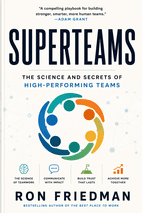
This collection brings together the sharpest insights from Superteams, a book that dissects what makes exceptional groups tick. You will find provocative lines about productivity, collaboration, and the hidden costs of how we work. Each quote is a tiny bomb of wisdom.
What makes this book so quotable is its ability to turn research into memorable, counterintuitive truths. The ideas stick because they challenge common habits while offering a better way. Whether it is about trust, focus, or leadership, every line feels both surprising and immediately useful.
Top Quotes from Superteams
“People on Superteams are twice as likely to look forward to Monday—to reconnecting with colleagues, tackling big projects, and experiencing the satisfaction of making progress.”
From the section comparing how superteams feel about Sunday nights versus average teams.
This line vividly captures the emotional payoff of being on a high-performing team, turning a dreaded day into something exciting.
“For them, Sunday isn't the end of something good. It's the beginning of something better.”
Describing the mindset of people on Superteams regarding Sunday evenings.
The concise, rhythmic phrasing reframes a common source of anxiety into anticipation, making it highly memorable and shareable.
“After even a brief interruption, it takes an average of 25 minutes to regain full focus.”
The author cites research on the cost of distractions at work.
This startling statistic makes the abstract cost of interruptions tangible and actionable. It sticks in the mind because it quantifies a feeling many workers already know.
“Time stress has a stronger negative effect on happiness than being unemployed.”
Ashley Whillans, a psychologist at Harvard Business School, on the research into time affluence.
It reframes productivity as a well-being issue, showing that time poverty is more damaging to happiness than losing a job.
“If you took a racehorse and stuffed it inside a closet, you wouldn't be the least bit surprised when it became sluggish and depressed. That's us.”
The author uses this metaphor after describing how modern humans spend 90% of their day sitting, far from our evolutionary design.
The vivid, relatable image of a confined racehorse perfectly captures the absurdity of our sedentary lifestyles and why they harm performance.
“Trust is earned in drops and lost in buckets.”
Author Kevin Kelly's insight on the fragility of trust.
This concise metaphor powerfully captures how trust builds slowly but can vanish instantly, making it a memorable reminder to protect relationships.
“The bottom line: friendship isn't a distraction. It's a competitive advantage.”
Concluding the argument that workplace friendships boost performance and resilience.
It reframes a soft-skill concept as a hard business imperative, challenging the common bias that socializing at work is unproductive.
Themes Behind the Quotes
A central theme is the tension between individual focus and collective interdependence. The best teams do not just pile on more work or more meetings; they engineer systems that protect deep concentration while enabling purposeful collaboration. Another thread is the hidden cost of poor habits, from constant notifications to pointless meetings, which drain energy and happiness more than we realize.
Trust and vulnerability emerge as foundational. Great teams are built not on likability alone but on a willingness to be open and a commitment to share credit. Leadership is distributed, with every member taking ownership. And perhaps most importantly, the book argues that our environment and rituals shape our performance far more than raw talent ever could.
Quotes by Chapter
Introduction: The Hidden Ingredient of High-Performing Teams
“Interdependence is the belief that you need your teammates to succeed.”
From the explanation of the three essentials that define a real team.
It distills a complex psychological concept into a simple, powerful statement that resonates with anyone who has experienced true collaboration.
“The best teams aren’t built on similarity—they’re built on complementarity.”
During the discussion of interdependence and how teams benefit from diverse skills.
This pithy counterintuitive insight challenges common assumptions about team composition and sticks in the reader's mind.
Chapter 1: The Secret Playbook Top Teams Use to Stay Focused
“Our brains weren't built for task-switching.”
The author explains why constant communication undermines focus.
This short, direct statement crystallizes a key insight about human cognition, making it memorable and relatable. It challenges the common assumption that multitasking is efficient.
“He real issue is the insidious, focus- killing nature of constant communication.”
The author distinguishes the problem from mere workload volume.
The phrase 'insidious, focus-killing nature' powerfully captures how constant communication erodes productivity in a hidden, cumulative way. It gives readers a clear villain to address.
“They get more done by striking the right balance between focused individual work and purposeful collaboration.”
The author summarizes how Superteams outperform typical teams.
This line offers a clear, positive alternative to both constant togetherness and total isolation. It provides a practical principle that readers can immediately apply to their own teams.
Chapter 2: How Superteams Avoid Useless Meetings
“The financial cost of excessive meetings is staggering, draining $1.4 trillion in productivity each year.”
The author presents a statistic about the economic impact of excessive meetings.
This line quantifies the massive scale of the meeting problem, making the abstract cost tangible and alarming for readers.
“On my team, we follow a single rule: no decision, no meeting.”
The author describes a simple guideline used on their own team to avoid unnecessary meetings.
This memorable rule cuts to the heart of meeting purpose, empowering readers to question every meeting invitation.
“Simply knowing that you have a meeting coming up makes you less productive before the meeting even starts.”
The author explains the hidden cost of 'pre-distraction' caused by scheduled meetings.
It reveals a subtle but powerful drain on productivity that many workers experience but rarely articulate.
“In a surprising number of cases, the moment people come together to decide, decision quality drops.”
The author challenges the assumption that group decision-making is always better.
This counterintuitive insight forces readers to reconsider their reliance on meetings and highlights the risks of groupthink.
Chapter 3: The Daily Habits That Set Top Performers Apart
“The only way to ensure that important tasks get done is to schedule them on your calendar.”
Stephen Covey's third habit, 'Put First Things First', as explained in the chapter.
A simple, actionable truth that distinguishes proactive time management from reactive busyness.
“Breakthrough performance doesn’t just come from talent. It comes from building smarter systems.”
The chapter's conclusion on how Superteams achieve consistent results.
Challenges the myth of individual genius and emphasizes sustainable team processes as the real driver of success.
“They frontload their thinking, so that when the moment comes, the right choice is already mapped out.”
Explaining how top performers prepare for high-pressure decisions.
This line perfectly captures the proactive mindset that separates high performers from the rest, making it a memorable call to action.
Chapter 4: How Great Teams Use Downtime to Boost Results
“More work rarely results in better work.”
The author introduces a fundamental truth of human productivity in contrast to the assumption that longer hours lead to more output.
This line succinctly challenges the common productivity myth that grinding harder leads to better results, inviting readers to reconsider their work habits.
“The moment we allow ourselves to step away is the moment a solution appears.”
The author explains how breaks can spark creative breakthroughs, citing studies on distraction and original thinking.
This line encapsulates the counterintuitive power of pausing, making a compelling case that stepping back often leads to forward progress.
“It’s not moving that wears you out. It's sitting still.”
The author contrasts common assumptions about exercise with research showing that sitting, not activity, drains energy.
It flips conventional wisdom on its head, offering a memorable and actionable insight that encourages movement throughout the workday.
Chapter 5: What the Best Teammates Do Differently
“Being likable is not the same thing as being indispensable.”
The author's conclusion after comparing top and bottom teammate traits.
This pithy line challenges the assumption that likability is the key to being valued, instead emphasizing contribution to results.
“On bad teams, no one leads. On average teams, the coaches lead. But on elite teams, the players lead.”
P.J. Fleck, University of Minnesota football coach, describing leadership dynamics.
It's a memorable, three-part framework that distinguishes between dysfunctional, average, and elite teams, making the ideal clear.
“You can soak up the praise yourself and revel in a fleeting moment of glory. Or, you can share the limelight, lift everyone's performance, and look like a leader in the process.”
The author summarizing the payoff of sharing credit after describing Chet Holmgren's example.
It presents a powerful choice that frames selflessness as a strategic advantage, motivating readers to elevate their teammates.
“Research shows we're happiest not just when we earn more, but when we earn slightly more than those around us.”
The chapter discusses how status shapes our thinking and feelings, citing research on income and happiness.
It reveals a counterintuitive truth about human nature—that relative standing often matters more than absolute gain—making it a memorable insight for readers.
Chapter 6: The Trust Equation (and How to Use It)
“Sympathy implies distance. It suggests you’ve become an outsider, someone to be pitied rather than supported as a peer.”
Reflection on how Def Leppard's bandmates reacted to Rick Allen's accident.
It reframes pity as a barrier to genuine connection, emphasizing that true support treats someone as an equal, not a victim.
“But the band’s vices weren't the cause of its collapse. They were a symptom, a response to something deeper.”
Analysis of Guns N' Roses' downfall.
This challenges surface-level explanations and encourages readers to look for root causes of team dysfunction, a lesson applicable beyond rock bands.
“Trust is a willingness to place yourself in a vulnerable position while expecting a positive result.”
Definition of trust provided in the chapter.
It distills a complex concept into a clear, actionable definition that highlights both risk and expectation, making it easy to apply in team settings.
Chapter 7: How Superteams Turn Teammates into Friends
“Some things are more important than votes.”
Scalia's response to a clerk who asked why he gave Ginsburg roses every birthday despite it never swaying her vote.
This line captures the profound truth that genuine friendship transcends ideological battles and professional disagreements, making it deeply resonant for anyone navigating conflicting relationships.