San Fransicko — Interactive Mindmaps

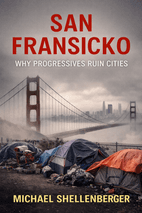
San Fransicko by Michael Shellenberger Book Cover

by Michael Shellenberger

Michael Shellenberger's San Fransicko critiques progressive policies on homelessness and addiction in California, arguing they have worsened public disorder. It is for readers debating urban crisis solutions and the limits of compassionate governance.

On Insta.page you also get an Apply This Book tool that lets you combine insights from up to 3 books to solve your specific situation.

Chapter mindmaps

Free preview: chapters 1–4 are fully interactive. Click any node to expand or collapse. Subscribe to unlock the rest.

Chapter 1: Introduction

Key concepts: Introduction

1. Introduction

Catalyst: The Seattle Occupation & Personal Awakening

  • The 2020 anarchist occupation of a Seattle neighborhood, including killings within the zone, prompted the author's central question: why would a city government allow this?
  • Despite the author's own radical background (e.g., WTO protests), the government's acquiescence to armed groups seizing control was a shocking departure.
  • This event ignited a deeper investigation into the failure of progressive governance in major cities.

Personal Experience: Pandemic-Era Disorder in Berkeley

  • Daily life in downtown Berkeley during COVID-19 revealed escalating public chaos: psychotic episodes, aggression, and widespread homelessness.
  • Pandemic policies (reduced jail/shelter occupancy) exacerbated pre-existing crises, leaving trash and human waste in public spaces.
  • The breakdown in social cohesion was evident, where simple eye contact could provoke hostility, illustrating a collapse of public safety.

The Progressive Paradox: High Taxes, Worsening Outcomes

  • California, a progressive model, suffers the nation's highest taxes alongside a business exodus and deteriorating social conditions.
  • As a lifelong Democrat, the author questions the return on investment from taxes and ballot initiatives targeting addiction and homelessness.
  • A core contradiction: progressive officials have ceased enforcing laws for certain groups (unhoused, anarchists), yet the intended social problems have worsened.

Case Study: The Failure of San Francisco's Homelessness Policies

  • Decades of well-intentioned policies, from mayoral crackdowns/compassion to 'Care Not Cash', have failed to curb chronic homelessness.
  • Reliance on Single Room Occupancy (SRO) hotels, advocated by nonprofits, often created hubs for drug use and prostitution instead of solutions.
  • Supportive housing models frequently perpetuate addiction, and chronic homelessness is tightly linked to addiction and disaffiliation from support systems.

Core Thesis & Book's Mission

  • The book investigates why decades of progressive urban governance have led to increased disorder, homelessness, and addiction.
  • A key shift in progressive thought has reframed law and order as an obstacle to social justice, tolerating behaviors that degrade urban life.
  • The mission is to correct fundamental misconceptions about crime, homelessness, and urban management, advocating for evidence over ideology.

Chapter 2: 2: Pleasure Island

Key concepts: 2: Pleasure Island

2: Pleasure Island

Historical Context of Progressive Advocacy

  • Progressive activists since the 1980s defended the right to camp in public spaces, resisting bans on panhandling and sidewalk sitting
  • Advocates framed enforcement measures as attacks on civil rights comparable to Jim Crow laws
  • Humanitarian aid like tent distribution often facilitated encampment growth rather than resolution
  • This philosophical stance created a sense of entitlement among some homeless individuals to occupy public spaces

Financial Incentives and Magnet Effect

  • San Francisco spends more per homeless person than other major cities like New York or Los Angeles
  • High cash welfare benefits can be manipulated to fund drug habits rather than basic needs
  • Abundant services combined with mild climate and tolerant environment attract homeless from other states
  • Officials acknowledge this 'magnet effect' where increased spending attracts more people, overwhelming systems

The Pleasure Island Environment

  • Easy access to drugs with minimal legal consequences creates a destructive cycle
  • Free needles and food coexist with open drug dealing, enabling addiction
  • Many homeless refuse shelters to maintain substance use freedom in encampments
  • Even those in supportive housing often resist sobriety requirements
  • Encampment clearings typically result in few accepting help, merely displacing problems

Community Conflict and Political Stalemate

  • Frustrated residents sometimes take matters into their own hands (e.g., using boulders to block camping)
  • Progressive advocates frequently respond to critics with harsh personal accusations
  • Questioning the status quo is often labeled as demonizing the homeless
  • This polarization stifles constructive debate and makes the problem seem unsolvable
  • The city remains trapped in a cycle of good intentions and worsening outcomes

Systemic Consequences and Outcomes

  • Compassionate policies inadvertently enable addiction rather than promote recovery
  • Generous, unrestricted aid undermines traditional outreach and recovery efforts
  • The 'Pleasure Island' metaphor illustrates how easy access erodes personal autonomy
  • Many homeless actively choose street life over shelter to maintain addiction
  • The crisis has become intractable despite significant financial investment

Chapter 3: 3: The Experiment Was a Success but the Patients Died

Key concepts: 3: The Experiment Was a Success but the Patients Died

3: The Experiment Was a Success but the Patients Died

Advocacy Against Emergency Shelter

  • Leading advocates oppose shelters as a costly diversion from permanent housing goals.
  • Cities like San Francisco shelter less than half their homeless population due to this philosophy.
  • Advocates have successfully blocked shelter expansion proposals for decades.
  • Shelters are framed as an unacceptable alternative to a permanent home.

High Cost and Slow Pace of Permanent Housing

  • Permanent supportive housing costs have ballooned (e.g., from $140K to over $530K per unit in LA).
  • Funding initiatives often spread resources thin across various 'exits,' not just new housing units.
  • Massive budget increases have not reduced visible street homelessness proportionally.
  • Resources are not allocated to create immediate, lower-cost shelter alternatives.

Questioning Housing First Effectiveness

  • Key studies show housing does not reduce mortality rates among the chronically homeless.
  • National reviews find 'no substantial evidence' that permanent supportive housing improves health outcomes.
  • Housing First's harm-reduction approach may slow recovery from addiction for some.
  • Abstinence-contingent housing models show promise but are often rejected by dominant advocates.
  • Long-term studies show high death rates and low housing retention rates in supportive housing.

The Unaddressed Replacement and Inflow Problem

  • Housing current homeless does not prevent new people from becoming homeless.
  • Root causes like poverty and high rents are rarely confronted in policy debates.
  • Without addressing inflow, the system can never keep pace with need.
  • This points to a ceiling on success for policies focused solely on building units.

Core Policy Conflict and Consequences

  • Deliberate choice to prioritize permanent housing over shelter expansion.
  • Sustained street homelessness results from limited shelter capacity.
  • Emerging evidence challenges transformative claims of Housing First model.
  • A more diversified strategy including prevention and treatment is suggested as necessary.

Chapter 4: 4: The War on the War on Drugs

Key concepts: 4: The War on the War on Drugs

4: The War on the War on Drugs

Challenging the Narrative of Mass Incarceration

  • Data shows most state prisoners are incarcerated for violent offenses, not simple drug possession
  • Releasing all drug offenders would have minimal impact on racial disparities in prisons
  • Drug offenses are not the primary driver of prison population growth, complicating influential narratives like 'The New Jim Crow'
  • Parole violations leading to re-incarceration are more often due to new crimes than failed drug tests

The Pivotal Role of Violence and Community Response

  • Violence, particularly during the crack epidemic, was a major driver of prison growth
  • Policy responses were often supported by leaders in affected Black communities seeking relief from devastation
  • Historical context challenges simplistic framing of tough crime laws as purely racist in intent
  • Prison population trends for drug crimes tracked with violence levels rather than changes in sentencing laws

The Overdose Crisis and Limits of Decriminalization

  • Overdose deaths now far outpace homicides and car accidents, creating a catastrophic new front
  • Evidence suggests removing criminal penalties can lower drug prices and increase use
  • Portugal's model differs sharply from permissive American approaches by including fines and social pressure
  • Open-air drug markets in cities like San Francisco prompt tough reevaluation of decriminalization

Unintended Consequences of Policy Shifts

  • California's Proposition 47 reduced possession to a ticketable offense, removing police tools to compel detox
  • Policy changes correlated with rise in public disorder and addiction
  • National path from overprescribed prescription pills to cheap heroin and deadly fentanyl fueled crisis
  • San Francisco's long, tolerant history with drugs set stage for current methamphetamine crisis

Contradictions in Public Health Approaches

  • California aggressively regulates tobacco while officially distributing drug paraphernalia under harm reduction
  • Culture of fatalism normalizes repeated overdose on the streets
  • Interviews reveal lack of clear strategy to reduce overdose deaths at national or city level
  • Treatment access is severely limited with deadly wait times for detox beds

Accountability and Pressure in Recovery

  • Studies show mandated treatment through drug courts can be highly effective
  • Many recovered addicts credit the 'compulsion to stop' with saving their lives
  • Some argue current harm reduction practices act merely as 'life support' without promoting recovery
  • Tension exists between supporting life-saving tools like Narcan and endorsing commercial drug markets

This crisis prompts a critical re-evaluation of decriminalization and harm reduction policies the author once championed. While figures like Ethan Nadelmann and funders like George Soros successfully shifted the national conversation and laws, outcomes in progressive cities raise hard questions. The comparison to Portugal—often cited as a decriminalization model—is nuanced: Portugal maintains social pressure for treatment and fines for possession, a contrast to the more permissive approach seen in some American cities.

  • Evidence suggests that decriminalization can have unintended consequences.
  • By reducing risks for suppliers and users, it can lower drug prices and increase consumption and availability.
  • Data shows heroin use and addiction rose significantly in the U.S.

The Escalating Methamphetamine Crisis

  • The text details a dramatic surge in methamphetamine use from the 1990s onward, with hospital admissions for meth abuse tripling between 1995 and 2015.
  • In San Francisco, the crisis is particularly acute: meth overdose deaths rose 500% from 2008 to 2020, and it became the most common drug in California overdose deaths.
  • Veteran police sergeant Kelly Kruger observed that the drug culture has become more dangerous and isolated, with a loss of the community sense that once existed among people on the street.

Policy Shifts and Their Unintended Consequences

  • The passage of Proposition 47 in 2014, which decriminalized possession of small amounts of hard drugs, is cited by law enforcement and service providers as a factor that exacerbated addiction and public disorder.
  • Police lost the ability to hold intoxicated individuals for a few days to detox, often releasing them with only a ticket.
  • Service providers like Andy Bales note a direct correlation between this policy shift, the implementation of "Housing First" without sobriety requirements, and a sharp increase in both addiction rates and homelessness.

San Francisco's Historical Relationship with Drugs

  • The city has a long, complex history with substance use, from opium dens in the 1840s to being the birthplace of revolutionary approaches like Alcoholics Anonymous in the 1930s.
  • The 1967 "Summer of Love" cemented San Francisco's reputation as a haven for drug experimentation, though it left behind a legacy of addiction among poorer populations.
  • Policy has swung between periods of tolerance, like President Carter's advocacy for decriminalization in the 1970s, and prohibition, such as the "Just Say No" campaigns of the 1980s.

The Path from Prescription Pills to Heroin and Fentanyl

  • A significant portion of the text traces the origins of the opioid epidemic.
  • In the 1990s, a campaign to destigmatize pain medication, coupled with aggressive pharmaceutical marketing, led to massive overprescription.
  • When regulations finally tightened, users turned to cheaper, more accessible heroin.

The Harm Reduction Debate and a Culture of Fatalism

  • The chapter presents a stark contrast between California's aggressive regulation of public health risks like secondhand smoke and its tolerant, harm-reduction approach to hard drugs.
  • San Francisco officially promotes messages like "try not to use alone" and distributed drug paraphernalia, including crack pipes and foil for smoking fentanyl, to homeless individuals in city-funded hotel rooms.
  • Harm reduction advocates argue that fentanyl can be used safely and frame addiction as a symptom of "poverty and structural racism." This official stance exists alongside a deep sense of fatalism on the streets, where users like Jessica explicitly state they are in San Francisco "to die," describing a cycle of overdose and revival that has become normalized.

A Stark Lack of Strategy and Treatment Access

  • The chapter presents a series of revealing conversations that underscore a critical absence of a coherent, national strategy to reduce overdose deaths.
  • When asked directly, Monique Tula of the Harm Reduction Coalition states plainly there is no such strategy, while San Francisco Supervisor Rafael Mandelman admits none is clear to him within his own city.
  • This strategic void manifests in a street-level reality where individuals revived by Narcan are often returned directly to the open drug scene without being offered treatment.

Limitations of Healthcare Systems and Harm Reduction

  • Single-payer healthcare systems alone do not solve the overdose crisis, as evidenced by British Columbia's 74% increase in deaths despite decriminalization.
  • The core issue is not insurance coverage, as most destitute addicts qualify for Medicaid, but the availability and philosophy of treatment.
  • Some harm reduction advocates focus on expanding tools like Narcan rather than reevaluating the core treatment approach.
  • For some, solving overdoses is framed as requiring the prior elimination of broader societal ills like poverty, racism, and homelessness.

The Contrast in Treatment Philosophies and Efficacy

  • A study comparing public treatment on Skid Row with a private Malibu program revealed a stark philosophical split: strict accountability versus fatalistic leniency.
  • The public Skid Row program exhibited leniency, granting clients freedom to continue substance use, sometimes with fatal consequences.
  • The affluent Malibu program was significantly stricter, highlighting the role of structure and expectations in recovery.
  • This contrast introduces the central tension regarding the role of pressure and accountability in successful treatment outcomes.

The Critical Role of External Pressure in Recovery

  • Many recovered addicts attest they would not have entered treatment without external pressure from the criminal justice system.
  • Research supports that mandated treatment can be nearly as effective as voluntary treatment.
  • Drug courts, which mandate treatment as an alternative to incarceration, are highlighted as a successful model that reduces recidivism and saves public money.
  • Personal testimonies challenge the notion that recovery must be entirely self-motivated, emphasizing coercion as a life-saving intervention.

The Divisive Debate Over Full Legalization and Decriminalization

  • The push for full drug decriminalization and safe consumption sites creates a sharp divide between progressive advocates and recovered addicts.
  • Recovered addicts express deep skepticism, arguing that removing all pressure eliminates the 'compulsion to stop' necessary for many to seek recovery.
  • Arguments for legalizing drugs like heroin for recreational use are forcefully countered by experts who draw parallels to corporate tactics of pharmaceutical companies.
  • Supporting harm reduction tools like Narcan is framed as a distinct policy choice from supporting full drug legalization, clarifying a common point of confusion.

Continue exploring San Fransicko