Same as Ever Quotes
by Morgan Housel
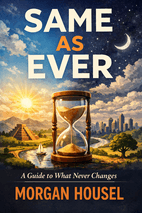
Looking for the best quotes from Same as Ever by Morgan Housel? Below are the lines that stand out most across the book.
The quotes are organized by chapter, each with a short note on where it appears and why it stands out.
Top Quotes from Same as Ever
“I almost never get the question: ‘What's not going to change in the next ten years?’” he said. “And I submit to you that that second question is actually the more important of the two.”
Amazon founder Jeff Bezos shares what he considers a more important question than predicting change.
This quote flips conventional thinking and underscores the power of identifying stable, predictable forces in a world obsessed with novelty.
“In 1,000 parallel universes, you want to be wealthy in 999 of them. You don’t want to be wealthy in the fifty of them where you got lucky, so we want to factor luck out of it.... I want to live in a way that if my life played out 1,000 times, Naval is successful 999 times.”
Entrepreneur Naval Ravikant explains his approach to focusing on reliable outcomes rather than luck.
This quote inspires readers to pursue strategies that work consistently across many scenarios, emphasizing the importance of resilience and sound principles over chance.
“If you know where we've been, you realize we have no idea where we're going.”
The author opens the chapter with this observation about history and prediction.
It encapsulates the book's central theme that the past reveals how unpredictable the future truly is, humbling our confidence in forecasts.
“It was a complete fluke, a random and thoughtless bit of dumb luck that became the most important decision of my life—far more important than every intentional decision I've ever made—or ever will make.”
The author reflects on his decision not to join his friends on the fatal avalanche run that killed them.
This line powerfully illustrates how a random, unthinking choice can have life-or-death consequences, underscoring the role of luck in shaping our paths.
“An irony of studying history is that we often know exactly how a story ends, but we have no idea where it began.”
The author discusses the difficulty of tracing the origins of major events.
It reminds readers that understanding the past is complex and that outcomes are rarely as straightforward as they seem, promoting intellectual humility.
“No matter what the world looks like today, and what seems obvious today, everything can change tomorrow because of some tiny accident no one's thinking about.”
The author advises keeping a wider imagination about potential change.
This warning highlights how small, overlooked events can overturn the status quo, urging us to remain adaptable and humble.
Quotes by Chapter
Risk Is What You Don’t See
“Risk is what's left over after you think you've thought of everything.”
Financial advisor Carl Richards is quoted in the chapter.
It captures the essence of unforeseen risk in a concise, memorable way, reminding readers that no amount of planning can account for every contingency.
“The biggest risk is always what no one sees coming, because if no one sees it coming, no one’s prepared for it; and if no one's prepared for it, its damage will be amplified when it arrives.”
The author explains why surprises are the most dangerous risks.
This line succinctly defines the central thesis of the chapter, emphasizing that true risk lies in the unknown and its cascading effects.
“Invest in preparedness, not in prediction.”
Nassim Taleb is quoted as a counterpoint to relying on forecasts.
It offers a practical, actionable mindset shift—focusing on resilience rather than futile attempts to foresee the unpredictable.
“What you don't see coming always is.”
The conclusion of the Harry Houdini story illustrates how an unseen, minor risk can be fatal.
This short, punchy sentence drives home the chapter's core lesson with a powerful, visceral example that sticks with the reader.
Expectations and Reality
“The first rule of a happy life is low expectations.”
Charlie Munger, when asked his secret to a happy life at age 98.
It's simple, counterintuitive advice that directly addresses the chapter's theme of expectations versus reality.
“The world isn’t driven by greed; it's driven by envy.”
Investor Charlie Munger once noted this.
It reframes human motivation and explains why relative comparisons often outweigh absolute gains.
“Money buys happiness in the same way drugs bring pleasure: incredible if done right, dangerous if used to mask a weakness, and disastrous when no amount is enough.”
The author's reflection on the relationship between money and happiness.
The vivid analogy captures the nuanced truth that money can improve life but can also lead to misery when expectations spiral.
“It was a tough life but they didn't know it because where they'd come from it was tougher. So it was an improvement no matter what.”
Ben Ferencz describing his parents' attitude despite their harsh living conditions in New York.
It powerfully illustrates how expectations shaped by past experiences determine one's perception of happiness.
Wild Minds
“People who think about the world in unique ways you like also think about the world in unique ways you won't like.”
The author introduces the chapter's central thesis about the trade-offs of exceptional minds.
It succinctly captures the paradox that we cannot selectively admire the traits of successful people without accepting their flaws, making it a memorable and universally applicable insight.
“The key thing is that unique minds have to be accepted as a full package, because the things they do well and that we admire cannot be separated from the things we wouldn't want for ourselves or we look down upon.”
The author concludes a discussion of John Boyd and other geniuses.
This provides a clear, actionable lesson about managing expectations and avoiding the common mistake of cherry-picking admirable traits from role models.
“People who are abnormally good at one thing tend to be abnormally bad at something else.”
The author offers a generalization about human capability and bandwidth.
It's a concise, pithy aphorism that resonates because it explains the inevitable trade-offs in talent and personality across many domains.
“Either you want someone else's life or you don’t. Either is equally powerful. Just know which is which when finding role models.”
Naval Ravikant's advice on jealousy and emulation, cited by the author.
It forces readers to confront the holistic nature of another person's existence, discouraging selective admiration and promoting honest self-reflection.
Wild Numbers
“People don’t want accuracy. They want certainty.”
Opening line of the chapter, setting up the theme.
It captures a universal human flaw in a simple, memorable phrase that resonates with anyone who has observed decision-making or forecasting.
“That something can be likely and not happen, or unlikely and still happen, is one of the world's most important tricks.”
The author discusses how people struggle with probability.
It distills the core paradox of probability into a sharp, insightful line that helps readers grasp why the world feels unpredictable.
“Human beings cannot comprehend very large or very small numbers. It would be useful for us to acknowledge that fact.”
Daniel Kahneman's observation, cited by the author.
This quote from a Nobel laureate explains a fundamental cognitive limitation that underpins many irrational beliefs and statistical misunderstandings.
“Knowing the high odds of something happening loses its meaning when that thing happening hurts.”
From the author's example of hotel valet parking accidents.
It highlights the emotional gap between statistical probability and real-world pain, explaining why people react irrationally to inevitable risks.
Does Not Compute
“To suppose that the value of a common stock is determined purely by a corporation's earnings discounted by the relevant interest rates and adjusted for the marginal tax rate is to forget that people have burned witches, gone to war on a whim, risen to the defense of Joseph Stalin and believed Orson Welles when he told them over the radio that the Martians had landed.”
Investor Jim Grant said this about stock valuation.
It humorously captures the irrationality of human behavior that defies rational financial models, reminding us that markets are driven by emotions and stories, not just numbers.
“The thing I have noticed is when the anecdotes and the data disagree, the anecdotes are usually right. There's something wrong with the way you are measuring it.”
Jeff Bezos said this about anecdotes and data.
It challenges the common belief that data is always superior to anecdotal evidence, emphasizing the importance of qualitative understanding in decision-making.
“Logic is an invention of man and may be ignored by the universe.”
Historian Will Durant said this.
It succinctly expresses the central theme of the chapter—that the universe and human affairs often do not follow logical rules, which can frustrate those who expect rationality.
“The only thing that changed during those three days was investors’ faith in the company. One day they believed in the company and bought its debt. The next day that belief stopped, and so did its funding.”
Describing Lehman Brothers' sudden collapse in 2008 despite strong financial ratios.
This passage captures how intangible faith can override hard data, making markets unpredictable and humbling even the most rigorous models.
Calm Plants the Seeds of Crazy
“Calm plants the seeds of crazy. Always has, always will.”
The author concludes the chapter's central theme that stability inevitably leads to instability.
It is a memorable, concise summary of the entire chapter's paradox, easily recalled and applied to diverse situations.
“At your highest moment, be careful. That's when the devil comes for you.”
Denzel Washington's advice to Will Smith after the Oscars slap, as recounted in the chapter.
It is a timeless warning about hubris and the danger of peak success, resonating with personal and professional experience.
“Things can become the most dangerous when people perceive them to be the safest.”
The author reflects on how perceived safety leads to risk and underestimation of danger.
It inverts common intuition, making a striking point that applies to finance, health, and everyday life.
Too Much, Too Soon, Too Fast
“Stocks pay a fortune in the long run but seek punitive damages when you demand to be paid sooner.”
The author summarizes a key lesson from investing history.
It captures the tension between patience and impatience in markets, reminding readers that forcing quick returns often backfires.