On Fire Key Takeaways
by John O'Leary
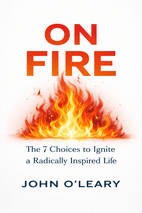
5 Main Takeaways from On Fire
Take full ownership of your life to transform challenges into growth.
This means stopping blame and entitlement, and instead taking responsibility for your actions and future. As shown in Chapter 1, inflection points demand decisive action toward self-reliance, freeing you to intentionally shape your path.
Embrace your authentic story with all its scars to empower yourself and others.
Like the Golden Buddha, your true worth is hidden under layers of protection. Sharing your vulnerabilities builds genuine connections, as highlighted in Chapter 2 where scars are celebrated as evidence of healing and strength.
Find and commit to a compelling purpose to overcome fear and live fully.
Heroes are ordinary people who choose courage in critical moments. Your 'why' anchors you through difficult times, enabling you to endure any 'how,' as seen in Chapter 3 where purpose transforms mundane tasks into life-saving missions.
Cultivate daily gratitude to shift your perspective and unlock sustained joy.
By actively appreciating ordinary moments, you can transform experiences from curses to gifts. Chapter 4 demonstrates that small habits of gratitude reframe your entire outlook, fostering resilience and happiness.
Choose love and courageous action to create a life of significance and impact.
Moving from 'I have to' to 'I want to' liberates you, as shown in Chapter 7. Small acts of courage and presence, emphasized in Chapters 5 and 6, ripple out to inspire others and build a lasting legacy.
Executive Analysis
The five takeaways form a cohesive blueprint for a radically inspired life. By taking ownership, you seize control of your narrative; embracing authenticity allows you to share that narrative powerfully; committing to purpose gives direction; practicing gratitude reframes challenges; and choosing love ensures actions are meaningful. Together, they argue that true fulfillment comes not from avoiding pain but from engaging fully with every moment, transforming obstacles into opportunities for growth.
'On Fire' matters because it translates profound life-and-death insights into daily practices. Unlike abstract self-help, it grounds its lessons in the author's harrowing recovery from a devastating fire, making the call to action urgent and relatable. For readers feeling stuck or indifferent, it offers a clear path from victimhood to empowerment, emphasizing that significance is found in service and presence. This book revitalizes the personal development genre by reminding us that our greatest trials can ignite our most purposeful lives.
Chapter-by-Chapter Key Takeaways
Do You Want to Die? (Chapter 1)
Life is a choice between actively living or passively dying. Our response to adversity, not the adversity itself, defines our path.
Ownership is the antidote to entitlement. Stop waiting for someone else to fix your life; the power to change it lies with you.
Accountability is power, not a burden. Taking full responsibility for your actions and their consequences frees you to intentionally shape your future.
Inflection points demand decisive action. Moments of crisis are opportunities to choose a new direction—toward ownership or away from it.
The fight for a meaningful life continues long after the initial victory. True resilience is shown in the daily, often frustrating, choices to be self-sufficient and move forward.
Lasting strength and independence are often forged in moments of struggle, not ease.
The most courageous love sometimes means withholding help to foster self-reliance.
Truly living requires moving from a mindset of blame or entitlement to one of personal responsibility.
Your current situation, no matter how challenging, holds the potential for an inflection point where you can choose to own your story.
A radically inspired life is built on the daily choice to engage fully with both obstacles and opportunities.
Try this: Decide to take full responsibility for your current situation and consciously choose your response to every challenge, moving from blame to proactive ownership.
What Are You Hiding? (Chapter 2)
Your story is a gift: Every experience, especially the painful ones, has shaped you and holds intrinsic value. Claiming your entire story (your "red jacket") is an act of empowerment, not victimhood.
Uncover your inner gold: Like the Golden Buddha, your true worth and beauty are often hidden under protective layers. Inspiring yourself and others requires the courage to chip away the plaster of pretense and let your authentic self be seen.
Vulnerability fosters connection: Superficiality keeps us isolated. Sharing your true struggles and scars is what builds genuine, life-giving community. The "most personal" is, in fact, "the most universal."
Scars are evidence of healing: They are not signs of weakness to be hidden, but symbols of strength and resilience to be celebrated. They are proof that you have survived and healed.
Choose self-acceptance: The journey ends not with changing your story, but with embracing it. Look at your reflection—scars and all—with love, recognizing it has led you perfectly to this moment and the possibilities ahead.
Try this: Reflect on a past struggle you've hidden, share it with someone you trust, and practice seeing your scars as evidence of strength, not shame.
Are You All In? (Chapter 3)
Heroes are often ordinary people who choose courage and sacrifice in critical moments, like Jim running into the fire or Amy refusing to let go.
A compelling purpose is essential to combat indifference and feel truly alive, as seen in both Jim’s transformed actions and the veterans rediscovering their mission.
Your “why” is your anchor. Knowing your deeper purpose—whether it’s love for a person, a duty, or a personal mission—provides the strength to endure even the most painful “hows” in life.
Inflection points define us. Life presents moments where we can pull back in self-preservation or step forward in courage; the choice determines the life we lead and the person we become.
Every Role Matters: Purpose transforms mundane tasks into life-saving missions, as demonstrated by the janitor whose cleaning prevented fatal infection.
Fuel Your Why: An "Ignition Statement" is a personal, present-tense mantra (beginning with "Because") that provides enduring motivation and focus for daily life.
Purpose Overcomes Fear: Knowing your profound why enables you to endure any how, exemplified by an eight-year-old girl running into a burning house.
The Daily Choice: Life presents a constant choice between indifference, which disengages and kills spirit, and purpose, which engages and saves lives—sometimes your own.
Try this: Draft a personal 'Ignition Statement' beginning with 'Because' to clarify your core purpose, and let it guide your decisions and actions today.
Why Are You in Jail? (Chapter 4)
Gratitude is the foundation of joy: Actively appreciating life, especially its ordinary moments, is scientifically linked to sustained happiness.
Perspective transforms experience: The same circumstance—like imprisonment or illness—can be seen as a curse or a source of gratitude, radically altering one's daily reality.
Choose empowerment over victimhood: We have the power to ask "Why me?" not with despair, but with curiosity and thankfulness for gifts received and those to come.
Small practices lead to big shifts: Daily habits of gratitude, like acknowledging simple comforts, can reframe our entire outlook and inspire those around us.
Leadership and compassion show the way: Figures like Dr. Ayvazian demonstrate that true care involves guiding others to see their own potential, fostering resilience beyond immediate challenges.
Try this: Start a daily gratitude practice by writing down three ordinary things you appreciate, framing challenges as opportunities for growth.
Next chapter: “Can You Say Yes?” is locked
Keep learning from On Fire — and unlock all 600+ book summaries with audio, mindmaps and AI Q&A.
$0.00 due today · 7 days free, then $89.99/year ($7.49/mo) · Cancel anytime before day 7
plus sales tax where applicable