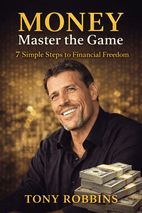
MONEY Master the Game — Interactive Mindmaps

MONEY Master the Game by Tony Robbins Book Cover

by Tony Robbins

Tony Robbins's MONEY Master the Game translates insights from top investors into a seven-step plan for financial freedom, focusing on low-cost index funds and strategic asset allocation. It empowers everyday individuals to build secure, long-term wealth by avoiding high fees and emotional investing mistakes.

On Insta.page you also get an Apply This Book tool that lets you combine insights from up to 3 books to solve your specific situation.

Chapter mindmaps

Free preview: chapters 1–4 are fully interactive. Click any node to expand or collapse. Subscribe to unlock the rest.

Chapter 1: Chapter 1.1 It’s Your Money! It’s Your Life! Take Control

Key concepts: Chapter 1.1 It’s Your Money! It’s Your Life! Take Control

1. Chapter 1.1 It’s Your Money! It’s Your Life! Take Control

The Nature and Power of Money

  • Money is an emotionally charged force representing deeper desires like empowerment, freedom, and security.
  • It is fundamentally an illusion—a shape-shifter for what we truly crave.
  • The core choice is binary: master money or be mastered by it.

The Money Game Mindset

  • View finance as a serious strategic game, not a frivolous pastime.
  • The world's wealthiest are top players; learning their rules is key to winning.
  • The goal is to transition from being a chess piece to becoming the chess player.

Vision of Financial Freedom

  • Financial freedom means working from joy and abundance, not necessity.
  • It enables life choices like travel, family care, and entrepreneurship.
  • The secret to wealth is becoming more valuable by doing more for others.

Challenges of the Modern Financial System

  • The system is complex and often rigged, with tools like High-Frequency Trading (HFT) disadvantaging everyday investors.
  • Traditional safety nets (e.g., pensions) are disappearing.
  • Overwhelming product choices (mutual funds, ETFs, etc.) are designed to confuse and encourage reliance on 'experts'.

Seeking True Financial Mastery

  • Most financial advice is noise from unqualified voices; real wisdom comes from proven masters like Bogle and Dalio.
  • True mastery requires acknowledging what you don't know and adopting timeless, passive strategies.
  • The author's mission is to democratize smart-money knowledge through tools like Portfolio CheckUp.

The Broader Purpose of Wealth

  • True wealth is about having enough to make a difference.
  • Generosity is both a privilege and a responsibility, starting now regardless of wealth level.
  • The journey leads to a life where money is a source of excitement, not stress.

Wisdom from the True Masters

  • Learn from proven masters, not self-proclaimed experts or media talking heads.
  • The book distills principles and strategies from 50 top financial minds, including Bogle, Dalio, and Swensen.
  • The greatest potential inheritance is not money, but a set of timeless, actionable financial principles.
  • The strategies are designed to help investors weather any market condition.

An Empowering, Accessible Blueprint

  • The book provides a practical blueprint for all ages, focusing on psychology and avoiding common mistakes.
  • The author acts as a translator and 'personal financial search engine,' cutting through jargon and complexity.
  • It reveals how to save significant fees and access investment vehicles with principal protection.
  • The goal is to level the playing field, making strategies of the ultra-wealthy accessible to everyone.

The Author's Mission: From Crisis to Advocacy

  • The 2008 financial crisis and its aftermath sparked the author's mission to provide tangible financial tools.
  • Inspired by transformative books from his youth and Napoleon Hill's interview method.
  • Embarked on a four-year quest to interview modern financial masters to create a practical owner's manual.
  • The mission evolved from passive knowledge gathering to passionate advocacy for democratizing financial wisdom.

Core Investment Philosophy from Ray Dalio

  • Individual investors should not try to beat professional traders at their hyper-competitive 'poker game.'
  • Advocates for a 'passive way to win' using a diversified, principle-driven system.
  • The ideal portfolio is designed to protect against downturns, acknowledging even the best investors are often wrong.
  • Shares a system historically yielding positive returns 85% of the time, with minimal losses in catastrophic years.

Democratizing Access and Tools

  • Uncovered sophisticated investment tools and opportunities traditionally reserved for the ultra-wealthy.
  • Goal is to democratize 'smart money' knowledge for every reader.
  • Crowning achievement is the 'Portfolio CheckUp,' a free online tool to audit brokerage accounts for hidden fees and underperformance.
  • Creates a win-win: institutions build loyalty while everyday investors gain transparency and power.

The Responsibility and Impact of True Wealth

  • True wealth mastery includes having enough to make a meaningful difference.
  • Giving is framed as both a privilege and a responsibility, tied to a mindset of abundance.
  • The author shares a personal commitment to philanthropy, helping feed millions annually.
  • Purchasing the book directly contributes to providing meals, linking the reader's journey to a larger mission.

The Financial Freedom Promise

  • Achieve a lifelong income that allows you to work only by choice, not necessity
  • Transform money from a source of stress into a source of excitement and possibility
  • Join the minority who commit to and complete the full journey toward financial control

Tools for Immediate Action

  • PortfolioCheckUp.com provides a free audit of investment fees and performance
  • This tool democratizes financial insights previously available only to the wealthy
  • Taking this audit is a concrete first step toward understanding your current financial position

The Philosophy of True Wealth

  • Generosity is an integral component of genuine wealth, not an afterthought
  • The responsibility to give back begins immediately, regardless of financial starting point
  • Purchasing this book has already contributed to fighting hunger through the author's commitment

The Reader's Commitment

  • The challenge is to commit fully to the entire process outlined in the book
  • Reading past the first chapter places you in a proactive minority of readers
  • The reward for this commitment is a fundamentally transformed relationship with money

The Roadmap Ahead

  • The path forward will be clearly outlined in 7 Simple Steps to Financial Freedom
  • These steps provide a concrete, actionable framework for achieving control
  • The coming sections will detail this systematic approach to building financial security

Chapter 2: Chapter 1.2 The 7 Simple Steps to Financial Freedom: Create an Income for Life

Key concepts: Chapter 1.2 The 7 Simple Steps to Financial Freedom: Create an Income for Life

2. Chapter 1.2 The 7 Simple Steps to Financial Freedom: Create an Income for Life

The Power of Anticipation

  • Wealth leaders anticipate rather than react to financial events
  • Knowledge of future patterns provides a competitive advantage
  • The book distills wisdom from top financial minds to serve as a guide

The Broken Retirement System

  • Retirement was designed for shorter lifespans (life expectancy ~62)
  • Modern retirements may span 30+ years, creating mathematical challenges
  • The #1 fear is outliving savings, with 75% of Americans at risk
  • Social Security is insufficient and faces an unsustainable future

Systemic Barriers to Financial Security

  • Traditional pensions have vanished, shifting risk to individuals
  • 401(k) traps include high hidden fees that devastate long-term growth
  • Tax drag is a major wealth destroyer—what you keep matters more than what you earn
  • Behavioral barriers like inertia and cognitive illusions prevent action

The Solution Framework

  • Modern financial tools can create protected lifetime income streams
  • The 7 Simple Steps provide a clear, actionable roadmap
  • Automation transforms intention into habit for lasting change

The Path to Mastery

  • True change requires progression from cognitive to emotional to physical mastery
  • Consistent repetition makes right actions automatic
  • The book is designed as a blueprint to build habits, not just knowledge

The 7-Step Roadmap Overview

  • Start with the psychological decision to save automatically
  • Learn to invest like an insider while avoiding myths and fees
  • Price your dreams and create a concrete financial plan
  • Master asset allocation and create protected lifetime income
  • Learn from top investors and transition to enjoying and giving

The Path to Mastery: Beyond Information

  • Distinguishes between knowing information and mastering it for lasting financial change
  • Outlines three levels of mastery: Cognitive Understanding, Emotional Mastery, and Physical Mastery
  • Emphasizes that information alone has little real-world value without emotional engagement
  • Identifies consistent repetition as the only method to achieve Physical Mastery
  • Uses a Tae Kwon Do training story to illustrate how refinement through repetition creates true mastery

A Blueprint for Automatic Action

  • Book's interactive design is deliberate to move knowledge from head to habits
  • Uses questions, repeated phrases, and emphatic punctuation to build deep understanding
  • Goal is to make right financial actions become automatic through consistent practice
  • Positioned as more than a book—a personalized blueprint for financial diagnosis and improvement
  • Designed to close the gap between current financial position and desired outcomes

The 7-Step Roadmap Unveiled

  • Presents a guided journey from financial novice to empowered insider
  • Each step builds progressively toward complete financial transformation
  • Combines psychological foundations with practical investment strategies
  • Integrates lifetime income planning with wealth accumulation principles
  • Concludes with action, fulfillment, and legacy components

Step 1: Welcome to the Jungle

  • Begins with understanding the psychology of wealth
  • Culminates in the 'most important financial decision of your life'
  • Focuses on deciding to save and invest automatically
  • Teaches how to build a 'money machine' using compounding
  • Lays foundation for generating lifetime income

Step 2: Become the Insider

  • Provides a red-flagged map through the 'investment jungle'
  • Exposes marketing myths and hidden fees in financial products
  • Reveals how fees can siphon away 60% of potential returns over time
  • Goal is to invest like an informed insider from the start
  • Teaches the rules before investing begins

Step 3: What's the Price of Your Dreams?

  • Transforms vague dreams into concrete, winnable plans
  • Calculates needs for financial security, independence, and freedom
  • Often reveals targets are more achievable than imagined
  • Uses customizable tools to create and adjust personal plans
  • Makes financial goals specific and measurable

Step 4: Make the Most Important Investment Decision

  • Focuses on asset allocation between secure and growth-oriented 'buckets'
  • Identified by top investors as crucial for long-term success
  • Key to both building and staying wealthy
  • Determines how investments are divided for optimal results
  • Strategic decision that underpins all investment success

Step 5: Upside Without the Downside

  • Shifts focus from accumulation to creating protected lifetime income
  • Reveals strategies for generating guaranteed income streams
  • Protects against market crashes and longevity risk
  • Ensures you don't outlive your money
  • Offers 'the upside without the downside' through principal protection

Step 6: Invest Like the .001%

  • Shares insights from financial legends like Ray Dalio and Jack Bogle
  • Provides access to the 'Billionaire's Playbook'
  • Teaches how to navigate all market conditions
  • Emphasizes avoiding losses as key to building extraordinary wealth
  • Shows strategies that work from humble beginnings

Step 7: Just Do It, Enjoy It, and Share It

  • Final step focuses on action, fulfillment, and legacy
  • Includes concrete action plans for implementation
  • Looks at future technologies that will improve quality of life
  • Reminds that 'the secret to living is giving'
  • Integrates wealth with a life of joy and contribution

Implementation and Support System

  • 7 Simple Steps paired with free smartphone app for guidance
  • App designed to automate process, provide nudges, and simplify execution
  • Once plan is set, maintenance requires only minimal annual check-ins
  • Journey can be taken at self-paced speed—from weekend immersion to gradual absorption
  • Framework designed to overcome inertia and complexity through guided structure

Chapter 3: Chapter 1.3 Tap the Power: Make the Most Important Financial Decision of Your Life

Key concepts: Chapter 1.3 Tap the Power: Make the Most Important Financial Decision of Your Life

3. Chapter 1.3 Tap the Power: Make the Most Important Financial Decision of Your Life

The Fundamental Truth: You Can't Earn Your Way to Wealth

  • High salary or windfalls alone cannot create lasting wealth
  • Earned income is insufficient without a system to grow capital
  • The biggest mistake is failing to harness compound interest

The Unmatched Power of Compounding

  • Starting early creates massive differences (William vs. James twin example)
  • Time is more important than contribution amount for compound growth
  • Historical proof: Benjamin Franklin's $1,000 grew to $6.5M over 200 years
  • Compound interest works exponentially, not linearly

The Earnings Trap: Lessons from the Rich and Famous

  • High earners like Curt Schilling, Kim Basinger went bankrupt
  • Spending rises to meet income without a capital growth system
  • Cycle of 'work, get money, spend money, work' is a dead end
  • No income level is immune to financial ruin without proper systems

Shifting from Earning to Investing

  • Move from trading time for money to making money work for you
  • Create a separate, automated financial system
  • Build a 'Freedom Fund' by paying yourself first
  • Transition from being the 'money machine' to building one

Building Your 'Money Machine'

  • Save a committed percentage of every paycheck (Freedom Fund)
  • Automation is the non-negotiable secret to success
  • Redirect funds before they hit checking account to remove temptation
  • Choose personal savings rate (10-15% recommended) and commit unconditionally
  • Reach 'critical mass' where investment returns cover living expenses

Proof from Everyday People & Behavioral Solutions

  • UPS manager, laundress, Sir John Templeton built wealth through discipline
  • Best investment opportunities often appear during times of fear/pessimism
  • Save More Tomorrow (SMarT) plan painlessly increases savings via future raises
  • Overcome present bias and loss aversion through behavioral strategies
  • Ancient principle: A part of all earnings must be kept

The Decisive Commitment

  • Start now, not with large sums but with commitment
  • Automate your chosen percentage into Freedom Fund
  • This is the most important financial decision of your life
  • Foundation for compounding to build future freedom

Real-World Proof: The System Works for Anyone

  • Theodore Johnson saved 20% of his modest UPS salary, growing it to over $70 million through patience and compounding.
  • Oseola McCarty, a laundress, consistently saved from her modest earnings and donated $150,000 to fund a university scholarship.
  • Sir John Templeton started humbly, saved 50% of his earnings, and combined it with contrarian investing to become a multibillionaire.

The Templeton Lesson: Invest in Financial Winter

  • In 1939, Templeton invested $10,000 in the most downtrodden stocks, believing 'financial winter is always followed by spring.'
  • His faith was rewarded post-WWII, growing that investment into a multibillion-dollar fortune.
  • The greatest opportunities emerge during periods of widespread fear and pessimism, a pattern repeated throughout market history.

Commit to Your Savings Number

  • The foundational step to wealth is the conscious decision to become an investor by paying yourself first.
  • Treat saved money as sacrosanct—for your future freedom, not for discretionary spending.
  • Reframe small spending sacrifices as investments in future freedom (e.g., saving $40/week could grow to over $580,000 in 40 years).

Automate Your Savings: The Non-Negotiable System

  • Willpower is unreliable; automation is the secret to consistent saving success.
  • Employees: Contact HR to automatically direct a percentage of your paycheck to a retirement account.
  • Self-employed: Set up automatic transfers from your checking account to savings/investment accounts.
  • This act of automation is framed as 'the most important financial decision of your life.'

Overcoming Behavioral Hurdles: The Save More Tomorrow Plan

  • People fail to save due to 'present bias' (prioritizing immediate gratification) and 'loss aversion' (saving feels like losing spending power).
  • The Save More Tomorrow (SMarT) plan commits you to saving a portion of your future raises, not current income.
  • Since you never had the money in your paycheck, you don't feel the loss, making saving painless.
  • This method has helped workers save 14-19% of their income effectively.

The Ancient Rule: Pay Yourself First

  • Internalize the rule from 'The Richest Man in Babylon': 'A part of all I earn is mine to keep.'
  • This portion must be taken first, before any other expense or bill.
  • Begin by deciding on a percentage (ideally at least 10%) and automating it to create your 'Freedom Fund.'

Chapter 4: Chapter 1.4 Money Mastery: It’s Time to Break Through

Key concepts: Chapter 1.4 Money Mastery: It’s Time to Break Through

4. Chapter 1.4 Money Mastery: It’s Time to Break Through

The Two Faces of Wealth: A Central Question

  • Adolf Merckle's suicide illustrates the danger of tying identity and significance entirely to wealth.
  • Chuck Feeney's anonymous philanthropy shows money as a vehicle for contribution and change.
  • The central question: Do you use money, or does money use you?
  • Wealth alone cannot fulfill deeper human needs for meaning and identity.

A Personal Turning Point: The Power of Giving

  • A childhood experience of poverty and an anonymous gift of food shattered a cynical worldview.
  • A personal tradition of giving, started at age 17, grew into a foundation feeding millions.
  • The deepest joy comes from the act of giving, not from possessing wealth.
  • Money is merely a tool to facilitate feelings of contribution and connection.

The Six Human Needs: What Money Can and Cannot Fulfill

  • All behavior is driven by attempts to meet six core needs: Certainty, Variety, Significance, Love/Connection, Growth, and Contribution.
  • Money can be a vehicle for the first four (needs of the personality).
  • Lasting fulfillment comes primarily from meeting Growth and Contribution (needs of the spirit).
  • If Significance is your primary driver, wealth alone will leave you empty; true significance stems from internal growth and contribution.

The Path to True Wealth: Gratitude and Self-Mastery

  • Gratitude is the foundational secret to wealth and happiness, as cited from Sir John Templeton.
  • Gratitude dispels fear and anger, allowing one to 'start rich' regardless of financial state.
  • The ultimate goal is to master oneself alongside mastering money.
  • Wealth should become a fun journey of mastery, not a source of pain or a false idol.

Key Principles of Money Mastery

  • Money magnifies your existing character; it does not change who you are.
  • Understanding why you want money—what needs you are trying to fulfill—is more important than the pursuit itself.
  • Financial mastery requires self-mastery first; know your values to make money a tool, not a target.
  • The chapter sets the stage for navigating a financial system where others may take advantage of inexperience.

Continue exploring MONEY Master the Game