Maximizing LinkedIn for Business Growth, Updated and Expanded Key Takeaways

by Neal Schaffer
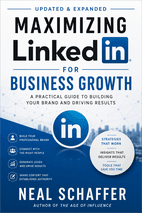
Maximizing LinkedIn for Business Growth, Updated and Expanded by Neal Schaffer Book Cover

5 Main Takeaways from Maximizing LinkedIn for Business Growth, Updated and Expanded

Invest 90% of Effort in Your Personal Profile

Your personal LinkedIn profile outperforms any company page as an inbound marketing tool. Optimize it with a search-friendly headline, a compelling story in the About section, and quantifiable achievements—then treat it as a dynamic asset, not a static resume.

Consistent Engagement Beats Viral Reach Every Time

Small daily actions—commenting on posts, sending personalized messages, and following a structured playbook—build lasting relationships and steady visibility. Unlike other platforms where content fades quickly, LinkedIn rewards regular, genuine interaction that nurtures prospects for weeks.

Authentic, Varied Content Builds Trust and Leads

Short-form video, user-generated testimonials, and podcast clips require less effort and feel more credible than polished marketing. You don't need to go viral; even one post per month that shares your real journey can attract clients, collaborators, and referrals.

Use AI and CRM to Scale Your Human Touch

Leverage AI tools like the ASKNEAL framework for content and headshots, but always personalize the output. Pair this with a personal CRM to track follow-ups and re-engage dormant connections—technology amplifies relationships, it doesn't replace them.

LinkedIn's Demographics Make It the B2B Powerhouse

With 80% of B2B social leads originating here and longer organic visibility than any other platform, LinkedIn offers a concentrated audience of professionals and decision-makers. This trust advantage makes it the premier space for thought leadership and business development.

Executive Analysis

These five takeaways form the book's central argument: LinkedIn success is not about viral hacks or paid features, but about a disciplined, human-centric strategy built on a strong personal profile, consistent relationship-building, authentic content, smart use of tools, and deep understanding of the platform's unique B2B ecosystem. Neal Schaffer weaves each element into a cohesive system where profile optimization fuels discovery, daily engagement warms relationships, and content creation sustains visibility—all while AI and CRM tools keep efforts organized and scalable without sacrificing authenticity.

This book matters because it cuts through the noise with actionable, updated tactics for a rapidly evolving platform. Unlike generic LinkedIn guides, Schaffer emphasizes practical routines (a 5–15 minute daily playbook), free resources over costly subscriptions, and real-world case studies that show how modest, consistent efforts reshape careers and generate revenue. It stands out in the crowded social-media-marketing genre by addressing every department—sales, marketing, recruiting, branding—and by teaching readers to turn the platform into a long-term relationship engine rather than a short-term lead dump. For any professional serious about B2B growth, this is the definitive playbook.

Chapter-by-Chapter Key Takeaways

Introduction (Introduction)

  • LinkedIn has evolved from a resume/networking tool into a dynamic engine for brand building, lead generation, and career opportunities.

  • The book provides current, proven strategies that account for rapid platform changes and the impact of AI.

  • Five free resources are available to accelerate implementation, along with a personal invitation to connect with the author on LinkedIn.

  • Tool recommendations are genuine and not paid for, though some may involve affiliate relationships.

Try this: Download the five free resources from the book and connect with the author on LinkedIn to accelerate your implementation.

1. LinkedIn Statistics: Understanding the Platform’s Impact (Chapter 1)

  • LinkedIn’s 1.2 billion members are concentrated among professionals, decision makers, and high-income earners in the U.S. and Western Europe.

  • 80% of B2B social media leads originate on LinkedIn, and 99% of Fortune 500 companies are active here.

  • Organic content on LinkedIn enjoys far longer visibility than on other networks—up to a week of algorithmic reach.

  • Users trust LinkedIn more than most platforms, creating a fertile environment for thought leadership and business development.

  • The platform’s focused demographics make it the premier space for serious professional networking, not casual socializing.

Try this: Analyze LinkedIn’s demographic data to target your ideal audience—focus on decision-makers in the U.S. and Western Europe for B2B success.

2. How LinkedIn Is Used Today for Business (Chapter 2)

  • LinkedIn is far more than a job board: it's a hub for recruiting, sales, marketing, advocacy, branding, and thought leadership.

  • Your personal profile outperforms your company page every time—invest 90% of your effort there.

  • Employee voices are more trusted than executive messaging, making employee advocacy a powerful growth lever.

  • Thought leadership isn't optional for ambitious professionals; it's how you differentiate and build lasting influence.

  • LinkedIn’s value extends to every department, not just sales and marketing.

Try this: Invest 90% of your LinkedIn effort into your personal profile and launch an employee advocacy program, as individual voices outperform corporate pages.

3. Optimizing Your LinkedIn Profile for Maximum Impact (Chapter 3)

  • Your LinkedIn profile is an inbound marketing tool, not a résumé—optimize it to attract your ideal audience.

  • Visuals matter: a professional photo and branded cover image dramatically increase engagement.

  • Your headline must be search-friendly, audience-focused, and tested regularly for best results.

  • The About section should tell a compelling story with a clear call to action.

  • Use the Featured section to showcase your best visual assets and keep your profile dynamic.

  • Fill out work history completely with quantifiable achievements and target keywords.

  • Leverage additional sections like certifications, volunteer work, and honors to differentiate yourself.

  • Always customize your public profile URL for a polished, brandable finish.

Try this: Optimize your profile as an inbound marketing tool by writing a search-friendly headline, a story-driven About section, and featuring visual assets with a clear call to action.

4. Build Your Network (Chapter 4)

  • Your LinkedIn network isn’t just your connections; it’s the entire web of people they know. Each new first-degree connection exponentially expands your reach.

  • With only five personalized invites per month, engage with others’ content first to make your connection requests feel natural and familiar.

  • Start with people you already know—colleagues, classmates, mentors—then branch out strategically.

  • Have a clear policy for accepting requests. Quality matters more than quantity, but a solid guideline is to aim for ten times your age.

  • Look for “hidden connections of value”: people in your network who can introduce you to someone important, even if you don’t realize it yet. Regularly search your second-degree connections and ask for warm introductions.

Try this: Grow your network strategically by starting with people you know and using personalized engagement before sending connection requests—aim for ten times your age in connections.

5. Establish Credibility Through Recommendations (Chapter 5)

  • Recommendations beat endorsements: they are detailed, third-party proof of your skills.

  • Request them at the peak of a successful project or relationship for the most genuine result.

  • Offer to draft a recommendation to make it easy for the other person.

  • Prioritize quality and diversity over quantity—three to five strong, specific recommendations from different sources create powerful social proof.

  • Keep the process ongoing: as your career evolves, so should your recommendations.

Try this: Request recommendations at the peak of successful projects and offer to draft them; maintain three to five diverse, specific recommendations as ongoing social proof.

6. Engaging on LinkedIn: Building Relationships Through Interaction (Chapter 6)

  • Consistency is non-negotiable: Small, regular interactions keep you visible and strengthen relationships.

  • Use search to find conversations: Proactively discover content and people outside your network using targeted keywords.

  • Viewing profiles and following are low-risk signals: They prompt curiosity and can lead back to you.

  • Personalized messages open doors: Especially when connecting with new people, always mention a shared connection or interest.

  • Think of engagement as a pyramid: Start with simple actions and gradually work toward deeper conversations and offline meetings.

Try this: Engage daily with small interactions like commenting and following, use LinkedIn search to find relevant conversations, and personalize every message to deepen relationships.

7. LinkedIn for Business: Free vs. Paid (Chapter 7)

  • The free LinkedIn plan is powerful enough for most users—focus on strategy, not features.

  • Paid subscriptions buy efficiency, not hidden access; upgrade only when your daily outreach demands it.

  • InMail works best when short, personalized, and sent to the right target; treat each as a limited opportunity.

  • Experiment with a one-month trial and a specific goal before committing long-term.

  • Over 85% of LinkedIn members succeed without paying—your profile, consistency, and relationships drive results.

Try this: Start with the free plan and upgrade to paid only if your daily outreach demands it—experiment with a one-month trial focused on a specific goal.

8. Prospecting on LinkedIn: Finding and Connecting with Potential Clients (Chapter 8)

  • Use Advanced Search filters (location, company, industry, title) to narrow prospects—avoid scrolling through millions of irrelevant results.

  • Boolean search (AND, OR, NOT, quotes, parentheses) lets you craft precise queries without paying for Sales Navigator.

  • Never connect cold; follow and engage with a prospect’s content first to warm them up.

  • Only send connection requests when you have several mutual connections—this protects your account from restrictions.

  • Personalize every invite with specific, authentic details from their profile or activity.

  • After connecting, nurture for at least a month before any ask. Consistent, value-driven engagement builds lasting relationships.

Try this: Use Advanced Search with Boolean operators to find prospects, engage with their content before connecting, and personalize every invite; then nurture for at least a month before making an ask.

9. Creating Content That Resonates on LinkedIn (Chapter 9)

  • Short-form video works on LinkedIn; repurpose content from other platforms to save effort.

  • User-generated content (testimonials, case studies, recommendations, mentions, client visuals) builds credibility without extra creation.

  • Podcast appearances are a goldmine for UGC—each interview produces clips, quotes, and social proof.

  • Always request permission before republishing content that isn’t already publicly shared.

  • Start slow (even one post per month) and capture content opportunities as they arise.

Try this: Repurpose short-form video and user-generated content from testimonials and podcast appearances, always requesting permission, and start with just one post per month.

10. Leveraging AI to Enhance Your LinkedIn (Chapter 10)

  • Use the ASKNEAL framework to guide AI prompts and keep your unique voice in the output.

  • AI headshot and cover image tools save time and money while keeping your visuals authentic.

  • Never copy-paste AI content; always revise and personalize it to sound like you.

  • Third-party tools like Taplio can analyze LinkedIn’s algorithm to boost engagement.

  • Track metrics like profile views and comments to measure what works and keep improving.

Try this: Apply the ASKNEAL framework to guide AI prompts, revise all AI output to retain your voice, and track metrics like profile views to refine your approach.

11. Using a Personal CRM to Stay Organized on LinkedIn (Chapter 11)

  • Your LinkedIn inbox is likely a graveyard of missed opportunities; a personal CRM is the cure.

  • A personal CRM (or PRM) helps you tag, organize, follow up, and re-engage—without the chaos.

  • Start with a single tool like Kondo for LinkedIn, then expand to a full CRM like Nimble, Clay, or Relatable.

  • The 7-step playbook (audit, choose, sync, tag, schedule, reignite, track) makes the process actionable.

  • The real ROI isn’t visible in likes or shares—it’s in stronger relationships, more referrals, and fewer lost connections.

Try this: Audit your LinkedIn inbox, choose a personal CRM tool like Kondo, tag and schedule follow-ups, and re-engage dormant connections using the 7-step playbook.

12. Creating a LinkedIn Playbook: Building a Daily Routine for Success (Chapter 12)

  • A LinkedIn playbook replaces random activity with a structured daily routine that takes 5–15 minutes.

  • Five core elements: curating connections, engaging with others’ posts, scheduling your own content, prospecting, and reviewing analytics to optimize.

  • Avoid automation tools—they risk account suspension and undermine genuine relationship building.

  • Batch schedule content weekly using LinkedIn’s built-in scheduler to maintain consistency without daily scrambling.

  • Review and refine your playbook periodically based on engagement data; treat it as a living document.

Try this: Create a daily 5–15 minute playbook incorporating connection curation, engagement, content scheduling, prospecting, and analytics review—avoid automation tools.

13. LinkedIn Case Studies: Real-World Success Stories (Chapter 13)

  • Profile optimization is a passive but powerful lead generation tool when aligned with the right keywords.

  • Short, non-promotional status updates can create unexpected opportunities through referral and serendipity.

  • Consistent, value-first content builds a reliable inbound pipeline over time.

  • Authentic sharing attracts not just clients but also collaborators and co-founders.

  • You don't need to go viral; consistent visibility can reshape your career and open new business models.

  • Community building on LinkedIn can replace traditional sales infrastructure, even generating millions in revenue.

  • Sharing your honest, imperfect journey—especially around challenges—builds trust faster than polished marketing ever could.

Try this: Share your authentic, imperfect journey consistently to build trust and attract opportunities—you don't need to go viral, just stay visible and value-first.

Continue Exploring