Lean Marketing Quotes
by Allan Dib
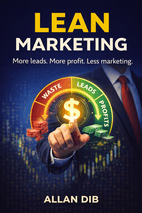
Here you will find some of the most memorable lines from Allan Dib's Lean Marketing. These quotes cut through the noise with direct, no nonsense advice. They are the kind of lines that make you stop and rethink your approach to business and marketing.
What makes this book so quotable is its relentless focus on what actually works. Dib avoids vague theory and instead delivers hard hitting truths that are easy to remember and apply. His metaphors stick with you long after you close the book. Whether he is talking about the pain of being invisible or the power of specificity, each quote packs a punch. This collection captures the essence of a modern, lean marketing mindset.
Top Quotes from Lean Marketing
“Being the best-kept secret is soul-crushing.”
Opening lines of the chapter, contrasting discovery vs obscurity.
It succinctly captures the emotional pain of being invisible despite offering value.
“The reality is you don’t get what you deserve; you get what you negotiate.”
After discussing how merit alone doesn't guarantee business success.
It challenges the naive belief in meritocracy and empowers readers to take control of their outcomes.
“Hope is not an effective marketing strategy.”
Concluding that hope alone is insufficient for business growth.
A blunt, memorable truth that forces entrepreneurs to replace wishful thinking with action.
“Your marketing should be so valuable that your target market would pay you to receive it.”
The author introduces Lean Marketing Principle 1: Create value for your target market with your marketing.
This line flips the traditional view of marketing as an interruption, challenging marketers to create genuine value that customers would willingly pay for.
“Good marketing is stuff for your people, not people for your stuff.”
The author states this as a core principle after explaining the mistake of starting with product rather than market.
It flips the typical mindset and provides a memorable, concise mantra that reframes marketing as serving an existing audience rather than hunting for customers.
“Specificity sells, and generality repels.”
The author uses this phrase to introduce the idea that narrow targeting is more effective than broad appeals.
The alliterative and contrasting structure makes it easy to remember, and it directly counters the common fear of niching down.
“Better is not better. Different is better.”
The author quotes Mike Michalowicz from the book 'Get Different' to emphasize differentiation over mere improvement.
This short, paradoxical statement challenges the conventional drive to be the best and instead advocates for standing out through uniqueness.
Themes Behind the Quotes
One central theme is the power of focus and specificity. The quotes repeatedly stress that trying to appeal to everyone leads to failure. Instead, success comes from narrowing your niche and delivering content so valuable people would pay for it. Another theme is that marketing must be built on action, not wishful thinking. Hope and endless planning are traps. You have to implement, even when it is uncomfortable.
A second major theme is the human element. Despite all the talk of data and AI, the core is human to human connection. Emotions drive decisions, and logic only justifies them afterwards. The quotes also highlight that passion is not a starting point but a byproduct of professional commitment. Ultimately, these ideas combine to form a lean approach where you leverage leverage, use tools like AI wisely, and always prioritize substance over fluff.
Quotes by Chapter
Introduction
“If you commit to the work and actually implement the stuff in this book, it'll often feel like crawling on your hands and knees, butt naked, over broken glass.”
Describing the challenging reality of mastering marketing.
The vivid metaphor makes the necessary pain of real progress unforgettable.
1: Leaning Into Marketing
“Linear thinking gives you incremental gains. Leveraged thinking gets you exponential results.”
The author explains the concept of leverage as a force multiplier in business.
It concisely contrasts two mindsets, motivating readers to seek exponential growth through leverage rather than just working harder.
“It's spewing pollution, just like the thick smoke from the smokestack of a factory.”
The author compares conventional marketing's negative externalities to industrial pollution.
The vivid imagery makes the waste and harm of mass marketing instantly relatable, reinforcing the need for a leaner, more valuable approach.
“Too many smart people think they're measuring twice and cutting once, but often they never cut. They just measure forever.”
The author warns against analysis paralysis when perfecting product-market fit.
This memorable twist on a common proverb highlights the danger of overthinking and encourages taking action despite imperfect conditions.
2: Who Are Your People?
“You want your niche to be an inch wide and a mile deep.”
The author explains the concept of a tightly defined segment with a large enough addressable market.
This visual metaphor perfectly captures the balance between focus and opportunity, encouraging entrepreneurs to go narrow but deep.
3: What Are You (Really) Selling?
“Most businesses that fail die of starvation, not murder.”
The author discusses the importance of product-market fit over obsession with competitors.
This line is memorable because it reframes business failure as a lack of market demand rather than competitive defeat, making it a powerful reminder for entrepreneurs to focus on customer pull.
“No one knows how good your product or service is until after the sale. Before they buy, they only know how good your marketing is. Put simply, the best marketer wins every time.”
The author explains that marketing is the primary acquisition tool, while product quality retains customers after purchase.
This quote succinctly captures the reality that marketing drives initial sales, making it a foundational principle for lean marketing.
“Truth in marketing is determined not by how people use their mouths but by how they use their wallets.”
The author argues against relying on focus groups and surveys because people's stated preferences often differ from their actual buying behavior.
This sharp contrast between words and actions provides a memorable, actionable insight for marketers to observe real behavior rather than self-reported data.
“Pain moves your market to action more effectively than pleasure.”
The author explains why painkillers (immediate relief) outperform vitamins (future benefit) in driving purchase decisions.
This concise statement highlights a core psychological driver of buying behavior, helping marketers prioritize urgent customer problems over optional improvements.
4: Your Marketing Nerve Center
“Used correctly, it will help you drive almost every important process in your business, including lead flow, sales, onboarding, and much more.”
The author describes the potential of a customer relationship management (CRM) system when used strategically.
This line emphasizes the central, transformative role of a CRM in business operations, making it a compelling call to action for readers to leverage their system fully.
“If you don’t do anything useful with your data, you may as well just have it sitting in a spreadsheet (and many businesses do!).”
The author warns against using a CRM merely as a passive database.
The blunt, relatable analogy drives home the cost of inaction, prompting readers to evaluate whether they are truly using their data to drive decisions.
“The best crm system is the one that you'll actually use.”
In response to the common question of which CRM system is best.
This short, memorable line cuts through feature comparisons and reminds readers that adoption and consistent use matter more than any specification.
“Sending irrelevant content to your audience is the fastest way to get them to unplug, unsubscribe, or ignore you.”
The author explains the importance of tagging and segmentation.
It powerfully captures the consequence of poor targeting, motivating readers to prioritize relevance in their marketing communications.
5: Programming Moist Robots
“Marketing is the master skill of business, and copywriting is the master skill of marketing.”
The author introduces the chapter on copywriting as the core skill of marketing.
This line succinctly elevates copywriting to the highest priority skill, making it clear that mastering words is the path to marketing mastery. It's a bold, memorable claim that reframes how marketers should invest their time.
“The reality is people don't have short attention spans, they have short boredom spans.”
The author challenges the common myth that people have short attention spans, arguing instead that boredom is the real enemy.
This reframes the entire approach to content creation, freeing marketers from the fear of length and focusing them on engagement. It's counterintuitive and immediately actionable.
“Emotion commits the crime, and logic does the cover-up.”
The author explains why emotional appeals are more powerful than logical arguments in driving buying decisions.
This vivid, memorable phrase captures the essence of how humans make decisions—emotion first, then rationalization. It's a sharp reminder that marketers must tap into feelings, not just facts.
“You're not selling to ceos, nor are you selling 828 or 82c—these are all conceptual designations. You're selling 42H: human-to-human.”
The author addresses the objection that B2B sales are purely logical, emphasizing that all buying is human.
This line breaks down artificial market categories and reminds marketers that regardless of title, every buyer is a human driven by emotion. The typo-laden '42H' makes it stick in the reader's mind.
6: Artificial Intelligence
“I, for one, welcome our silicon overlords.”
The author humorously responds to fears that artificial intelligence will destroy or take over humanity.
This line disarms anxiety with wit and memorable phrasing, making the reader more open to embracing AI.
“Ai won't take your job or disrupt your business, but someone using ai will.”
The author discusses how AI disruption works in practice.
It delivers a clear, actionable warning that competitive advantage comes from adoption, not resistance, motivating readers to act.
“If your writing is mediocre, boring, and volume-based, it's already game over for you.”
The author explains how large language models can easily replace low-quality, formulaic writing.
This blunt statement forces marketers to elevate their craft or become obsolete, creating urgency and self-reflection.
“Al is truly the Iron Man suit for marketers, allowing you to do more with less and helping you build a truly lean marketing infrastructure.”
The author summarizes the empowering potential of AI tools for marketing.
The Iron Man metaphor is vivid and aspirational, framing AI as a superpower that amplifies human capability rather than replacing it.
7: Your Brand (Start with Buy)
“Do what you love is for amateurs. Love what you do is for professionals.”
The author contrasts two common mantras about passion and work.
This line flips the popular advice 'follow your passion' into a more disciplined, actionable mindset. It's memorable because it reframes passion as something you cultivate through commitment, not as a prerequisite.
“Passion, like profit, is a result. You don't find your passion. It finds you.”
The author argues that passion typically follows success rather than preceding it.
This resonates because it relieves pressure on entrepreneurs who haven't discovered their 'passion' yet. It reframes passion as an outcome of effort and curiosity, making success feel more attainable.