Dealers of Lightning Key Takeaways
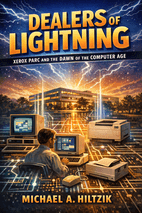
by Michael A. Hiltzik
5 Main Takeaways from Dealers of Lightning
Innovation thrives in cultures that balance creative freedom with rigorous critique.
At PARC, Bob Taylor fostered a collaborative yet fiercely critical community through 'Dealer' meetings, where ideas were brutally peer-reviewed. This environment, combined with unparalleled research freedom, allowed technologies like the graphical user interface and Ethernet to be refined and perfected.
Corporate structure can stifle innovation when executives and researchers are culturally divided.
Xerox's copier-focused leadership failed to grasp the value of PARC's 'paperless office' concepts, as seen in the tepid response to Futures Day. This cultural and perceptual gap led to a decade of missed opportunities, allowing others to commercialize PARC's breakthroughs.
Visionary leadership and talent cultivation are more crucial than technical prowess alone.
Bob Taylor's genius lay in identifying and recruiting top talent, such as from Doug Engelbart's lab and the failed BCC venture, building the team that created the Alto. His ability to foster collaboration and shield researchers from bureaucracy was key to PARC's prolific output.
Technological success requires market alignment, not just brilliant engineering.
The Xerox Star was a technical masterpiece but failed commercially due to high cost and ignoring competitive threats like the IBM PC. This underscores that innovation must consider customer needs, price sensitivity, and execution to achieve market adoption.
Foundational research spreads through talent diaspora, not always direct commercialization.
PARC's innovations like the GUI and laser printing were popularized by Apple, Microsoft, and others after key alumni left Xerox. The exodus of talent became a primary vector for spreading PARC's ideas, proving that impact can be world-changing even if the original funder doesn't profit.
Executive Analysis
The five takeaways collectively form the book's central thesis: Xerox PARC was a unique convergence of talent, culture, and funding that produced the bedrock of modern computing, but a profound cultural divide between its visionaries and the corporation's copier-sales executives led to a failure in commercialization. This story illustrates that innovation requires not just brilliant ideas but also an organizational structure that can bridge research and market realities, with leadership that protects creative habitats while aligning with commercial goals.
The book matters as a seminal case study in the history of technology, offering practical lessons for managers and entrepreneurs on fostering innovation, managing creative teams, and avoiding the pitfalls that cause companies to miss disruptive opportunities. It sits at the intersection of business history and technology analysis, providing a nuanced narrative that moves beyond the myth of corporate neglect to explore the complex dynamics of research and commercialization.
Chapter-by-Chapter Key Takeaways
Introduction (Introduction)
The Alto, built at Xerox PARC in 1973, was the functional prototype of the modern personal computer, incorporating a graphical display, interactive use, and a single-user design a decade before commercial successes.
PARC's culture was defined by brilliant, iconoclastic engineers like Chuck Thacker, operating with unparalleled freedom and funded by Xerox's copier revenues to invent the future.
The core technologies of contemporary computing—the graphical user interface, word processing, laser printing, and Ethernet networking—were pioneered at PARC.
The relationship between PARC's visionaries and the Xerox corporation was complex, marked by both generous support and profound failures in commercialization, a story more nuanced than the popular legend of total corporate neglect.
PARC's success was a unique convergence of talent, timing, technology, and management philosophy, creating one of history's most prolific and influential research environments.
Try this: Recognize that revolutionary innovation requires a unique blend of talent, freedom, and funding, but without commercial alignment, it may benefit others more than the inventor.
Chapter 1 (Chapter 1)
Bob Taylor’s genius lay not in technical prowess, but in exceptional people skills, talent cultivation, and bureaucratic savvy.
He intentionally fostered a collaborative yet fiercely critical community among researchers, believing rigorous debate was the best way to refine ideas and assess talent.
Taylor’s advocacy for smaller, affordable time-sharing systems, exemplified by the SDS 940, helped democratize access to interactive computing.
His decisive clash with Max Palevsky highlighted a fundamental conflict between visionary technological idealism and conservative commercial pragmatism—a theme that would resound in his future career.
Try this: Cultivate leaders who excel at people skills and fostering critical collaboration to drive innovation beyond technical expertise.
Chapter 2 (Chapter 2)
Internal conflict at Xerox revealed a core tension between short-term product development and long-term, foundational research.
CEO Peter McColough's unilateral support was crucial in bypassing organizational resistance and championing innovation.
The new research lab was deliberately scaled to complement, not compete with, the existing Webster facility.
Jack Goldman's visionary drive and strategic focus were central to founding PARC as a beacon for transformative scientific discovery.
Try this: Secure top-level executive support to bypass internal resistance and champion long-term, transformative research initiatives.
Chapter 3 (Chapter 3)
Bob Taylor's ARPANET proposal was approved with remarkable speed by ARPA director Charles Herzfeld, highlighting the agency's unique, agile culture.
Taylor's persuasive, and sometimes forceful, recruitment tactics were crucial in securing Lawrence Roberts to engineer the nascent network.
Taylor's direct involvement in Vietnam War logistics deepened his disillusionment with the conflict and coincided with ARPA's transformation into a more narrowly focused, military-aligned agency.
George Pake recruited Taylor to Xerox PARC primarily for his expertise in identifying top-tier computer science talent, not for his theoretical vision.
The working relationship between Taylor and Pake was strained from the beginning by unspoken tensions over academic credentials and differing priorities for the research lab.
Taylor arrived at PARC with a clear, ambitious goal: to render existing office technology obsolete through networked, interactive personal computing.
Try this: Use strategic recruitment to build teams with diverse expertise and a shared ambitious vision, even from failed ventures.
Chapter 4 (Chapter 4)
Vannevar Bush's concept of the "memex" provided a foundational vision for associative, linked information systems that predated the modern web by decades.
Doug Engelbart's NLS system was a groundbreaking integration of hardware and software, introducing the mouse, hypertext, and real-time video collaboration in a public demonstration that redefined the potential of human-computer interaction.
Visionary leadership, while inspiring, can sometimes hinder practical progress, as seen in Engelbart's open-ended research approach that led to discontent within his team.
Bob Taylor's strategic recruitment from Engelbart's lab successfully transplanted core interactive computing concepts to Xerox PARC, ensuring their development continued, albeit with mixed eventual success for the original NLS project.
Try this: Learn from visionary predecessors but adapt their ideas pragmatically to ensure practical progress and avoid open-ended stagnation.
Chapter 5 (Chapter 5)
Extraordinary teams can form in unlikely places, as demonstrated by the convergence of Lampson, Deutsch, and Thacker at Berkeley.
The “second-system effect” is a profound pitfall in technology design, where the desire to perfect and expand upon a first success can lead to over-engineering and failure.
Financial optimism cannot indefinitely outpace technical reality; BCC’s story is a classic case of ambitious engineering colliding with funding constraints and market readiness.
Bob Taylor’s strategic hiring at PARC capitalized on a market failure, assembling a world-class team from the wreckage of a bold but flawed venture. However, he still faced the challenge of convincing this time-sharing-oriented group to embrace his vision of personal, interactive computing.
Alan Kay was a polarizing but profoundly influential figure, seen as both a crackpot and a visionary for his futuristic concepts of personal computing.
His Dynabook concept was a remarkably accurate prophecy of modern portable, multimedia computing devices, emphasizing creativity and personal expression.
Kay’s greatest contribution was his conceptual and software architecture, which became the bedrock for future technological revolutions, even if he did not build the final consumer products himself.
Try this: Assemble world-class teams from market failures by recognizing and redirecting valuable talent toward new, focused goals.
Chapter 6 (Chapter 6)
Seymour Papert's LOGO system was a foundational model for Kay, demonstrating that computing for learning must be visually responsive, intuitive, and creatively stimulating to capture a child's imagination.
Kay's Dynabook concept—a portable, powerful, and simple personal computer for creativity and communication—was fully formed before he arrived at PARC, born from the gap he saw between existing technology and human potential.
His placement in SSL, not CSL, was a crucial strategic decision that allowed him to maintain intellectual autonomy while collaborating closely with PARC's top engineers, creating a powerful and dynamic partnership with Bob Taylor's group.
Try this: Place visionary thinkers in environments where they can maintain intellectual autonomy while collaborating closely with practical engineers.
Chapter 7 (Chapter 7)
The legal constraint of not copying the PDP-10 led to the strategic advantage of using microcode, trading hardwired circuits for flexible, repairable software.
The team deliberately chose the flawed Intel 1103 semiconductor memory, overcoming its issues with custom error-correction to achieve a performance leap.
The project fostered key innovations like an early form of multitasking and refined hardware design principles.
Naming the machine MAXC (with a "silent C") symbolized the team's ownership and independence from both DEC and SDS.
Building MAXC was not just a technical task but a critical team-forging exercise, transforming a group of brilliant individuals into a cohesive, deeply collaborative unit ready for even more ambitious projects.
Try this: Use constrained technical projects as team-forging exercises to build cohesion and readiness for more ambitious challenges.
Chapter 8 (Chapter 8)
Taylor's recruitment of Elkind was a tactical move to manage his conflict with Pake, but their differing views on management and research direction planted the roots of future strife.
Pressure from Xerox headquarters, embodied by Don Pendery, directly led to the creation of the visionary "Pendery Papers."
These papers served as PARC's strategic manifesto, accurately forecasting key technologies of the coming decades and formally establishing the goal of the personal computer.
The process of writing the papers unified the lab around a shared, ambitious vision, turning external pressure into an internal catalyst for defining their own future.
Try this: Turn external pressure into an internal catalyst by unifying your team around a shared, written strategic vision.
Chapter 9 (Chapter 9)
Innovation often requires overcoming not just technical hurdles but organizational and cultural barriers.
The laser printer's development exemplifies how generalized solutions, like the RCG, can address future unasked questions.
Persistence and demonstration of value are crucial in bringing groundbreaking technologies to market, as seen in Goldman's advocacy.
The integration of components into systems like EARS foreshadowed modern computing environments, emphasizing connectivity and user-centric design.
Try this: Demonstrate the value of breakthroughs through persistent advocacy and practical applications to overcome organizational and cultural barriers.
Chapter 10 (Chapter 10)
Constructive Conflict: The "Dealer" meetings institutionalized brutal, objective peer review, creating a culture where only rigorously examined ideas could progress, separating personal ego from professional critique.
Cultural Alchemy: PARC's success stemmed from a unique alchemy: the intense, adversarial scrutiny of Dealer was balanced by a strong, familial sense of camaraderie and shared purpose outside the meeting room.
Organic Collaboration: Innovation was often driven by informal "Tom Sawyering," a self-organizing model where researchers voluntarily rallied around promising ideas, demonstrating fluid collaboration across formal lab divisions.
Insular Brilliance: The lab's immense intellectual capital and intense internal culture created a world-leading center of innovation, but also fostered an insularity and arrogance that would later create friction with the wider Xerox corporation.
Try this: Institutionalize constructive conflict balanced with camaraderie to drive rigorous innovation without burning out your team.
Chapter 11 (Chapter 11)
The Rolling Stone article "Spacewar" exposed the cultural clash between Xerox's corporate conservatism and PARC's innovative, free-spirited research environment.
Corporate backlash led to tightened security and media controls, stifling some of PARC's openness but also formalizing its research efforts.
Despite the negative reaction, the article helped forge PARC's mystique, highlighting its role in pioneering personal computing and attracting talent.
The incident underscored the tension between revolutionary ideas and traditional business structures, a theme that would define PARC's journey.
Try this: Manage external perceptions carefully, as publicity can forge mystique and attract talent but also trigger conservative backlash.
Chapter 12 (Chapter 12)
The Alto's graphical capability required major engineering compromises, notably a memory conflict that caused the display to "shrink" during use.
Butler Lampson's "Why Alto" memo provided the project's crucial philosophical and economic justification, framing it as an affordable, necessary experiment to test PARC's core ideas.
The Alto's sophisticated task-priority system, while innovative, was preceded by similar work in Wes Clark's earlier TX-2 computer.
The emotional impact of seeing the first Alto in operation was profound, instantly convincing those present of its revolutionary significance.
Try this: Justify ambitious projects with clear philosophical and economic reasoning to secure resources and align stakeholders.
Chapter 13 (Chapter 13)
Ethernet’s success was forged in a period of total, collaborative immersion between Metcalfe and Boggs.
Its “best efforts” design philosophy prioritized resilient, imperfect operation over fragile perfection.
Initial adoption was slow until the killer application—the laser printer—made the network indispensable, killing "sneakernet."
Metcalfe’s departure marked a turning point, proving the external market’s high value for PARC’s knowledge and shaking the lab’s insulated culture.
Try this: Design systems for resilient, imperfect operation and rely on killer applications to drive essential adoption.
Chapter 14 (Chapter 14)
The development of the Gypsy word processor was a direct, user-centered response to the failures of the complex POLOS system and the moded limitations of the Bravo editor.
User research was pioneered as a critical design step, with Tim Mott observing non-engineer editors at Ginn to shape an intuitive interface based on real-world tasks, coining the enduring “cut and paste” metaphor.
Larry Tesler championed the modeless interface and early graphical elements like icons and menus, fundamentally improving user safety and accessibility, even at the cost of initial performance.
Gypsy’s successful deployment provided a decisive, practical rationale for the Alto over POLOS, proving the viability of personal computers for professional office work and sealing the fate of the rival network-based system.
Try this: Base product design on direct user research to create intuitive interfaces that solve real-world problems and validate new paradigms.
Chapter 15 (Chapter 15)
Direct user testing with children revealed intuitive programming insights and validated the importance of accessible, engaging interfaces.
Alan Kay’s risk-taking and management’s pragmatic tolerance enabled groundbreaking experiments that pushed technological boundaries.
The development of BitBlt was a pivotal technical innovation that made dynamic graphical interfaces fast and feasible, leading to overlapping windows.
The accidental reveal of the pop-up menu during a demo to CSL highlighted the power of intuitive, responsive design, instantly convincing peers of its transformative potential.
This era at PARC solidified core elements of the modern computer desktop metaphor, influencing countless future systems.
Try this: Empower risk-taking and tolerate boundary-pushing experiments, as they can lead to foundational technical innovations.
Chapter 16 (Chapter 16)
Innovation vs. Orthodoxy: PARC’s CSL, despite its innovative culture, developed a powerful orthodoxy focused on a specific goal (the black-and-white office of the future), which could actively suppress divergent, equally visionary work.
The Cost of Color: Dick Shoup’s Superpaint was a pioneering digital video and color graphics system, but it was rejected by his lab primarily because color was deemed irrelevant to office work and too expensive a distraction.
Cultural Clash: The conflict embodied a deeper struggle between engineering pragmatism (Taylor, Lampson) and artistic exploration (Shoup, Smith). CSL valued incremental, shared progress toward a defined goal, while the Superpaint team valued open-ended creative experimentation.
The Pariah’s Path: Shoup’s journey from core CSL insider to isolated pariah shows how managerial pressure and group consensus can marginalize a talented inventor who stubbornly pursues a different, but ultimately prescient, path.
PARC’s leadership formally terminated Dick Shoup’s color graphics research, confiscating his lab and equipment, which underscored the institution’s failure to see its potential.
Alan Kay’s group provided a temporary refuge for Shoup, highlighting a cultural divide within PARC itself between applied computer science and more speculative, media-focused research.
Shoup’s subsequent commercial success with Aurora Systems validated his ideas in the marketplace, creating iconic early computer graphics for television.
The joint technical Emmy award to Shoup and Xerox served as a final, ironic testament to the gap between corporate oversight and genuine innovation, symbolized by the company’s award disappearing into its archives.
Try this: Avoid letting organizational orthodoxy suppress divergent ideas; nurture creative exploration even if it diverges from core goals.
Chapter 17 (Chapter 17)
PARC’s brilliant “Dandelion” processor solved the Star’s hardware problems, but the project’s long timeline left it vulnerable to the coming revolution in cheap, mass-market personal computers.
The move to the custom-designed Coyote Hill Road building marked PARC’s ascendance as a world-class research center, even as its corporate parent faced a severe crisis.
The total collapse and $84 million write-off of the SDS division shattered Xerox’s formal computing strategy, isolating PARC as the company’s only beacon of success in digital technology and increasing the pressure on its innovations to prove their value.
Try this: Monitor market trends and development timelines closely, as technological superiority can be undermined by slower cycles and emerging competition.
Chapter 18 (Chapter 18)
PARC’s "Futures Day" was a stunning technical success, demonstrating a fully functional, networked office environment with revolutionary hardware like the Alto and laser printers.
A deep cultural and perceptual divide was exposed: Xerox's copier-sales leadership could not conceptualize the value of a "paperless" office that threatened their established, meter-driven revenue model.
The enthusiastic engagement of the executives' wives (as former end-users) contrasted sharply with the skepticism of the executives themselves, highlighting a fatal disconnect between PARC's innovations and the company's commercial instincts.
The event ended not with a corporate commitment to action, but with a vague thank you, foreshadowing Xerox's impending failure to capitalize on the very future it had just flawlessly demonstrated.
Try this: Bridge cultural divides by framing innovations in terms decision-makers understand, leveraging end-user perspectives to demonstrate value.
Chapter 19 (Chapter 19)
Cultural Incompatibility: Shelby Carter’s instinct-driven, entrepreneurial style was fundamentally at odds with Xerox’s evolved, committee-based decision-making, ensuring his advocacy was ignored.
The Peril of Bypassing Protocol: Even with CEO-level awareness, an idea that circumvented the formal management chain was doomed to face entrenched hostility and bureaucratic rejection.
A Final Straw for Talent: The handling of Ellenby’s proposal exemplified the systemic failure to leverage internal advocacy, directly leading to the departure of a key innovator who then succeeded outside the company.
Lost Opportunity: Xerox’s inability to act on the proposal, even when presented directly to leadership, solidified its failure to capitalize on PARC’s groundbreaking technology, leaving the market for personal computing to others.
Try this: Align advocacy with corporate protocols to avoid bureaucratic rejection, even when ideas have high-level awareness.
Chapter 20 (Chapter 20)
Unintended Consequences: Even well-intentioned, controlled experiments in complex systems can spiral into catastrophic failures, as shown by the worm's accidental rampage.
The Cost of Secrecy: Xerox's culture of extreme proprietary control stifled recognition, hampered collaboration, and obscured PARC's foundational role in developing key internetworking protocols.
Pioneering Parallel Processing: Shoch's worm was an early, practical exploration of distributed computing, harnessing multiple machines to work as one—a precursor to modern supercomputing architectures.
A Hidden Titan: PARC's internal network was, in its day, a denser and more advanced proving ground for networking concepts than the famed ARPANET, operating at a scale the outside world rarely appreciated.
Try this: Balance proprietary control with collaboration to ensure recognition and avoid stifling innovation in fast-moving fields like networking.
Chapter 21 (Chapter 21)
Jim Clark’s Geometry Engine chip was a triumphant, rapid proof of VLSI’s commercial and industrial potential, launching the computer graphics industry and making him wealthy.
Carver Mead’s urgent advice for Xerox to create a venture capital arm to harness PARC’s innovations was rejected as too radical, showcasing a critical failure of corporate foresight.
President David Kearns’s anecdote about the bootlegged Model 3100 copier exposed a corporate culture that actively resisted and penalized internal innovation, even when it addressed existential market threats.
The section foreshadows the exodus of PARC talent and the inevitable commercialization of its technologies by others, leaving Xerox as a sidelined observer to the revolution it funded.
Try this: Create internal mechanisms like venture capital arms to harness innovations and prevent talent exodus to external competitors.
Chapter 22 (Chapter 22)
The Dorado, while revolutionary in power, was plagued by practical issues like extreme heat and noise, leading to centralized hosting, yet its performance kept demand high despite limited production.
The Notetaker pioneered the "luggable" computer design with its split-case form factor and achieved the milestone of first in-flight use, but it failed to secure commercial backing from Xerox.
These projects marked the end of an era at PARC, as key figures like Alan Kay departed, leaving the original teams diminished and disillusioned with Xerox's lack of product commitment.
Try this: Evaluate commercial potential early for prototype projects to make informed decisions about investment or strategic abandonment.
Chapter 23 (Chapter 23)
The legendary PARC demo was as much about human connection and validation as it was about technology, with Apple's prepared and brilliant engineers deeply impressing the presenters.
While the demo directly influenced Apple's commitment to the mouse and graphical interfaces, its greater role was providing confidence and solving conceptual blocks for engineers like Bill Atkinson.
Steve Jobs's vision was strikingly selective; he embraced the user interface but completely overlooked the foundational concepts of object-oriented programming and networking.
The ultimate consequence was a talent migration from PARC to Apple, sparked by the realization that their innovations were more appreciated outside of Xerox, challenging PARC's insular belief in its own unmatched intellectual monopoly.
Try this: Be open to external inspiration and recognize that demonstrations can validate ideas, solve conceptual blocks, and attract key talent.
Chapter 24 (Chapter 24)
The Power of the Low End: Seeing VisiCalc on an Apple II was a catalytic moment, proving that transformative, pragmatic software could emerge from the accessible personal computing market, not just from well-funded corporate labs.
Culture as Destiny: The stark contrast between Xerox's bureaucratic, risk-averse "graveyard" and Microsoft's agile, high-bandwidth "maternity ward" highlighted how organizational culture directly determines the ability to innovate and execute.
A Consequential Intersection: The meeting of Simonyi's PARC-honed vision and Gates's entrepreneurial drive was a historic pivot point, directly transferring foundational computing concepts from the research lab to the company that would ultimately popularize them globally.
Try this: Pay attention to low-end market disruptions, as accessible, pragmatic solutions can redefine standards and outpace premium offerings.
Chapter 25 (Chapter 25)
Brilliance is Not Enough: The Xerox Star was a technical masterpiece that fundamentally shaped modern computing, but its commercial failure underscores that superior technology alone cannot guarantee market success.
The Cost of Ignoring the Market: Engineers, given unlimited freedom and bolstered by flawed market research, created a product without regard for customer price sensitivity or emerging competitive threats.
The Disruptive Power of "Good Enough": The IBM PC demonstrated that a cheaper, simpler, and open alternative could overwhelm a superior but expensive and closed system by meeting the baseline needs of a massive new market.
Internal Culture is Critical: The Star's development was hindered by corporate vacillation, internal resistance to innovation, and a damaging disconnect between engineering and realistic marketing.
Try this: Align product development with market realities, including price sensitivity and competitive threats, not just technical excellence.
Chapter 26 (Chapter 26)
The Protective Buffer: Management fatally misunderstood Bob Taylor's primary value—he was not an administrator or the top technologist, but the essential cultural buffer and habitat-creator who shielded his researchers from corporate bureaucracy.
Inevitable Exodus: Taylor's forced resignation triggered an irreversible brain drain, as loyal staff departed en masse once their financial incentives were secured, gutting the Computer Science Laboratory's core.
End of an Era: The confrontation marked a deliberate and definitive end to PARC's founding ethos of autonomous, blue-sky research. The new mandate demanded direct alignment with Xerox's commercial imperatives.
Corporate Irony: The same managerial instinct to enforce business discipline that caused Xerox to lose its top talent was later repeated by DEC's management when they inherited that same independent-minded team.
Try this: Protect cultural buffers that shield innovators from corporate bureaucracy to retain key talent and sustain creative momentum.
Epilogue (Epilogue)
A casual lunch with a reflective Steve Jobs, who vividly analyzed PARC’s failures, provided the direct inspiration for the author to pursue this history.
The book is the product of a vast collaborative effort, built on the candid and heartfelt recollections of the very people who built PARC.
The author’s personal and professional support system was instrumental in transforming years of research and interviews into a coherent narrative.
Xerox PARC’s greatest inventions—the Alto’s GUI, Ethernet, and laser printing—succeeded commercially primarily through other companies (Apple, Microsoft, 3Com, Adobe), not through Xerox itself.
A profound cultural divide between the copier company’s executives and the lab’s computing visionaries, along with a risk-averse corporate structure, led to a "lost decade" of missed opportunity.
The diaspora of PARC talent became a primary vector for spreading its innovations across Silicon Valley and the global tech industry.
PARC’s true legacy is its monumental contribution to the bedrock of modern computing, proving that the impact of fundamental research can be world-changing, even if the direct path to commercialization is fractured.
Try this: Document and learn from historical innovation failures to understand the fractured paths from research to commercialization.
Continue Exploring
- Read the full chapter-by-chapter summary →
- Best quotes from Dealers of Lightning → (coming soon)
- Explore more book summaries →