Connect to Close Quotes
by Amy Reczek
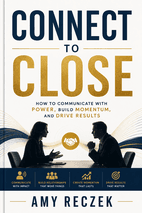
These quotes come from a sales book that cuts through the noise. You will find lines that reframe what you thought you knew about selling and building connections. They are direct, honest, and often counterintuitive. Each one packs a punch and stays with you long after you read it.
What makes this book quotable is how it blends real world experience with a human centered approach. The author writes with clarity and conviction. Her words stick because they feel true. They are not just motivational. They are actionable insights that make you pause and rethink your daily habits. You will come back to these lines again and again.
Top Quotes from Connect to Close
“That's why you get ghosted even when you do everything you're trained to do.”
The author lists common frustrations salespeople face despite following best practices.
This line captures the painful reality that following the 'right' process doesn't guarantee results, making salespeople feel validated in their struggle.
“Spending company dime taking teams to happy hours or golf outings may qualify as a decent relationship builder—but that isn’t sales.”
The author distinguishes between generic relationship-building and sales that creates momentum.
It challenges the common misconception that socializing equals selling, refocusing readers on purposeful connection that drives deals forward.
“Even with all the change that’s reshaped business—technology, automation, virtual everything—the core of sales hasn't changed. It still starts and ends with trust and connection.”
The author discusses the impact of COVID-19 and AI on sales, emphasizing enduring principles amid rapid change.
This provides grounding reassurance in a time of disruption, reminding readers that technology is a tool, not a replacement for human connection. It refocuses effort on what truly matters.
“You do not rise to the level of your goals. You fall to the level of your systems.”
The author quotes James Clear from Atomic Habits to shift the reader's mindset about sales goals.
This counterintuitive statement sticks with readers, emphasizing that consistent, thoughtful systems matter more than ambitious targets.
“It is obvious. It isn't easy. If it was, everyone would be doing it. They're not. This is rare.”
The author acknowledges that advice like 'be more intentional' is common but rarely acted upon.
The blunt honesty here validates readers' struggles while motivating them to invest the effort that sets them apart—a rare and powerful call to action.
“Become it, don’t fake it. Shift it, don’t overhaul it. Be consistent, not perfect.”
The summary of the three ground rules at the end of the chapter.
This triplet encapsulates the chapter's key lessons in a concise, memorable form that readers can easily recall and apply.
“Your client doesn't “need your product.” They need to stop losing deals.”
After explaining the 'Why Funnel' technique, the author highlights the real pain point behind a client's surface need.
This quote cuts through the noise and refocuses sellers on the true value they provide—solving the client's core problem, not just selling a product.
Themes Behind the Quotes
The core message across these quotes is that sales success depends on genuine human connection and trust, not on tactics or scripts. The author argues that the old ways of happy hours and closing techniques are outdated. Instead, the focus should be on creating meaningful experiences for clients in every interaction. This requires being present, curious, and intentional.
Another strong theme is the power of small, consistent actions over grand gestures. Momentum is built moment by moment through deliberate choices. The book emphasizes authenticity and the idea that your personal and professional selves are not separate. Confidence is a skill you can develop, and structure helps you become a conductor of conversations. Ultimately, these insights push you to shift from chasing numbers to nurturing relationships.
Quotes by Chapter
Introduction
“The problem is that nobody is teaching us how to build connection that moves deals forward.”
The author identifies a critical gap in sales training.
This succinctly states the core problem the book aims to solve, serving as a rallying cry for salespeople seeking practical guidance beyond theory.
“Sales is evolving. Are you ready to evolve with it?”
The closing lines of the introduction challenge the reader.
It inspires urgency and personal accountability, compelling readers to commit to growth and embrace change in their sales approach.
Chapter 1: The Sales Evolution
“The future of sales belongs to those who can communicate in a way that conveys credibility and establishes trust, creating impact and building momentum, moment by moment.”
The author concludes her story about losing a client to a competitor and introduces the core idea of the book.
This line captures the new paradigm of sales—moving beyond relationship-building to deliberate, trust-building moments. It inspires readers to shift from passive connection to active, credible communication.
“I was curious about people before I even knew that curiosity could become a career skill.”
The author reflects on her childhood tendency to observe and study people, which later shaped her sales approach.
This resonates because it reframes natural curiosity as a professional asset, validating that soft skills like observation are foundational to sales success. It encourages readers to embrace their own innate traits.
“I wasn't interested in being the loudest person in the room; I was interested in being the one who understood the room.”
The author describes her early sales mindset, contrasting the traditional loud salesperson with her observational approach.
This memorable contrast redefines effective selling as understanding rather than dominating. It empowers introverts and challenges the pushy sales stereotype.
Chapter 2: The Power of a Moment
“Every moment is a chance to connect. To create. To solve. To become a partner. To create an experience.”
The author emphasizes the importance of being present in sales interactions.
This line succinctly captures the book's core philosophy, reframing every interaction as an opportunity rather than a transaction.
“When you start becoming the moment maker for your clients, you're opening the door for stronger, more meaningful connections. And that's where the real magic happens.”
The author describes the impact of intentional, moment-focused engagement after sharing a story about her father.
It empowers readers to see themselves as architects of relationships, making the idea of intentional connection feel achievable and inspiring.
“In a conversation, it's pausing, observing what's going on, what's being said, and what's not being said that gives you insight that you will never get if you are too busy in your own head instead of being in the moment.”
The author discusses how musical rests apply to listening and presence in conversations.
It offers concrete, actionable advice that resonates deeply in a distracted world, highlighting the value of stillness and observation.
Chapter 3: What Sets Certain Moments Apart?
“Your job is to make those types of moments for your clients—little moments with big impact.”
The author explains how everyday interactions can create lasting memories for clients.
This line succinctly captures the chapter's core message—that small, intentional actions can have outsized influence in building relationships.
“When you take a series of moments like these, executed with confidence, openness, and curiosity, you stand out. You convey leadership. You leave an impact. You brew momentum, moment by moment.”
After listing examples of impactful sales moments, the author describes the cumulative effect of such actions.
The rhythmic, declarative phrasing reinforces how consistency in small behaviors builds trust and distinction, making it both memorable and aspirational.
“Your intention isn't to close the deal. It's to make an experience for your client.”
In the 'Becoming a Moment Maker' section, the author shifts the focus from transactional goals to experiential ones.
This quote reframes the purpose of sales interactions, encouraging a deeper, more human-centered approach that resonates with readers tired of pressure-driven tactics.
Chapter 4: Real-Life Moments That Resonated
“Nothing he did was revolutionary. Everything he did was intentional.”
The author reflects on the Starbucks Kid's actions during a memorable coffee shop interaction.
This line distills the core message of the chapter: small, intentional actions create powerful moments, not grand gestures.
“Who we are in our personal lives and who we are in business is connected. There is no clean divide between your professional self and your personal self.”
The author wraps up the chapter by explaining why the stories aren't specifically sales-related.
It reminds readers that authenticity bridges all contexts, making the lessons universally applicable and freeing them from having to put on a different persona at work.
“If you can become an authentic moment maker at home or out and about in your life, you're going to be able to put this into practice at work.”
The author encourages readers to start practicing moment-making outside of professional settings.
This line lowers the barrier to entry, suggesting that the skills are already within reach and best honed in everyday interactions.
“It's about intentionality. There will be times that you miss moments. Just make sure that you're intentional about making moments when it matters.”
The author closes the chapter by addressing the unrealistic expectation of always being 'on'.
It offers a compassionate, realistic take: perfection isn't required, but conscious choice is what transforms ordinary interactions into memorable connections.
Chapter 5: Get Ready to BREW—Ground Rules for Success
“Think small. Think manageable. What's the one change you can practice consistently? That’s where the magic starts.”
From Ground Rule 2 about focusing on small shifts rather than an overhaul.
This distills the concept of incremental improvement into a memorable, actionable mantra that feels immediately applicable.
“Stop focusing on the number goal and start focusing on your consistency of connection.”
From Ground Rule 3, discussing why New Year's resolutions fail and the importance of habit over outcome.
It challenges conventional goal-setting and redirects focus to the relational process, which is the core of the book's method.
Chapter 6: Be the “Moment” in Momentum
“Momentum doesn’t just happen. You create it.”
The author concludes the chapter by emphasizing that momentum is a deliberate creation, not a passive occurrence.
This line is empowering and actionable, reminding readers that they have control over building momentum in their sales interactions.
“Structure is you being the conductor, not just a player.”
The author contrasts a simple plan with real structure, using the metaphor of an orchestra conductor.
It reframes structure as active leadership rather than a passive checklist, inspiring readers to take charge of their sales process.
“Different interrupts patterns. Different gets noticed. Different creates an impact.”
The author discusses the importance of planning to be different in sales interactions.
The rhythmic repetition makes it memorable, driving home the idea that intentional differentiation is key to standing out.
Chapter 7: Raise Confidence
“Confidence is not a fixed trait you're either born with or not. It's a learned skill.”
The author states this after challenging the idea that confidence is innate.
It reframes confidence as something anyone can develop, empowering readers to take action.
“True confidence isn't about unwavering certainty—it's about balancing conviction with curiosity.”
The author cites Daniel Pink's definition of true confidence.
This elegant quote captures the balance between self-assurance and openness, making it a memorable guide for authentic confidence.
“Know your worth. Know your value. You are in the room for a reason.”
The author advises readers to ground themselves in group settings by remembering their inherent worth.
It's a simple, direct mantra that boosts self-esteem and reminds people they belong, especially in intimidating situations.