Building a StoryBrand 2.0 Key Takeaways

by Donald Miller
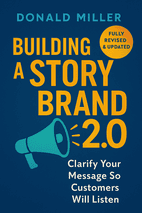
Building a StoryBrand 2.0 by Donald Miller Book Cover

5 Main Takeaways from Building a StoryBrand 2.0

Clarity is the ultimate weapon against business noise and confusion.

The book argues that the primary enemy of growth is not competition but the self-created noise that confuses customers. By simplifying your message using the StoryBrand framework, you ensure customers instantly understand how you improve their lives, which has led to significant sales increases for many companies.

Position your customer as the hero and your brand as the guide.

Stories resonate when customers see themselves as the protagonist on a journey. Your role is to be the empathetic and competent guide who provides a plan and tools to help them overcome challenges, building trust and engagement as outlined in the SB7 Framework.

Use the SB7 framework to craft a compelling brand narrative.

The SB7 framework—character, problem, guide, plan, call to action, avoidance of failure, and success—provides a proven formula for organizing marketing messages. It reduces cognitive load by structuring information like a story, making your communication captivating and actionable.

Highlight transformation and stakes to drive customer action.

Customers are motivated by the desire for personal transformation and the fear of loss. Clearly articulate the positive outcomes (like status or self-realization) and what they avoid by using your product, creating urgency and deeper connection across all touchpoints.

Implement and repeat your clarified message across all channels.

A clear BrandScript must be actively integrated into every marketing touchpoint, from websites to campaigns. Consistency and repetition—often dozens of times—ensure customers internalize your message and take action, turning them into brand ambassadors.

Executive Analysis

"Building a StoryBrand 2.0" argues that the chaos of modern marketing can be conquered by applying timeless storytelling principles. The five key takeaways form a cohesive system: start by achieving clarity, then structure your message around the customer's journey using the SB7 framework, where the brand acts as a guide to help the hero overcome problems. This narrative approach is not just theoretical; it requires highlighting stakes and transformation to motivate action, and finally, relentless implementation across all channels to ensure the message is heard and acted upon.

This book matters because it translates abstract storytelling concepts into a repeatable, scalable process for business growth. Unlike many marketing books that offer vague advice, Miller provides a specific formula (SB7) and practical tools like wireframing and AI-assisted campaign creation. It sits at the intersection of brand strategy and communication psychology, offering a proven method to cut through noise and connect with customers on a deeper level, ultimately driving sales and loyalty.

Chapter-by-Chapter Key Takeaways

Want Your Entire Team to Understand the StoryBrand Framework? (Chapter 1)

  • The StoryBrand framework can be effectively taught through engaging tools like the radio theater production, making it accessible for entire teams.

  • Stories serve as powerful sense-making devices that reduce cognitive load for audiences, guiding them effortlessly through messages.

  • By defining a brand's story elements—ambition, challenges, and plan—businesses create a clear mental map for customer engagement.

  • Adopting a story-based approach has led to significant sales increases for many companies, demonstrating its practical value.

  • The framework is a tested, reliable formula for communication, leveraging time-tested storytelling principles to ensure messages are heard and understood.

Try this: Introduce the StoryBrand framework to your team using engaging tools like the radio theater production to ensure universal understanding and application.

Note from the Author on This Updated Edition (Chapter 2)

  • Clear, customer-focused messaging is essential for business growth, as ambiguity drives potential clients away.

  • The updated edition offers enhanced tools, including the StoryBrand Brain AI, to quickly generate tailored marketing materials.

  • Noise from overly complex or irrelevant content is a major barrier to success; simplifying your narrative can dramatically improve results.

  • Applying story formulas used in entertainment can make business communication more engaging and effective, positioning products along a path customers naturally follow.

Try this: Leverage the updated StoryBrand tools, including the AI assistant, to rapidly generate clear, customer-focused marketing materials that avoid noise.

1. The Key to Being Seen, Heard, and Understood (Chapter 3)

  • Clarity is survival: The primary enemy of business growth is not the competition but the self-created noise that confuses potential customers.

  • Simplicity sells: Customers make decisions based on the simple, core message they hear. Eliminating every element that doesn't directly support that message is crucial for engagement.

  • A framework for focus: Using a structured formula like the SB7 Framework is essential for cutting through the noise, organizing your communication, and ensuring your message is always understood.

Try this: Eliminate all ambiguous or complex elements from your messaging and adopt the SB7 Framework to organize communication for maximum clarity.

2. The Secret Weapon That Will Grow Your Business (Chapter 4)

  • Story is your secret weapon: It cuts through noise by organizing information in a way that captivates and motivates people, directly impacting business growth.

  • Clarity over complexity: Simplify your message using storytelling frameworks to ensure customers instantly understand how you can improve their lives.

  • Position yourself as a guide: Customers are the heroes of their own stories; your role is to provide the tools and plans that help them overcome challenges and achieve success.

  • Use the SB7 framework: Master the seven plot points—character, problem, guide, plan, call to action, avoidance of failure, and success—to create compelling brand narratives.

  • Test for simplicity: Apply the "grunt test" to your marketing materials to guarantee they communicate your offer, benefits, and next steps in under five seconds.

Try this: Craft your brand narrative using the SB7 framework and validate it with the "grunt test" to ensure instant comprehension and engagement.

3. The Simple SB7 Framework (Chapter 5)

  • Customer-Centricity: Always position the customer as the hero and your brand as the guide to build trust and relevance.

  • Problem Layers: Address external, internal, and philosophical problems to connect deeply with customer needs.

  • Actionable Guidance: Provide clear plans and calls to action to reduce friction and motivate engagement.

  • Stakes and Vision: Highlight what's at stake and the positive outcomes to create urgency and inspire loyalty.

  • Clarity Through Storytelling: Use the SB7 Framework to craft simple, repeatable messages that resonate and drive growth.

Try this: Map your customer's entire journey using the SB7 plot points, addressing layered problems and providing clear guidance toward success.

Section 2: Building Your StoryBrand (Chapter 6)

  • A BrandScript turns confusion into clarity by structuring your brand's story around the customer's journey.

  • It emphasizes the customer as the hero and your brand as the guide, fostering stronger engagement.

  • Regularly refining your BrandScript ensures your messaging stays relevant and impactful.

Try this: Create and regularly refine a BrandScript document that positions the customer as the hero and your brand as the guide in their story.

4. A Character (Chapter 7)

  • Position the customer as the hero by defining a clear, simple desire they want to fulfill.

  • Use story gaps to create engagement by highlighting and resolving the distance between the customer and their goal.

  • Focus on a single core desire to avoid confusion and strengthen brand identity.

  • Ensure the desire relates to survival needs, such as safety, status, or community, to tap into fundamental human drives.

  • Communicate the brand's promise in repeatable language to foster clarity and customer loyalty.

Try this: Define a single, survival-related desire for your customer and build your brand promise around it using repeatable language.

5. Has a Problem (Chapter 8)

  • A philosophical problem provides the "why" that gives a story or brand deeper meaning and universal resonance, often framed in terms of "ought" and "shouldn't."

  • The most satisfying narratives resolve a triple-layered conflict: the external problem, the accompanying internal problem, and the overarching philosophical problem.

  • Brands can harness this power by positioning their products as the definitive solution that closes this three-level "story gap" for the customer.

  • Effective messaging requires identifying a single, clear villain and simply defining the external, internal, and philosophical problems it creates for your customer.

Try this: Identify a core "villain" for your customer and articulate how your product solves the external, internal, and philosophical problems it creates.

6. And Meets a Guide (Chapter 9)

  • Position your brand as a guide by sharing selective backstory elements that emphasize empathy and competency.

  • Use testimonials, statistics, awards, press mentions, and client logos to provide tangible proof of your expertise.

  • Build trust first through empathy, then establish respect with competency, mirroring human interaction dynamics.

  • Leverage tools like StoryBrand's BrandScript to systematically craft messages that address customer concerns and foster engagement.

Try this: Develop your brand's guide persona by demonstrating empathy through selective backstory and proving competency with testimonials and data.

7. Who Gives Them a Plan (Chapter 10)

  • Customers hesitate due to cognitive dissonance and fear of risk, which a clear plan can mitigate by breaking the journey into simple, trusted steps.

  • Process plans clarify the steps to purchase or use a product, reducing confusion and making the path feel achievable.

  • Agreement plans address underlying fears by making promises that build trust and align with customer values.

  • Effective plans should have three to six steps, be named to enhance credibility, and be tailored to alleviate specific customer concerns.

  • Implementing these plans increases conversion rates by transforming uncertainty into confident action.

Try this: Design a named plan with 3-6 steps that combines process instructions and agreement promises to reduce customer hesitation and build trust.

8. And Calls Them to Action (Chapter 11)

  • Customers need explicit challenges to take action, as passivity leads to missed opportunities.

  • Use clear, simple language in calls to action to avoid confusion and build trust.

  • Implement both direct calls (e.g., "Buy Now") for immediate sales and transitional calls (e.g., free resources) to nurture relationships.

  • Bold calls to action communicate confidence in your product and respect for the customer's time.

  • Consistently repeating calls to action across all marketing channels increases the likelihood of conversion.

Try this: Implement bold, clear calls to action—both direct and transitional—across all marketing channels and repeat them consistently.

9. That Helps Them Avoid Failure (Chapter 12)

  • Negative stakes create urgency by highlighting what customers could lose, making stories and marketing messages more engaging.

  • Use loss aversion principles—people are more motivated to avoid losses than to pursue gains—to frame your offerings as essential protections.

  • Implement fear appeals moderately: start with vulnerability, suggest action, present your solution, and call for a decision.

  • Balance warnings with hope; too little negativity lacks impact, while too much can alienate, but a measured approach drives action.

  • Apply stakes consistently across all customer touchpoints, from emails to landing pages, to maintain narrative cohesion and urgency.

Try this: Incorporate negative stakes into your messaging to create urgency, using loss aversion principles while balancing fear with hope.

10. And Ends in a Success (Chapter 13)

  • Always articulate the transformation: Never leave customers guessing—explicitly describe how your brand leads to a happier, more successful life.

  • Specificity drives engagement: Vague visions fall flat; use clear, vivid details to make the desired future feel attainable and real.

  • Resolve multi-level conflicts: Address external, internal, and philosophical problems in your messaging to deliver deep satisfaction.

  • Leverage universal desires: Align your brand’s promise with status, completeness, or self-realization to tap into core human motivations.

  • Keep it simple and repetitive: Use straightforward language and consistent visuals to reinforce the happy ending you offer, ensuring customers understand and remember the journey you’re guiding them through.

Try this: Explicitly describe the specific, multi-level transformation your brand delivers, aligning it with universal human desires.

11. People Want Your Brand to Participate in Their Transformation (Chapter 14)

  • Customers are motivated by a deep desire for personal transformation, and brands that participate in this journey build passionate loyalty.

  • Define an aspirational identity for your customers by considering how they want to be perceived, and use this to shape all communications.

  • Act as a guide who not only provides solutions but also affirms and celebrates customers' growth, mirroring storytelling arcs where heroes realize their change.

  • Use the "from X to Y" framework in your BrandScript to outline the identity shift, ensuring your brand adds value beyond the product by improving self-perception.

  • Embracing this approach can unite your team around a meaningful mission, turning routine transactions into life-changing experiences.

Try this: Use the "from X to Y" framework to define how your brand participates in the customer's identity transformation and affirm their growth.

12. Define Your Controlling Idea (Chapter 15)

  • Your controlling idea is the single most important message for driving business growth

  • This complete thought should be instantly understandable without explanation

  • Derive it from your BrandScript by identifying the "moral" of your customer's story

  • Repetition across all marketing materials turns customers into brand ambassadors

  • The simplified message should be memorable enough for word-of-mouth sharing

Try this: Distill your BrandScript into a single, memorable controlling idea and repeat it relentlessly across all marketing materials.

13. How to Execute a Flawless StoryBrand Communication Campaign (Chapter 16)

  • Implementation is Non-Negotiable: A clear BrandScript must be actively integrated into all marketing materials to drive results.

  • Repetition Drives Recognition: Customers need to hear your message multiple times—often dozens—to internalize it, so consistency across channels is crucial.

  • Sound Bites Must Be Clear, Not Clever: Focus on editing your messaging until it prompts immediate customer action, like inquiries or purchases.

  • Campaigns Require Discipline: Follow the three-step process—create, edit, repeat—to ensure your message is not only understood but remembered and acted upon.

Try this: Execute a flawless communication campaign by integrating your BrandScript everywhere, editing for clarity, and repeating the message dozens of times.

14. How to Get Your Website Right (Chapter 17)

  • Wireframing your website clarifies your offer and translates into effective communication across all channels.

  • Always feature a clear, customer-centric offer above the fold to immediately hook visitors.

  • Make calls to action obvious, repeated, and visually distinct to guide users toward transactions.

  • Use images of happy, satisfied customers to visually communicate the benefits of your brand.

  • Present products as a unified menu under an umbrella problem to simplify customer choices.

  • Keep text minimal and scannable, using bullet points and expandable sections to enhance readability.

Try this: Wireframe your website to place a clear offer and obvious calls to action above the fold, supported by images of happy customers and minimal text.

15. How to Execute a StoryBrand Messaging and Marketing Campaign (Chapter 18)

  • Empower customers with easy-to-use referral tools like discount codes or shareable content to turn them into brand advocates.

  • Automate referral processes with CRM systems to maintain consistency and scale efforts efficiently.

  • Real-world examples show that creative incentives, from refunds to social events, can dramatically increase referrals and revenue.

  • A structured marketing campaign, akin to a chess opening, provides a clear path to engage customers and drive business growth using StoryBrand principles.

Try this: Empower customers to refer others by providing easy-to-use tools and automating the process, then launch a structured StoryBrand marketing campaign.

Afterword (Afterword)

  • Clarifying your message is the fundamental key to attracting your ideal audience

  • The StoryBrand framework extends beyond the book through additional resources like the audio drama that demonstrate principles in action

  • Practical implementation is available through StoryBrand.AI, which automates campaign creation across multiple marketing channels

  • Effective marketing incorporates storytelling techniques like cliffhangers to maintain engagement

  • The framework remains relevant for both refining existing messaging and developing new brand concepts

Try this: Commit to perpetual message clarity by utilizing StoryBrand's extended resources, like AI and storytelling techniques, for ongoing campaign refinement.

Continue Exploring